

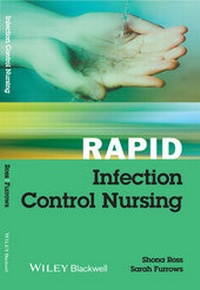
Rapid Infection Control Nursing
Description

Reviews / Votes
"This is a well-done introduction to infection controlnursing that can also serve as an excellent primer for nursingstudents or new ward nurses." (Doody's, 16January 2015) "Covering all the key topics in infectionprevention and control, this concise and easy-to-read title is theperfect quick-reference book for the wards." (Kingbook73's Medical Ebook and Video Collection, 20 August2014)More details
Other editions
Additional editions
Persons
Shona Ross is Clinical Nurse Specialist in Infection Prevention and Control at Kingston Hospital NHS Trust, London, UK. She is a member of the Infection Prevention Society (UK) (formerly Infection Control Nurses Association) and the Healthcare Infection Society.
Sarah Furrows is Consultant Microbiologist and Infection Control Doctor at Kingston Hospital NHS Trust, London, UK.
Content
3
Wider Aspects
Managing an outbreak of infection
This section is broken down into the following subsections: definitions, patient management, communication, and staff, visitors and others.
Definitions
An outbreak of infection is two or more people infected with the same organism that have something else in common, such as their location or the timing of their symptoms. The term ‘outbreak’ is also used when the observed number of people infected with a particular organism in a particular location is greater than the number expected.
A suspected outbreak of infection is two or more people having similar symptoms in the same clinical area but where the cause is not yet established, e.g. two patients in the same bay with diarrhoea and vomiting.
An outbreak of infection is considered a major outbreak when there are a large number of people infected or the infection is caused by a notifiable disease or the infection is a health hazard to the local population. The infection control doctor will decide if an outbreak is a major outbreak.
Patient management
ISOLATION OF SYMPTOMATIC PATIENTS
Symptomatic patients should be isolated with isolation precautions implemented. If isolation facilities are not available, the area(s) where the patients are being cared for should be closed to admissions, transfers and discharges, with isolation precautions implemented. Movement of patients at this stage is not advisable and may expose more patients (and staff) to the risk of infection. Contact the infection control team and bed manager for advice.
IDENTIFYING THE CAUSE
Take the relevant samples or swabs from the patient for microbiological testing to determine the cause of the suspected outbreak. If you are unclear about the samples that are required contact the microbiology laboratory for advice. Timing of samples is important; the sooner a sample is taken, the earlier the cause of the infection is known, which makes managing the risks of transmission simpler.
SCREENING
It may be necessary to screen other patients in the same ward/clinical area to ascertain if they have been infected with the causative organism. The infection control doctor will advise on this.
IDENTIFYING THE SOURCE
It may be necessary to examine clinical practice – the cleaning and disinfection techniques used for instruments, equipment and the environment; theatre discipline and kitchen hygiene, etc. – to determine the source of the infection. The infection control team will lead on this and liaise with contractors and external agencies as required.
CLOSED BAYS AND WARDS
The infection control team and bed managers will manage beds, movement of patients, transfers and discharges throughout the outbreak.
ADMISSIONS, TRANSFERS AND DISCHARGES
Admissions to the ward and transfers and discharges to other wards, care homes and hospitals will be restricted during an outbreak, if not stopped altogether. This will depend on the cause of the outbreak and the infection control team will advise on this.
PATIENT TRANSFER
Transferring a patient from a ward closed due to an outbreak of infection can lead to a further outbreak in the receiving area, even if the patient is asymptomatic, as they could be incubating the infection.
If it is necessary to transfer an infected patient (or a patient without symptoms from an area affected by an outbreak of infection) to another ward/hospital/department, it is essential to inform staff at the receiving area of the outbreak situation in your ward before the transfer takes place in order that they can take the necessary isolation precautions when the patient arrives. This can be done by phone prior to the transfer. Details of the patient’s infectious status should be documented in their notes and discussed at handover. No infected/infectious patient should ever be transferred without prior notice to the receiving area. Patients with diarrhoea should not be transferred unless it is an emergency situation.
If the transfer will involve patient transfer or ambulance staff they too should be informed prior to the transfer. Ideally, this patient should go last on their list, providing it is medically safe for the patient to wait until then. The ambulance/patient transport vehicle should be cleaned and disinfected once the transfer is complete.
Gloves and an apron should be worn by staff involved in assisting the patient out of bed on to a trolley or into a chair and should then be removed and the hands washed. Gloves and aprons should not be worn when moving a patient between wards/departments.
DOCUMENTATION
It is essential that the following information is recorded for each patient with symptoms:
- Name.
- Date of birth.
- Date and time of onset of symptoms.
- Date and time symptoms resolved.
- Dates and times of samples sent for testing.
- Results of microbiology tests.
- Date of admission.
- Where they were admitted from, e.g. home, a care home, another hospital.
- Have they been in contact with anyone else with similar symptoms?
- Stool charts should be maintained when patients have diarrhoea. It is important to record the time, nature and frequency of bowel movements, using the same terminology. The Bristol stool form scale is useful for this.
IDENTIFYING CONTACTS
It may be necessary to identify individuals who have been in contact with those who are infected. The infection control team will manage this.
DISCHARGE HOME
For some conditions it is acceptable for patients to be discharged to their own home. This should be discussed with the infection control team before making any arrangements to move the patient.
POST-OUTBREAK CLEANING AND DISINFECTION
At the end of the outbreak, before any new patients are admitted, the clinical area must be cleaned and disinfected with detergent followed by a chlorine-releasing agent at 1000 parts per million available chlorine strength, or cleaned and disinfected in one step using a chlorine-based detergent at 1000 parts per million available chlorine strength. Curtains must also be changed.
Communication
Rapid detection of an outbreak is crucial in controlling the numbers of those who are exposed and become infected. If you suspect an outbreak in your place of work you should report it immediately in order that you receive the support you need to manage it and minimise the risk of further spread.
The following list of people is whom you should contact – if you cannot get the first person you call, try the next one on the list. You do not need to contact each person listed; you just need to inform one of them in order that they can get involved with managing the situation and notify senior managers and directors if the operation of the hospital or provision of services is likely to be affected.
- Ward manager (if that is not you)
- The infection control team (outside office hours, contact the on-call microbiologist)
- On-call manager (if the outbreak occurs at a weekend Matrons and Head of Nursing will not be available)
- Matron
- Bed manager
- Head of Nursing
- Divisional Manager
- Divisional Director
- Director of Nursing
- Chief Operating Officer
- Chief Executive Officer
The hospital cleaning manager must also be informed of the outbreak to allow preparation to be made for increased cleaning throughout the outbreak.
After initial escalation and reporting it is important to ensure that all staff are aware of the outbreak and of the isolation precautions to take. The infection control team will inform external agencies such as the local Health Protection Unit and the Consultant in Communicable Disease Control (CCDC) and convene outbreak meetings as required.
NOTIFIABLE DISEASES
If the cause of the outbreak is a notifiable disease the medical staff responsible for the patient must complete the ‘notification of infection diseases’ documentation and submit it to the local health protection unit.
DECLARING THE OUTBREAK OVER
The infection control team will declare the outbreak over when there are no new cases and the incubation period for new cases of the causative organism has elapsed.
MEDIA ENQUIRIES
There may be enquiries from the media about the outbreak, particularly if a large number of people are affected, if it is caused by something of a sensitive nature (such as scabies) or an unusual organism, or if a concerned patient, relative or visitor contacts a journalist. You should not discuss the outbreak with the media; you should advise them to contact the communication team in accordance with local policy.
POST-OUTBREAK LEARNING
Any lessons learned during and from the outbreak should be discussed with the whole team involved. The infection control team will lead on this with support from the local Health Protection Unit.
Staff, visitors and others
RESTRICTING STAFF MOVEMENT
Ideally,...
