

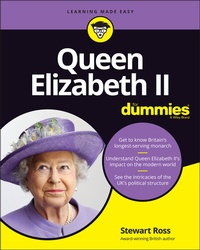
Queen Elizabeth II For Dummies
Description

If the news about Harry, William, Kate, Meghan, and the rest of the British royals has you wondering about how this latest generation of princes, princesses, dukes, and duchesses got their start, you're not alone. Queen Elizabeth II For Dummies takes you on a fascinating journey through the life of Great Britain's longest-serving monarch.
You'll find revealing stories about Queen Elizabeth II's family background, her childhood, early ascension to the throne, and her role during times of national crisis and triumph. The book combines must-know facts about the monarchy with details of the remarkable woman who has held the crown for over 68 years (and counting). You'll also read about:
* Where shows like The Crown stay true-to-life and where they take artistic liberties with historical fact
* Queen Elizabeth II's relationship with Prince Charles, the late Prince Phillip, Princess Diana, and the thousands of famous figures she has encountered during her reign
* The subtle and at times controversial role of a hereditary Head of State in a democracy
Perfect for anyone with an interest in the monarchy, British governance, power and society, leadership, or the resurgence of the British monarchy in popular culture, Queen Elizabeth II For Dummies is a cracking read full of trivia, secrets, and history that puts one of the most central figures of the 20th and 21st centuries in the palm of your hand.
More details
Other editions
Additional editions
Person
Content
Chapter 1
Queen Elizabeth II: A Global Icon
IN THIS CHAPTER
Carrying the weight of history on her shoulders
Following in her family's footsteps
Being a multi-tasking Queen and mother
Understanding the secrets of Elizabeth's success
Great Britain is the only country in the world without a name on its postage stamps. This is not just because Britain invented adhesive postage stamps with a 'we were here first' attitude when it comes to mail; it's also because Brits reckon an image is all that's needed for others to recognize where UK mail has come from.
The image is not a map, nor a man-made feature, nor an animal. It is a portrait of the Head of State, meaning Britain's reigning monarch. For almost three-quarters of a century, longer than any other person to hold the office, Great Britain's stamps have been adorned by the profile of Queen Elizabeth II.
Since the time of Henry VIII (r. 1509-1547 - see the nearby sidebar to find out what 'r.' means), England's monarchs have been called 'Your Majesty'. The title had previously been used only for God. The weight of history grows heavier if we give the Queen her full title: 'Elizabeth II, by the Grace of God, of the United Kingdom of Great Britain and Northern Ireland and of her other realms and territories Queen, Head of the Commonwealth, Defender of the Faith.' That's quite a mouthful!
REIGNS AND LIVES
Dates prefaced by an 'r.' are the years of a monarch's reign. Dates given without an 'r.' are the years of a person's life or an event. A single date preceded by a 'b.' is the year a person was born.
The inheritance is as daunting as the job title. As we get to grips with what makes Elizabeth tick, bear in mind that she sees herself as a sort of athlete in a relay race. The royal baton was handed to her by her father (see Chapters 5 and 6); her job is to hand it on intact to her heir. That, above all, is what drives her.
Throughout this book, you'll encounter Elizabeth's extended family, heirs, and line of succession. Check out Figure 1-1 for a diagram explaining who's who in the modern Royal Family (and flick back to this page as you're reading through the book - I honestly don't expect you to memorize this sort of thing!).
© John Wiley & Sons, Inc.
FIGURE 1-1: Queen Elizabeth II's family tree.
This chapter looks more closely at the Queen's historic inheritance and the range of work involved in trying to maintain it. It concludes with a few suggestions as to why, showing stoic toughness and blessed with not a little luck, in most people's opinion by the time of her Platinum Jubilee (2022), she had made a fair fist of it.
Carrying the Weight of History
Queen Elizabeth's paternal grandmother, Queen Mary, sometime Empress of India, was an impressive figure. She demanded that Elizabeth curtsey whenever they met, and instructed her awestruck grandchild that kings and queens never smiled in public.
Though no academic, Queen Mary was a keen historian. Her specialization was genealogy, specifically the genealogy of her family. Born in 1867, she clearly remembered Queen Victoria (r. 1837-1901) and proudly recalled how King George III (r. 1760-1820) was her great-grandfather (find out more about these monarchs in Chapter 3). From this austere figure of her impressionable childhood years, Elizabeth was left in no doubt as to the weighty significance of her royal heritage.
Perhaps appropriately, in 1913, Britain's latest armour-plated battlecruiser was named after Queen Mary. It lasted less well than its namesake, exploding and sinking during the Battle of Jutland, 1916, in World War I.
You can read more about Queen Mary in Chapter 4.
Heading up a monarchy 1,500 years in the making
Elizabeth was born in 1926. Though Britain had been severely shaken by the bloodletting and vast expenditure of World War I (1914-1918), during the years of the Princess' childhood it was still a major world power. Its industry and commerce were formidable. The sprawling British empire - the largest the world had ever seen - remained more or less intact. If self-governing Dominions (see Chapter 10) were included, it stretched from New Zealand via India and large swathes of Africa to northern Canada.
That a country less than half the size of Texas should achieve so much was a source of national pride. This was reflected in the history taught to the young Elizabeth by family members and tutors (see Chapter 4 for more on her early life). She learned that, though there had been setbacks, British history was generally a story of progress. And a number of worthy monarchs had sometimes been part of that progress.
Here are a few of the more important ones she may have been told about:
- Alfred the Great (r. 871-899): The doughty King of Wessex (an Anglo-Saxon kingdom in southwest England) who resisted and then overcame an invasion by barbaric Vikings.
- William the Conqueror (r. 1066-1087): The Duke of Normandy in northern France who seized the English throne, thereby paving the way for his country to become a major European power.
- Henry V (r. 1413-1422): A warrior king whose victory over the French at the Battle of Agincourt (1415) inspired William Shakespeare's memorable patriotic verses.
- Henry VIII (r. 1509-1547): A ruthless patriot who freed England from papal (Catholic) interference and put himself at the head of the Church of England.
- Elizabeth I (r. 1558-1603): A potential role model for Elizabeth II (though she denied it!) who demonstrated how a queen could reign as competently as any king.
- Charles II (r. 1660-1685): A highly intelligent king with an innate political sense who guided the monarchy through a tricky post-republican era.
- Victoria (r. 1837-1901): Elizabeth's great-great-grandmother whose reign laid the foundations of Britain's modern constitutional monarchy.
As well as these stand-out characters, the young Elizabeth would probably have found out about a whole host of others. A good many were pretty average. She can't have imagined enjoying a tea party with the ineffective Henry VI (r. 1422-1461) or the oddly named Harthacnut (r. 940-942). Nor with George I, who spoke scarcely any English. And poor Edward V (r. 1485) wasn't on the throne long enough to take tea with anyone. (Not that the Brits knew what tea was back then.)
Did the Princess thrill at the martial exploits of the warrior king Edward III (r. 1327-1377)? Was she fascinated by the idea that monarchs, like her doting but grumpy grandfather George V (r. 1910-1936), were placed on the throne by God, as propounded by James I of England (r. 1603-1625; aka King James VI of Scotland)? Maybe some of the tales she heard gave her nightmares. According to Shakespeare, the source of all the best stories of medieval skullduggery, Richard II (r. 1377-1399) was slain with an axe, John (r. 1199-1216) was poisoned by a monk, and Richard III (r. 1483-1485) had two little princes murdered in the Tower of London.
The sovereigns I've mentioned are by no means a complete list and the details offered are scanty. Don't worry, we'll meet them again in greater detail in Chapters 2 and 3. They are here simply to illustrate the enormous weight of history that bore down on Elizabeth's shoulders the moment she knew she was destined to wear the Crown. Whatever she thought of the long line of kings and queens who came before her, she was their heir and could never, ever forget it.
She owed it to them, and to history, not to mess things up.
Ruling the jig-saw kingdom
Non-Brits frequently refer to Elizabeth II as Queen of England. Though this is not wrong, it is incomplete. The reason why becomes apparent when scrolling down the list of countries that springs up automatically when completing an online form. After searching in vain for 'England' or even 'Britain', down among the 'U's one finds 'United Kingdom' between 'United Arab Emirates' and 'United States'. In the British Isles, Elizabeth is Queen of the United Kingdom, a jig-saw realm.
Even Brits get confused by this one! The 'British Isles' is a geographical name for a group of 6,000+ islands off northwest Europe. The two largest are Britain (made up of the countries of England, Scotland and Wales) and Ireland. The 'United Kingdom' is the European bit of Elizabeth II's realm. It comprises England, Scotland and Wales, plus the province of Northern Ireland.
Like many countries, the United Kingdom started small and expanded over time. Between the years 43 and 410, England and Wales (but not Scotland or Ireland) were part of the Roman Empire. After the Romans left, the British Isles split up into a number of tribal units.
By the sixth century AD, some tribal chiefs were calling themselves kings, and may even have taken the title Bretwalda ('Britain ruler'). The title didn't mean much because...
