

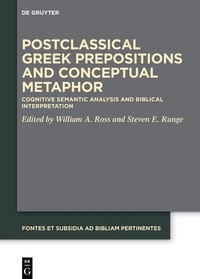
Postclassical Greek Prepositions and Conceptual Metaphor
Description

Traditional semantic description of Ancient Greek prepositions has struggled to synthesize the varied and seemingly arbitrary uses into something other than a disparate, sometimes overlapping list of senses. The Cognitive Linguistic approach of prototype theory holds that the meanings of a preposition are better explained as a semantic network of related senses that radially extend from a primary, spatial sense. These radial extensions arise from contextual factors that affect the metaphorical representation of the spatial scene that is profiled. Building upon the Cognitive Linguistic descriptions of Bortone (2009) and Luraghi (2009), linguists, biblical scholars, and Greek lexicographers apply these developments to offer more in-depth descriptions of select postclassical Greek prepositions and consider the exegetical and lexicographical implications of these findings. This volume will be of interest to those studying or researching the Greek of the New Testament seeking more linguistically-informed description of prepositional semantics, particularly with a focus on the exegetical implications of choice among seemingly similar prepositions in Greek and the challenges of potentially mismatched translation into English.
More details
Other editions
Additional editions
Persons
Content
- Intro
- Contents
- Lists of Abbreviations
- 1 Introduction
- 2 Greek Prepositions: A Cognitive Linguistic View
- 3 The Overlap between ?p? and ?p? to Mark Agents: The Trials and Tribulations of a Traditionalist Lexicographic Treatment
- 4 Spatial Profiling: ??, ?p?, and Their Entailments in Postclassical Greek
- 5 The pe?? Preposition Phrase at the Grammar-Discourse Interface
- 6 Construals of Faith in ?? and ?? Prepositional Constructions
- 7 "Why Do You Eat and Drink with Tax Collectors and Sinners?"
- 8 Land Forms, Weapons, and Body Parts: How Mismatches in Preferred Construals Have Shaped Our Understanding of Greek Prepositions
- 9 Construing Agency and Cause in Passive Constructions
- 10 The "Ins" and "Outs" of Matthew 15:1-20: Insights on Prepositions from Prototype Theory and Metaphor Theory
- 11 Cognitive Linguistics and Greek Prepositions: A New Testament Perspective
- Bibliography
- List of Contributors
- Source index
- Topic index
