

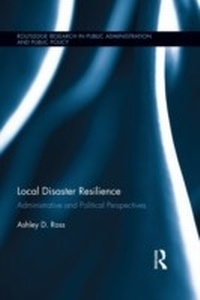
Local Disaster Resilience
Administrative and Political Perspectives
1st Edition
Published on 12. November 2013
298 pages
978-1-135-91068-6 (ISBN)
Description

Since 2000, the Gulf Coast states - Texas, Louisiana, Mississippi, Alabama, and Florida - have experienced a series of hurricanes, multiple floods and severe storms, and one oil spill. These disasters have not only been numerous but also devastating. Response to and recovery from these unprecedented disasters has been fraught with missteps in management. In efforts to avoid similar failures in the future, government agencies and policy practitioners have looked to recast emergency management, and community resilience has emerged as a way for to better prevent, manage, and recover from these disasters. How is disaster resilience perceived by local government officials and translated into their disaster response and recovery efforts?
Ashley D. Ross systematically explores and measures disaster resilience across the Gulf Coast to gain a better understanding of how resilience in concept is translated into disaster management practices, particularly on the local government level. In doing so, she presents disaster resilience theory to the Gulf Coast using existing data to create county-level baseline indicators of Gulf Coast disaster resilience and an original survey of county emergency managers and elected municipal officials in 60 counties and 120 municipalities across the Gulf States. The findings of the original survey measure the disaster resilience perceptions held by local government officials, which are examined to identify commonalities and differences across the set of cases. Additional analyses compare these perceptions to objective baseline indicators of disaster resilience to assess how perceptions align with resilience realities.
Local Disaster Resilience not only fills a critical gap in the literature by applying existing theories and models to a region that has experienced the worst disasters the United States has faced in the past decade, but it can also be used as a tool to advance our knowledge of disasters in an interdisciplinary manner.
Ashley D. Ross systematically explores and measures disaster resilience across the Gulf Coast to gain a better understanding of how resilience in concept is translated into disaster management practices, particularly on the local government level. In doing so, she presents disaster resilience theory to the Gulf Coast using existing data to create county-level baseline indicators of Gulf Coast disaster resilience and an original survey of county emergency managers and elected municipal officials in 60 counties and 120 municipalities across the Gulf States. The findings of the original survey measure the disaster resilience perceptions held by local government officials, which are examined to identify commonalities and differences across the set of cases. Additional analyses compare these perceptions to objective baseline indicators of disaster resilience to assess how perceptions align with resilience realities.
Local Disaster Resilience not only fills a critical gap in the literature by applying existing theories and models to a region that has experienced the worst disasters the United States has faced in the past decade, but it can also be used as a tool to advance our knowledge of disasters in an interdisciplinary manner.
Reviews / Votes
"Ashley D. Ross has done those of us who think resilience has meaning in disaster recovery a great favor. This book establishes the definition of resilience in a nuance and important way. No longer are we left with a rudimentary discussion of resilience. Ross has attached methodological heft to the meaning of resilience. Going forward, we can discern just what can be termed a resilient response to disaster and what is not."-Roland V. Anglin, Rutgers University
"Ashley D. Ross is a rising star among the next generation of scholars who study natural hazards and disasters. Her book represents an important contribution to the field, effectively filling a niche in how emergency managers and elected officials perceive their own community's disaster resilience relative to an empirical assessment of local resilience in these same jurisdictions. Her findings are particularly relevant to our emerging understanding of this often misunderstood concept, while providing key insights into how we can improve our national policy in order to better assist local communities achieve this still elusive aim."
-Gavin Smith, University of North Carolina at Chapel Hill & Executive Director, Department of Homeland Security Coastal Hazards Center of Excellence
More details
Series
Language
English
Place of publication
London
United Kingdom
Publishing group
Taylor & Francis Ltd
Target group
College/higher education
Product notice
Reflowable
Illustrations
26 s/w Tabellen, 20 s/w Zeichnungen
26 Tables, black and white; 20 Line drawings, black and white
File size
5,58 MB
ISBN-13
978-1-135-91068-6 (9781135910686)
Copyright in bibliographic data and cover images is held by Nielsen Book Services Limited or by the publishers or by their respective licensors: all rights reserved.
Schweitzer Classification
Other editions
Additional editions
Book
12/2015
1st Edition
Routledge
€65.70
Shipment within 10-20 days
Book
12/2013
1st Edition
Routledge
€232.10
Shipment within 15-20 days
Person
Ashley D. Ross is an Assistant Professor of Political Science at Sam Houston State University. Her research focuses on comparative public policy with an emphasis on local governments. In addition to this work on local disaster resilience, her research has examined decentralization in Latin America, education policy in the United States, and environmental policy among municipalities in Costa Rica.
Content
1. Introduction: Local Disaster Resilience. 2. The Concept of Disaster Resilience. 3. Studying Disaster Resilience of the Gulf Coast. 4. Resilience Meanings and Perceptions. 5. Adaptive Capacities for Disaster Resilience across the Gulf Coast. 6. Exploring the Adaptive Process of Resilience across the Gulf Coast. 7. Intersecting Perceptions with Realities to Assess Resilience across the Gulf Coast. 8. Concluding Thoughts on Local Disaster Resilience.
