

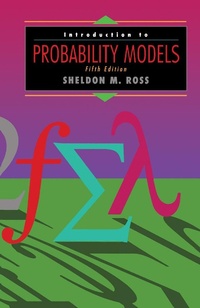
Introduction to Probability Models
5th Edition
Published on 10. May 2014
568 pages
978-1-4832-7658-8 (ISBN)
Description

Introduction to Probability Models, Fifth Edition focuses on different probability models of natural phenomena. This edition includes additional material in Chapters 5 and 10, such as examples relating to analyzing algorithms, minimizing highway encounters, collecting coupons, and tracking the AIDS virus. The arbitrage theorem and its relationship to the duality theorem of linear program are also covered, as well as how the arbitrage theorem leads to the Black-Scholes option pricing formula. Other topics include the Bernoulli random variable, Chapman-Kolmogorov equations, and properties of the exponential distribution. The continuous-time Markov chains, single-server exponential queueing system, variations on Brownian motion; and variance reduction by conditioning are also elaborated. This book is a good reference for students and researchers conducting work on probability models.
More details
Other editions
New editions
Sheldon M. Ross
Introduction to Probability Models
E-Book
11/2006
9th Edition
Academic Press
€62.77
Available for download
Additional editions

Sheldon M. Ross
Introduction to Probability Models
Book
01/1993
5th Edition
Academic Press
€43.27
Article exhausted; check for reprint
Content
Preface1. Introduction to Probability Theory 1.1. Introduction 1.2. Sample Space and Events 1.3. Probabilities Defined on Events 1.4. Conditional Probabilities 1.5. Independent Events 1.6. Bayes' Formula Exercises References2. Random Variables 2.1. Random Variables 2.2. Discrete Random Variables 2.2.1. The Bernoulli Random Variable 2.2.2. The Binomial Random Variable 2.2.3. The Geometric Random Variable 2.2.4. The Poisson Random Variable 2.3. Continuous Random Variables 2.3.1. The Uniform Random Variable 2.3.2. Exponential Random Variables 2.3.3. Gamma Random Variables 2.3.4. Normal Random Variables 2.4. Expectation of a Random Variable 2.4.1. The Discrete Case 2.4.2. The Continuous Case 2.4.3. Expectation of a Function of a Random Variable 2.5. Jointly Distributed Random Variables 2.5.1. Joint Distribution Functions 2.5.2. Independent Random Variables 2.5.3. Joint Probability Distribution of Functions of Random Variables 2.6. Moment Generating Functions 2.7. Limit Theorems 2.8. Stochastic Processes Exercises References3. Conditional Probability and Conditional Expectation 3.1. Introduction 3.2. The Discrete Case 3.3. The Continuous Case 3.4. Computing Expectations by Conditioning 3.5. Computing Probabilities by Conditioning 3.6. Some Applications 3.6.1. A List Model 3.6.2. A Random Graph 3.6.3. Uniform Priors, Polya's Urn Model, and Bose-Einstein Statistics 3.6.4. In Normal Sampling X- and S2 are Independent Exercises4. Markov Chains 4.1. Introduction 4.2. Chapman-Kolmogorov Equations 4.3. Classification of States 4.4. Limiting Probabilities 4.5. Some Applications 4.5.1. The Gambler's Ruin Problem 4.5.2. A Model for Algorithmic Efficiency 4.6. Branching Processes 4.7. Time Reversible Markov Chains 4.8. Markov Decision Processes Exercises References5. The Exponential Distribution and the Poisson Process 5.1. Introduction 5.2. The Exponential Distribution 5.2.1. Definition 5.2.2. Properties of the Exponential Distribution 5.2.3. Further Properties of the Exponential Distribution 5.3. The Poisson Process 5.3.1. Counting Processes 5.3.2. Definition of the Poisson Process 5.3.3. Interarrival and Waiting Time Distributions 5.3.4. Further Properties of Poisson Processes 5.3.5. Conditional Distribution of the Arrival Times 5.3.6. Estimating Software Reliability 5.4. Generalizations of the Poisson Process 5.4.1. Nonhomogeneous Poisson Process 5.4.2. Compound Poisson Process Exercises References6. Continuous-Time Markov Chains 6.1. Introduction 6.2. Continuous-Time Markov Chains 6.3. Birth and Death Processes 6.4. The Kolmogorov Differential Equations 6.5. Limiting Probabilities 6.6. Time Reversibility 6.7. Uniformization 6.8. Computing the Transition Probabilities Exercises References7. Renewal Theory and Its Applications 7.1. Introduction 7.2. Distribution of N(t) 7.3. Limit Theorems and Their Applications 7.4. Renewal Reward Processes 7.5. Regenerative Processes 325 7.5.1. Alternating Renewal Processes 7.6. Semi-Markov Processes 7.7. The Inspection Paradox 7.8. Computing the Renewal Function Exercises References8. Queueing Theory 8.1. Introduction 8.2. Preliminaries 8.2.1. Cost Equations 8.2.2. Steady-State Probabilities 8.3. Exponential Models 8.3.1. A Single-Server Exponential Queueing System 8.3.2. A Single-Server Exponential Queueing System Having Finite Capacity 8.3.3. A Shoeshine Shop 8.3.4. A Queueing System with Bulk Service 8.4.
