

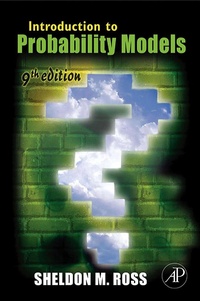
Introduction to Probability Models, ISE
9th Edition
Published on 17. November 2006
800 pages
978-0-08-092017-7 (ISBN)
Description

Ross's classic bestseller, Introduction to Probability Models, has been used extensively by professionals and as the primary text for a first undergraduate course in applied probability. It provides an introduction to elementary probability theory and stochastic processes, and shows how probability theory can be applied to the study of phenomena in fields such as engineering, computer science, management science, the physical and social sciences, and operations research. With the addition of several new sections relating to actuaries, this text is highly recommended by the Society of Actuaries. A new section (3.7) on COMPOUND RANDOM VARIABLES, that can be used to establish a recursive formula for computing probability mass functions for a variety of common compounding distributions. A new section (4.11) on HIDDDEN MARKOV CHAINS, including the forward and backward approaches for computing the joint probability mass function of the signals, as well as the Viterbi algorithm for determining the most likely sequence of states. Simplified Approach for Analyzing Nonhomogeneous Poisson processes Additional results on queues relating to the (a) conditional distribution of the number found by an M/M/1 arrival who spends a time t in the system; (b) inspection paradox for M/M/1 queues (c) M/G/1 queue with server breakdown Many new examples and exercises.
More details
Other editions
Additional editions

Sheldon M. Ross
Introduction to Probability Models, ISE
Book
11/2006
9th Edition
Academic Press
€60.65
Shipment within 15-20 days
Person
Dr. Sheldon M. Ross is a professor in the Department of Industrial and Systems Engineering at the University of Southern California. He received his PhD in statistics at Stanford University in 1968. He has published many technical articles and textbooks in the areas of statistics and applied probability. Among his texts are A First Course in Probability, Introduction to Probability Models, Stochastic Processes, and Introductory Statistics. Professor Ross is the founding and continuing editor of the journal Probability in the Engineering and Informational Sciences. He is a Fellow of the Institute of Mathematical Statistics, a Fellow of INFORMS, and a recipient of the Humboldt US Senior Scientist Award.
Content
- Front cover
- Title page
- Copyright page
- Table of Contents
- Preface
- New to This Edition
- Course
- Examples and Exercises
- Organization
- Acknowledgments
- 1 Introduction to Probability Theory
- 1.1. Introduction
- 1.2. Sample Space and Events
- 1.3. Probabilities Defined on Events
- 1.4. Conditional Probabilities
- 1.5. Independent Events
- 1.6. Bayes' Formula
- Exercises
- References
- 2 Random Variables
- 2.1. Random Variables
- 2.2. Discrete Random Variables
- 2.3. Continuous Random Variables
- 2.4. Expectation of a Random Variable
- 2.5. Jointly Distributed Random Variables
- 2.6. Moment Generating Functions
- 2.7. Limit Theorems
- 2.8. Stochastic Processes
- Exercises
- References
- 3 Conditional Probability and Conditional Expectation
- 3.1. Introduction
- 3.2. The Discrete Case
- 3.3. The Continuous Case
- 3.4. Computing Expectations by Conditioning
- 3.5. Computing Probabilities by Conditioning
- 3.6. Some Applications
- 3.7. An Identity for Compound Random Variables
- Exercises
- 4 Markov Chains
- 4.1. Introduction
- 4.2. Chapman-Kolmogorov Equations
- 4.3. Classification of States
- 4.4. Limiting Probabilities
- 4.5. Some Applications
- 4.6. Mean Time Spent in Transient States
- 4.7. Branching Processes
- 4.8. Time Reversible Markov Chains
- 4.9. Markov Chain Monte Carlo Methods
- 4.10. Markov Decision Processes
- 4.11. Hidden Markov Chains
- Exercises
- References
- 5 The Exponential Distribution and the Poisson Process
- 5.1. Introduction
- 5.2. The Exponential Distribution
- 5.3. The Poisson Process
- 5.4. Generalizations of the Poisson Process
- Exercises
- References
- 6 Continuous-Time Markov Chains
- 6.1. Introduction
- 6.2. Continuous-Time Markov Chains
- 6.3. Birth and Death Processes
- 6.4. The Transition Probability Function Pij(t)
- 6.5. Limiting Probabilities
- 6.6. Time Reversibility
- 6.7. Uniformization
- 6.8. Computing the Transition Probabilities
- Exercises
- References
- 7 Renewal Theory and Its Applications
- 7.1. Introduction
- 7.2. Distribution of N(t)
- 7.3. Limit Theorems and Their Applications
- 7.4. Renewal Reward Processes
- 7.5. Regenerative Processes
- 7.6. Semi-Markov Processes
- 7.7. The Inspection Paradox
- 7.8. Computing the Renewal Function
- 7.9. Applications to Patterns
- 7.10. The Insurance Ruin Problem
- Exercises
- References
- 8 Queueing Theory
- 8.1. Introduction
- 8.2. Preliminaries
- 8.3. Exponential Models
- 8.4. Network of Queues
- 8.5. The System M/G/1
- 8.6. Variations on the M/G/1
- 8.7. The Model G/M/1
- 8.8. A Finite Source Model
- 8.9. Multiserver Queues
- Exercises
- References
- 9 Reliability Theory
- 9.1. Introduction
- 9.2. Structure Functions
- 9.3. Reliability of Systems of Independent Components
- 9.4. Bounds on the Reliability Function
- 9.5. System Life as a Function of Component Lives
- 9.6. Expected System Lifetime
- 9.7. Systems with Repair
- Exercises
- References
- 10 Brownian Motion and Stationary Processes
- 10.1. Brownian Motion
- 10.2. Hitting Times, Maximum Variable, and the Gambler's Ruin Problem
- 10.3. Variations on Brownian Motion
- 10.4. Pricing Stock Options
- 10.5. White Noise
- 10.6. Gaussian Processes
- 10.7. Stationary and Weakly Stationary Processes
- 10.8. Harmonic Analysis of Weakly Stationary Processes
- Exercises
- References
- 11 Simulation
- 11.1. Introduction
- 11.2. General Techniques for Simulating Continuous Random Variables
- 11.3. Special Techniques for Simulating Continuous Random Variables
- 11.4. Simulating from Discrete Distributions
- 11.5. Stochastic Processes
- 11.6. Variance Reduction Techniques
- 11.7. Determining the Number of Runs
- 11.8. Coupling from the Past
- Exercises
- References
- Appendix Solutions to Starred Exercises
- Chapter 1
- Chapter 2
- Chapter 3
- Chapter 4
- Chapter 5
- Chapter 6
- Chapter 7
- Chapter 8
- Chapter 9
- Chapter 10
- Chapter 11
- Index
