

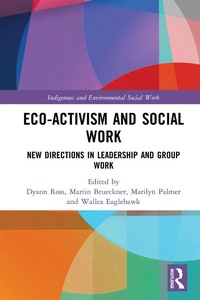
Eco-activism and Social Work
New Directions in Leadership and Group Work
1st Edition
Published on 28. November 2019
200 pages
978-1-000-75132-1 (ISBN)
Description

Social workers are called upon to shift from a human-centric bias to an ecological ethical sensibility by embracing love as integral to their justice mission and by extending the idea of social justice to include environmental and species justice. This book presents the love ethic model as a way to do eco-justice work using public campaigns, research, community arts practice and other nonviolent, direct action strategies.
The model is premised on an active and ongoing commitment to the eco-values of love, eco-justice and nonviolence for the purpose of upholding the public interest. The love ethic model is informed by the stories of eco-activists who used nonviolent actions to address ecological issues such as: pollution; degradation of the environment; exploitation of farm animals; mining industry overriding First Nation Peoples' land rights; and human health and social costs related to the natural resource industries, private land developments and government infrastructure projects.
Informed by practice insights by activists from a range of eco-justice concerns, this innovative book provides new directions in social work and environmental studies involving transformational change leadership and dialogical group work between interest groups. It should be considered essential reading for social work students, researchers and practitioners as well as eco-activists more generally.
The model is premised on an active and ongoing commitment to the eco-values of love, eco-justice and nonviolence for the purpose of upholding the public interest. The love ethic model is informed by the stories of eco-activists who used nonviolent actions to address ecological issues such as: pollution; degradation of the environment; exploitation of farm animals; mining industry overriding First Nation Peoples' land rights; and human health and social costs related to the natural resource industries, private land developments and government infrastructure projects.
Informed by practice insights by activists from a range of eco-justice concerns, this innovative book provides new directions in social work and environmental studies involving transformational change leadership and dialogical group work between interest groups. It should be considered essential reading for social work students, researchers and practitioners as well as eco-activists more generally.
Reviews / Votes
"Readers will encounter concrete examples that foster a new way of thinking about the social justice issues created because of environmental detachment. The case studies and analysis offer a new approach that may be brand-new to both social work students and practitioners. As issues of the environment continue to grow, this book will be a timely resource that should be in all social work program libraries. Summing Up: Highly recommended. Graduate students, faculty, and professionals." ---B. Ghilardi, Fairfield University, CHOICE ReviewMore details
Series
Edition
1. Auflage
Language
English
Place of publication
London
United Kingdom
Publishing group
Taylor & Francis Ltd
Target group
College/higher education
Illustrations
5 Line drawings, black and white; 6 Halftones, black and white; 11 Illustrations, black and white
ISBN-13
978-1-000-75132-1 (9781000751321)
Copyright in bibliographic data and cover images is held by Nielsen Book Services Limited or by the publishers or by their respective licensors: all rights reserved.
Schweitzer Classification
Other editions
Additional editions
Dyann Ross | Martin Brueckner | Marilyn Palmer
Eco-activism and Social Work
New Directions in Leadership and Group Work
Book
06/2021
1st Edition
Routledge
€63.00
Shipment within 10-20 days
Dyann Ross | Martin Brueckner | Marilyn Palmer
Eco-activism and Social Work
New Directions in Leadership and Group Work
Book
12/2019
1st Edition
Routledge
€179.81
Shipment within 15-20 days
Persons
Dyann Ross is a senior lecturer in social work in the School of Social Science at the University of the Sunshine Coast in Queensland. Dyann is a social worker with over forty years of practice in the areas of mental health, training and development in the human services and mining sectors and community and tertiary education.
Martin Brueckner is the co-founder and co-director of the Centre for Responsible Citizenship and Sustainability (CRCS) and senior lecturer at the School of Business and Governance at Murdoch University. Martin is a social ecologist whose work focuses on the politics and political economy of sustainable development, sustainable communities and regional sustainability using a transdisciplinary approach.
Marilyn Palmer teaches eco-social work theory and practice at Edith Cowan University through the curriculum in community development, gender, and social policy. She uses participatory research methodologies to better understand how post-structural ecofeminism can inform social work practice in the areas of domestic violence, community building and disaster recovery.
Wallea Eaglehawk is a sociologist, freelance writer and works in the community arts sector in roles such as arts producer, place making and events coordination. Wallea's interests include the areas of veganism, self-care and critical reflection, health, wellbeing and cultural phenomena.
Martin Brueckner is the co-founder and co-director of the Centre for Responsible Citizenship and Sustainability (CRCS) and senior lecturer at the School of Business and Governance at Murdoch University. Martin is a social ecologist whose work focuses on the politics and political economy of sustainable development, sustainable communities and regional sustainability using a transdisciplinary approach.
Marilyn Palmer teaches eco-social work theory and practice at Edith Cowan University through the curriculum in community development, gender, and social policy. She uses participatory research methodologies to better understand how post-structural ecofeminism can inform social work practice in the areas of domestic violence, community building and disaster recovery.
Wallea Eaglehawk is a sociologist, freelance writer and works in the community arts sector in roles such as arts producer, place making and events coordination. Wallea's interests include the areas of veganism, self-care and critical reflection, health, wellbeing and cultural phenomena.
Content
List of figures; Foreward; List of contributors; PART 1 What love looks like in public Chapter 1 Eco-activism and social work: in the public interest Martin Brueckner and Dyann Ross Chapter 2 Home-grown community activism in Yarloop Dyann Ross and Vince Puccio Chapter 3 Researching disaster recovery: the case for an activist participatory design Marilyn Palmer Chapter 4 Just(ice) arts in practice: processes and collaborations Helen Seiver Chapter 5 The wrong side of native title, the right side of mining Michael Woodley; Chapter 6 Saying no to Roe 8 Danielle Brady; Chapter 7 Hands off Point Peron Dawn Jecks; Chapter 8 Species justice is for every body Wallea Eaglehawk; Chapter 9 International experiences with social licence contestations Martin Brueckner and Lian Sinclair; PART 2 Clarion call for social work; Chapter 10 The love ethic practice model Dyann Ross; Chapter 11 Transformational change leadership and dialogue between groups Dyann Ross and Marilyn Palmer; Chapter 12 Conclusion: New directions in leadership and group work; Dyann Ross, Marilyn Palmer, Wallea Eaglehawk and Martin Brueckner; Resources for practice; Index
