

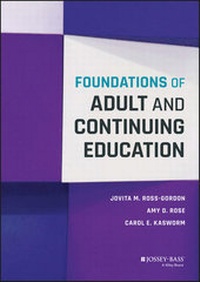
Foundations of Adult and Continuing Education
Description

More details
Other editions
Additional editions
Persons
Content
PREFACE
Adult and continuing education is an important segment of the?education enterprise. It creates and transforms structures, strategies, delivery systems, and policies that focus upon the effective facilitation and impact of adult learning. And it provides leadership and advocacy for those who serve adults within organizations and within our society. Adult learners come from all walks of life; adult and continuing educators reflect this diversity of place, identity, and knowledge of particular contexts, life or work roles, and specialized expertise in adult learning, program designs, and administration of learning settings.
Whether adults are engaged in self-directed learning, in face-to-face learning groups, or through various learning designs offered via audio and video technology, they seek out learning for many reasons. These include the desire for improved skills, for information, and for deeper knowledge about themselves, their families, institutions, and communities. Consider the myriad of contexts for adult learning, whether through formal or nonformal educational programs offered by providers such as educational organizations, government agencies, professional associations, or workplaces; or though informal learning, either in communities or self-directed with the aid of modern technologies and social networks-adult learning is ubiquitous. Of importance is the growing emphasis on professionalization and specialization and of adults seeking out adult learning resources and expertise to enhance innovative practices, such as participation in continuing medical education, military professional development, or creative exploration of uses of technology for teaching adults in online environments. Adult learners are an important and significant segment of the learning society.
For you as the reader, this text provides an exploration of this world of adult learners, the profession of adult and continuing education, and the broader social contexts of adult learning. Key insights and updated theory and research, as well as the continuing dilemmas faced by adult and continuing educators, are considered. The book will acquaint you with the historic foundations of more than one hundred years ago in the United States, when professional educators gathered together to form the first professional organization committed to serving fellow adult educators and adult learners. It will also introduce you to key resources of the field of adult and continuing education, beginning with the first edited handbook volume, the 1934 Handbook of Adult and Continuing Education (Rowden, 1934) and subsequent handbooks, as well as the first foundations text coauthored by Merriam and Darkenwald (Darkenwald & Merriam, 1982) approximately thirty-five years ago. And it builds upon the more recent updated Merriam and Brockett introductory editions of The Profession and Practice of Adult Education (Merriam & Brockett, 1997, 2007).
This current text represents a contemporary overview of the adult and continuing education profession. It offers baseline descriptions of key aspects of the knowledge of the field and, we hope, offers encouragement to new entrants into the field to focus upon best practices and future pursuits in professional development. Whether you are committed to serving adults in communities, in the workplace, in educational organizations, or through other formal and nonformal settings, your work can be enhanced and nurtured through a broad understanding of the development and the current status of the field.
Audience
This book is designed to be a foundational text for beginning graduate students, primarily at the master's level, as well as for professionals engaged in practice in the field. Because adult education is a field that does not require any specified credential or license, the majority of beginning professionals and graduate students have a limited understanding of the breadth of adult and continuing education. They typically are grounded in their own context of practice and specific adult learner group. And they typically possess a limited awareness of the broader field of adult learners as well as of research, theory, and practice in adult and continuing education. Therefore, a foundations text serves a crucial need in the field-of acquainting practitioners and emerging scholars alike with the historical and contemporary context of the field and its place in society. Our aim is to provide an up-to-date compendium of current understandings for practitioners and also to provide assistance in understanding for those professionals and practitioners who work with adult learners outside of traditional adult and continuing education contexts. This text may also have potential value for practitioners and students in other countries who desire to understand the current status of American adult and continuing education.
Purpose
This book offers an overview of the field, delineating key features of adult education and adult learning in the contemporary United States. Our aim is to provide an introduction to the guiding understandings of the practices and contexts of adult learning. In addition, we have interwoven contemporary concerns of social justice, cultural diversity, technology, and the aging society within key facets of adult and continuing education.
Overview of the Contents
The Foundations of Adult and Continuing Education provides an introduction to the major areas of theory, research, and practice of the field of adult and continuing education. It offers a descriptive landscape of the field, the history and contemporary practices of adult and continuing education, as well as highlights the increased challenges facing adult learners and the profession. This text is presented in three major sections. The first four chapters of the text define contemporary understandings of the field of adult education. The next four chapters consider the foundations of the field, and the final four chapters focus upon the contexts of adult and continuing education.
Examining the scope of the field, chapter 1 considers how conceptions of adult education have evolved over time, as well as the typologies of purposes, forms, and providers of adult education. It explicates key social forces that have contributed to the expansiveness of adult education in today's world, including technological expansion, demographic shifts, and globalization. Last, it explores what constitutes knowledge and adult learning, as well as relationships between adult education and other parts of the world of education. Chapter 2 considers key societal life contexts affecting the field of adult and continuing education. Through the lens of adult participation in adult and continuing learning, this chapter explores adult involvement in formal, nonformal, and informal learning. In addition, it discusses a contemporary model of adult access and participation based in the constraints of the policies and practices affecting adult participation in adult and continuing education.
What are the key roles for adult and continuing educators? Chapter 3 examines these key roles, both as categorized in the past, beginning with Houle's oft-cited pyramid of adult educators, and as reflected in more contemporary literature of the field. The chapter highlights those roles that have remained prominent over time, such as teaching and developing programs for adults, and roles that have become more prominent in contemporary society, such as coaching and designing media. The chapter also shares metaphors that have been used to characterize the work of adult educators, along with recommendations for the preparation and professional development of adult educators. Chapter 4 examines the diverse and evolving understandings of the profession and the practice worlds of adult and continuing education. Providing an historical overview of the development of the field and profession of adult and continuing education, it considers the context of its early beginnings in relation to today's specialized boundaries of practice. It also explores the tensions of valuing specialization while also desiring a unified voice and presence for adult and continuing education. The second part of chapter 4 considers the nature of professions in our current society and the broader notions of the professional field and of professional identity for adult and continuing educators.
Chapters 5 through 8 examine the foundations of the field, including philosophy, history, the basic understandings of the adult learner, and the growing importance of policy. Chapter 5 explores varying philosophical approaches to adult education. It begins with the myriad philosophical approaches and premises that pervade the field. It then considers the ways that adult education is unique and the ways that philosophical arguments define the adult and the purposes of adult education. Finally, ethical issues related to the practice and research of adult and continuing education are examined.
Chapter 6 considers the historical foundations of the field. Offering a chronological approach, it focuses upon historic organizations, policies, and groups through thematic events. Additionally, this chapter examines the uses of adult education for social change; the ways it has been used to resolve social conflict; the varying adult education efforts for cultural maintenance through diffusion, and the varying ways education has been used in the workplace.
At the heart of adult and continuing education is its focus upon the...
