

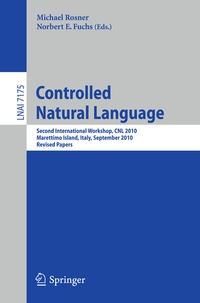
Controlled Natural Language
Second International Workshop, CNL 2010, Marettimo Island, Italy, September 13-15, 2010. Revised Papers
Published on 12. June 2012
IX, 195 pages
978-3-642-31175-8 (ISBN)
Description

This book constitutes the refereed proceedings of the Second International Workshop on Controlled Natural Language, CNL 2010, held in Marettimo Island, Italy, in September 2010.
The 9 revised papers presented in this volume, together with 1 tutorial, were carefully reviewed and selected from 17 initial submissions. They broadly cover the field of controlled natural language, stressing theoretical and practical aspects of CNLs, relations to other knowledge representation languages, tool support, and applications.
More details
Other editions
Additional editions
Michael Rosner | Norbert E. Fuchs
Controlled Natural Language
Second International Workshop, CNL 2010, Marettimo Island, Italy, September 13-15, 2010. Revised Papers
Book
06/2012
1st Edition
Springer
€53.49
Shipment within 7-9 days
Content
- Title
- Preface
- Organisation
- Table of Contents
- Typeful Ontologies with Direct Multilingual Verbalization
- Introduction
- The Abstract Syntax of SUMO-GF
- The Taxonomy
- Instances
- Functions, Predicates and Logical Formulas
- Proofs in Natural Language
- Russell's Paradox
- Verbalization
- Evaluation
- Automated Reasoning in SUMO-GF
- End-User Interface
- Related Work
- Future Work
- Conclusion
- References
- Controlling Ambiguities in Legislative Language
- Introduction
- Approach
- Status Quo in Legislative Drafting
- Ambiguities Controlled by Existing Drafting Guidelines
- Ambiguities Not Controlled by Existing Guidelines
- Proposed Rules
- Controlling Attachment Ambiguity
- Controlling Plural Ambiguities
- Related Work
- Conclusion
- References
- Interpreting Plurals in the Naproche CNL
- Introduction
- Proof Representation Structures
- Collective vs. Distributive Readings of Plurals
- Scope Ambiguity
- Pairwise Interpretations of Collective Plurals
- The Plural Interpretation Algorithm
- Related and Future Work
- Conclusion
- References
- Engineering a Controlled Natural Language into Semantic MediaWiki
- Introduction
- CLANN System
- CLANN Grammar
- CLANN Editor
- PDO Ontology
- Implementation
- CLANN Grammar
- Architecture
- Related Work
- Conclusion
- References
- First-Order Reasoning for Attempto Controlled English
- Introduction
- General Features of RACE
- Working with RACE
- A Look under the Hood of RACE
- All Things Considered
- Decidability, Termination, Efficiency, Looping and All That
- Conclusions
- References
- Codeco: A Practical Notation for Controlled English Grammars in Predictive Editors
- Introduction
- Background
- Requirements for Controlled English Grammars
- Natural Language Grammar Frameworks
- Parser Generators
- Definite Clause Grammars
- Related Work
- The Codeco Notation
- Simple Categories and Grammar Rules
- Normal Forward and Backward References
- Scopes and Accessibility
- Position Operators
- Negative Backward References
- Complex Backward References
- Strong Forward References
- Principles of Reference Resolution
- Restriction on Backward References
- Implementations
- ACE Codeco Grammar
- Evaluation
- Conclusions
- References
- Controlled Language for Everyday Use: The MOLTO Phrasebook
- Introduction
- The Semantic Model
- Concrete Syntax
- Ambiguity and Disambiguation
- Example-Based Grammar Writing
- The Mobile Application
- Evaluation
- Translation Quality
- Coverage
- Engineering Effort
- Usability
- Conclusion
- References
- Controlled Natural Language in a Game for Legal Assistance
- Introduction
- Artificial Legal Assistance
- Legal Assistance with Contracts
- CNLs, Contracts and Games
- Nomic and BanaNomic
- A Deontic Contract Logic and Language for BanaNomic
- BanaL, a CNL for BanaNomic User Input
- Discussion
- Explanation, Structure and Layout
- Layout and Presentation
- Syntactic Sugar and Semantics
- Conclusions
- References
- Working with Events and States in PENG Light
- Introduction
- Controlled Natural Languages (CNLs)
- PENG Light
- The Language Processor of PENG Light
- Writing Support for PENG Light
- Events and States in PENG Light
- A Scenario in PENG Light
- The Event Calculus (EC)
- The Simplified Event Calculus (SEC)
- The SEC at Work
- Specifying Background Knowledge in PENG Light
- Specifying Axioms for Direct Effects in PENG Light
- Specifying Axioms for Indirect Effects in PENG Light
- Specifying Axioms for Continuous Change in PENG Light
- Finding Explanations via Abduction
- Conclusions
- References
- Using CNL Techniques and Pattern Sentences to Involve Domain Experts in Modeling
- Need for Controlled Natural Languages in Modeling
- Related Work
- Syntax Based Approaches
- Pattern Based Approaches
- Textual versus Graphical Representations
- Using Pattern Sentences to Verbalize Models
- Separating Syntax from Semantics
- Mapping between Graphs and Pattern Sentences
- Example: A Telecom Product Model
- Example: Verbalizing a Process Ontology
- Choosing Pattern Sentences
- Structuring the Use of Natural Language
- RuleSpeak Sentence Patterns
- RuleSpeak Guidelines
- Human Interfaces Based on Pattern Sentences
- Using Language Representation in Knowledge Base Access
- Editing Models by Manipulating Sentences
- Conclusions and Future Work
- References
- Author Index
