

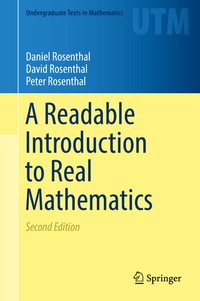
A Readable Introduction to Real Mathematics
Description

Designed for an undergraduate course or for independent study, this text presents sophisticated mathematical ideas in an elementary and friendly fashion. The fundamental purpose of this book is to teach mathematical thinking while conveying the beauty and elegance of mathematics. The book contains a large number of exercises of varying difficulty, some of which are designed to help reinforce basic concepts and others of which will challenge virtually all readers. The sole prerequisite for reading this text is high school algebra. Topics covered include: * mathematical induction * modular arithmetic * the Fundamental Theorem of Arithmetic * Fermat's Little Theorem * RSA encryption * the Euclidean algorithm * rational and irrational numbers * complex numbers * cardinality * Euclidean plane geometry * constructibility (including a proof that an angle of 60 degrees cannot be trisected with a straightedge and compass)* infinite series * higher dimensional spaces.
This textbook is suitable for a wide variety of courses and for a broad range of students of mathematics and other subjects. Mathematically inclined senior high school students will also be able to read this book.
From the reviews of the first edition :
"It is carefully written in a precise but readable and engaging style. I thoroughly enjoyed reading this recent addition to the Springer Undergraduate Texts in Mathematics series and commend this clear, well-organised, unfussy text to its target audiences." (Nick Lord, The Mathematical Gazette , Vol. 100 (547), 2016)
"The book is an introduction to real mathematics and is very readable. . The book is indeed a joy to read, and would be an excellent text for an 'appreciation of mathematics' course, among other possibilities." (G.A. Heuer, Mathematical Reviews , February, 2015)
"Many a benighted book misguidedly addresses the need [to teach mathematical thinking] by framing reasoning, or narrowly, proof, not as pervasive modality but somehow as itself an autonomous mathematical subject. Fortunately, the present book gets it right.... [presenting] well-chosen, basic, conceptual mathematics, suitably accessible after a K-12 education, in a detailed, self-conscious way that emphasizes methodology alongside content and crucially leads to an ultimate clear payoff. . Summing Up: Recommended. Lower-division undergraduates and two-year technical program students; general readers." (D.V. Feldman, Choice , Vol. 52 (6), February, 2015)
Reviews / Votes
"Rosenthals have between them produced a very fine, and very readable, introduction to 'real' mathematics." (Robin Harte, Irish Mathematical Society Bulletin, Issue 83, 2019)"The book was quite an enjoyable read . . It would undoubtedly help students just entering the world of theoretical mathematics, though perhaps after more advanced preparatory material than just high school algebra and trigonometry." (Meghan De Witt, MAA Reviews, October 6, 2019)
Reviews of the first edition:
"It is carefully written in a precise but readable and engaging style and is tightly organised into eight short 'core' chapters and four longer standalone 'extension' chapters. . I thoroughly enjoyed reading this recent addition to the Springer Undergraduate Texts in Mathematics series and commend this clear, well-organised, unfussy text to its target audiences." (Nick Lord, The Mathematical Gazette, Vol. 100 (547), 2016)
"The book is an introduction to real mathematics and is very readable. . The book is indeed a joy to read, and would be an excellent text for an 'appreciation of mathematics' course, among other possibilities." (G. A. Heuer, Mathematical Reviews, February, 2015)
"Daniel Rosenthal and Peter Rosenthal (both, Univ. of Toronto) and David Rosenthal (St. John's Univ.) present well-chosen, basic, conceptual mathematics, suitably accessible after a K-12 education, in a detailed, self-conscious way that emphasizes methodology alongside content and crucially leads to an ultimate clear payoff. . Summing Up: Recommended. Lower-division undergraduates and two-year technical program students; general readers." (D. V. Feldman, Choice, Vol. 52 (6), February, 2015)
More details
Other editions
Additional editions
Previous edition
Persons
David Rosenthal is Professor of Mathematics at St. John's University in New York City.
Peter Rosenthal is Professor Emeritus of Mathematics at the University of Toronto.
