

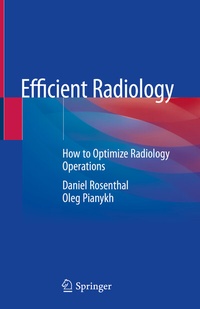
Efficient Radiology
Description

Aiming at building efficient radiology operations, this book walks the reader through the entire radiology workflow, from the moment that the examination is requested to the reporting of findings. Using their practical experience, the authors draw attention to the many elements that can go wrong at each step, and explain how critical analysis and objective metrics can be used to fix broken processes. Readers will learn how to measure the efficiency of their workflows, where to find relevant data, and how to use it in the most productive ways. The book also addresses how data can be turned into insightful operational information to produce organizational change.
All aspects of radiology operations are considered including ordering, scheduling, protocols, checking-in, image acquisition, image interpretation, communication, and billing. The closing section provides a deeper dive into the advanced tools and techniques that are used to analyze operations, including queuing theory, process mining and artificial intelligence.
More details
Other editions
Additional editions
Persons
Daniel I. Rosenthal, MD , is Professor of Radiology at Harvard Medical School, and Associate Radiologist-in-Chief in charge of clinical operations at Massachusetts General Hospital. Dr. Rosenthal's clinical interests have focused on diseases of the skeleton and locomotor system, but his administrative role has included development and implementation of the first practical speech recognition system for medicine, establishment of the first operational teleradiology site offering final interpretations, and creation of the first large scale interpretation site for a clinical trial using electronic imaging. He was the originator of the radiology order entry system with decision support which was used at Massachusetts General Hospital for 15 years. This was the first of its type, and had a profound influence on systems currently in use throughout the country. He is author of more than 200 scientific papers and co-author of three books.
Oleg S. Pianykh , PhD, is Assistant Professor of Radiology at Harvard Medical School, and Head of Massachusetts General Hospital's Radiology Medical Analytics Group. Dr. Pianykh received his graduate training in Applied Math and Computer Science, and has been fascinated by developing clinical applications since his student years. His projects have ranged from building state-wide healthcare networks and private healthcare businesses to directing research groups, and from optimizing daily clinical workflow to teaching advanced graduate courses. Extracting practical knowledge and operational rules from clinical data to drive healthcare innovations has become one of the most important directions of his recent work at Massachusetts General Hospital. Dr. Pianykh has also taught several data science classes at Harvard University and abroad.
Content
Part 1. A word about numbers.- Mining your own business.- Part 2. Ordering.- Scheduling.-Examinations, Protocols, Autoprotocols.- Arriving for the Examination.- Creating the Imagines.-Image Delivery.- From Images to Reports.- Part 3. Ars Longa, Vita Brevis.
