

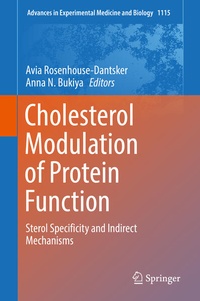
Cholesterol Modulation of Protein Function
Description

In this book, renowned scientists describe the role of steroid chirality and modification of lipid membrane physical properties in the modulation of G protein-coupled receptors and ion channels. The application of commonly-used technical approaches such as mass spectrometry and nucleic magnetic resonance transfer spectroscopy for studies on cholesterol distribution and alteration of lipid bilayer characteristics is also discussed.
This book offers comprehensive insights into the current understanding of cholesterol-driven modulation of protein function via mechanisms that extend beyond lipid-protein direct interactions. In the first part, the chapters introduce the reader to the use of the chemical derivatives of cholesterol as a valuable laboratory tool in the studies of cholesterol-driven modulation of protein function. In the second part, examples of cholesterol-induced changes in membrane physical characteristics are presented and discussed in light of their multifaceted contribution to the effect of cholesterol on protein function.
The book will be of interest to undergraduate and graduate students as well as basic science and medical researchers with a keen interest in the biophysical properties of cholesterol and physiological consequences of cholesterol presence in biological systems.
More details
Other editions
Additional editions
Persons
Avia Rosenhouse-Dantsker , D.Sc., is a Clinical Assistant Professor at the University of Illinois at Chicago. Her research background ranges from quantum theory and computational biology to biophysical chemistry, molecular biology and electrophysiology. Her current research employs experimental and computational approaches to elucidate structural and functional mechanisms of protein modulation with a special emphasis on the modulation of ion channels by lipids (e.g. cholesterol, phosphoinositides, and others). Dr. Rosenhouse-Dantsker is a member of the Biophysical Society and the American Society for Biochemistry and Molecular Biology. She is currently also serving as a co-Editor on a book on the Direct Mechanisms in Cholesterol Modulation of Protein Function.
Anna N. Bukiya , Ph.D., is an Associate Professor at the Department of Pharmacology, College of Medicine, University of Tennessee Health Science Center. Her scientific interests lie in the field of lipid modulation of ionic currents and ion channel sensitivity to alcohol starting from in utero development and spanning into adulthood. Current studies employ an array of computational, biochemical, electrophysiological, and integrative approaches. Dr. Anna Bukiya is a member of the Biophysical Society, and the American Society for Pharmacology and Experimental Therapeutics (Division of Cardiovascular Pharmacology). She is currently also serving as a co-Editor on a book on the Direct Mechanisms in Cholesterol Modulation of Protein Function.
Content
Part 1. Sterol specificity in modulating protein function: 1. Chirality effect on cholesterol modulation of protein function.- 2. A critical analysis of molecular mechanisms underlying membrane cholesterol sensitivity of GPCRs.- 3. Regulation of BK channel activity by cholesterol and its derivatives.- 4. Chiral specificity of cholesterol orientation within cholesterol binding sites in inwardly rectifying potassium channels.- Part 2. Indirect modulation of protein function by cholesterol: 5. Cholesterol effect on the physical properties of lipid membranes.- 6. Effect of cholesterol on the dipole potential of lipid membranes.- 7. Mass spectroscopy imaging of cholesterol.- 8. Cholesterol-dependent gating effects on ion channels.
