

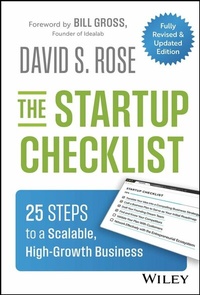
The Startup Checklist
Description

An irreplaceable, start-to-finish guide for entrepreneurs building high-growth companies in the era of artificial intelligence
In the first edition of The Startup Checklist: 25 Steps to a Scalable, High-Growth Business, Rose tackled the other half of the investor-entrepreneur relationship, explaining - in straightforward, granular detail drawn from a lifetime of successful experience in technology leadership - how to build exceptional companies that grow exponentially and lead to life-changing exits.
Now, Rose revisits the advice he offered in The Startup Checklist with a brand-new edition of his widely read entrepreneurship classic. The Startup Checklist, Second Edition, refines and builds on the concrete, step-by-step strategies of the book, adapting them for a market that's been utterly transformed by artificial intelligence and rapid technological change.
In the book, you'll not only find the down-and-dirty tasks you need to complete to plan, launch, scale, and exit your company (and exactly how to perform them), but the "why" of what you're doing, the online tools and technologies you need to save you time and money, and the resources that will multiply your efforts. You'll explore the psychology and behaviors of your potential investors so you can understand what they're thinking without being told.
You'll also find:
- Comprehensive discussions of the most common - and crippling - mistakes made by startup founders and specific strategies for avoiding them (as well as their expensive, time-consuming consequences)
- Deep insights into how the accelerated pace of technological change is impacting the types of businesses that are attracting investments today and how you can get ahead of that curve
- How to incorporate the latest artificial intelligence technologies to streamline your processes, realize permanent efficiencies, and outrun your ferocious rivals
- A complete strategy guide for building a scalable, high-growth company, including specific approaches for incorporation, hiring, IP protection, stock issuance, fundraising, growth management, and structuring your exit
Perfect for entrepreneurs at every level of experience, from brand-new founders who want a one-stop, from-scratch guide to everything they need to know to build a high-growth business to seasoned entrepreneurs looking for insights into how new technologies have changed the game, the latest edition of The Startup Checklist is the ideal roadmap to contemporary entrepreneurship.
More details
Other editions
Additional editions
Person
DAVID S. ROSE is The New York Times bestselling author of Angel Investing, Founder of Gust, Founder of New York Angels, and Chairman of the U.S. Real Estate Market. He is an Inc. 500 CEO, serial entrepreneur, and early-stage investor who has founded or funded over 100 companies. Named a "world conquering entrepreneur" by Businessweek, and "New York's Archangel" by Forbes, he was the Founding Track Chair for Finance and Entrepreneurship at Singularity University.
Content
Foreword by Bill Gross ix
Preface: Why Every Entrepreneur Needs This Book, Now xi
Prologue: What Is the Singularity and Why Should I Care? xv
Introduction: Key Action Steps for Every Entrepreneur xxi
Part I Prepare to Launch 1
Chapter 1 Translate Your Idea into a Compelling Business Model 3
Chapter 2 Craft a Lean Business Plan to Serve as Your Venture's Road Map 13
Chapter 3 Find and Know Your Competitors 25
Chapter 4 Build Your Dream Team 37
Chapter 5 Allocate the Equity in Your Startup 47
Chapter 6 Build a Minimum Viable Product and Validate Your Plan with Customers 57
Chapter 7 Establish Your Brand with Online Public Profiles 67
Chapter 8 Network Effectively Within the Entrepreneurial Ecosystem 75
Part II Launch and Build Your Company 83
Chapter 9 Incorporate Your Company for Protection and Investment 85
Chapter 10 "Lawyer Up" the Right Way 95
Chapter 11 Recruit Your Boards of Directors and Advisors 105
Chapter 12 Financial Forecasting and Accounting 115
Chapter 13 Establish and Manage Your Credit Profile 127
Chapter 14 Open Bank, Credit Card, and Payment Accounts 135
Chapter 15 Choosing Your Key Technologies, Platforms, and Vendors 145
Chapter 16 Measure Your Business with Data Analytics 155
Chapter 17 Round Out Your Team with Employees and Freelancers 165
Chapter 18 Establish a Stock Option Plan to Incentivize Your Team 179
Part III Raise Funds, Collaborate with Investors, Plan Your Exit 187
Chapter 19 Understand the Funding Process and What Investors Want to See 189
Chapter 20 Develop Your Investor Pipeline 203
Chapter 21 Crowdfunding and Online Platforms 217
Chapter 22 Survive the Term Sheet Negotiation and Investor Due Diligence 221
Chapter 23 Get the Most from Your Investors, Now and in the Future 233
Chapter 24 Understand Your Company's Valuation 241
Chapter 25 Keep Your Eye on the Exit and Reap the Benefits of Success 253
Epilogue: The Gust Online Platform for Startups 261
Acknowledgments 267
About the Author 271
Index 273
Prologue: What Is the Singularity and Why Should I Care?
HUMAN BEINGS ARE genetically and mentally wired to think in straight lines rather than curves, and this is best exemplified by our expectations for the future. Back in days of prehistory the condition of the world-everything from its climate to the way a person found food and shelter-changed so slowly that the world into which you were born looked and felt exactly the same as it would when you died.
As humans developed technologies, such as the wheel, fire, iron and bronze smelting, and farming implements, those developments had major impacts on society, but they still took centuries to evolve. Because of that, the change was imperceptible during a persons' lifetime. By the period of classical antiquity in ancient Greece and Rome, new inventions and techniques gave technology a slope. Things might have changed between a person's birth and death, but the changes were not noticeable to the average person.
It wasn't until the late Industrial Revolution that inventions were coming fast and furiously, and so continuously that a reasonable person could expect that things would change for the better during their lifetime, and the line's slope became visible.
As the world entered the 20th century, not only was change expected but also an entire class of literature developed to imagine what technological developments the future would bring: science fiction.
Following World War II, the pace of technological change exploded as humanity moved from the first airplane flight to the first person walking on the moon in only 65 years . less than the average American life expectancy.
With the development of transistors, computers, integrated circuits, global wired and later wireless communications networks, autopiloted planes and self-driving cars, and eventually artificial intelligence (AI) software so "smart" that it could graduate from college, the slope of the line appeared to get ever steeper.
But our human perceptions are all wrong! The development of technology-and thus its effect on the world in which we live-is not linear. It is not flat, not sloped, not even steeply sloped. It is, instead, an exponential power curve.
If you go one step up for every one step you take forward (thus tracing a straight line), after 30 steps forward you will be 30 steps higher. But if instead of adding one step up for each step forward, you were to double the number of steps you take up each time, then after 30 steps forward you would not be 30 steps up . you would be one billion steps up!
Today, with the power of technology doubling every one to two years, futurists such as Ray Kurzweil project that the next major technological paradigm shift will arrive no later than 2045. And what will that be? They predict that less than 20 years from now, as I write these words, humans and computers will merge with each other! That is what is known as the technological singularity, because when that happens things will be so mind-bogglingly different from the world as we know it that we can't possibly even conceive what it would look like.
Ray first made that remarkable prediction in 2005 in a seminal book, The Singularity Is Near, the new version of which, The Singularity Is Nearer, should be required reading for anyone founding a new company. The resulting discussions spawned the creation of a unique organization, part think tank and part executive training program, originally called Singularity University, with support from organizations including Google, NASA, Nokia, and LinkedIn. Ray Kurzweil was the chancellor, Peter Diamandis (the founder of the X Prize Foundation) was chairman, Salim Ismail was the program director, and I was the founding Track Chair for Finance, Entrepreneurship, & Economics.
Why is all this important? Because at the time I made the following rather brash statement: "Any company designed for success in the 20th century is doomed to failure in the 21st." While that may sound overdramatic, the ensuing decade and a half has born me out. Companies such as Blockbuster, Sears, Toys R Us, Borders, Circuit City, and Radio Shack are no longer around, while other major names including General Motors, Chrysler, Delta, American Airlines, Kodak, Brooks Brothers, Neiman Marcus, J.C. Penney, and Hertz, have all filed for bankruptcy since 2000.
Reid Hoffman, in his book, Superagency, notes that there is a spectrum of attitudes toward where explosive growth in the power of AI will take us. At one end are the Doomers. They believe AI is an existential threat that could bring about catastrophic consequences. Then come the Gloomers, who are skeptical and advocate for stringent regulatory controls but stop short of outright rejection. Zoomers, by contrast, are those who champion rapid AI expansion without much concern for potential risks and are often anti-regulation. Reid and I, however, identify ourselves as Bloomers, those who believe that AI (and exponentially advancing technologies across the board), when properly guided by intelligent risk management, can be an overwhelmingly positive force for humanity.
While reading this book, keep in mind that in this world of exponential technological growth, everything is changing literally every day. That's why you need to be completely flexible and understand that things that might seem immutable today may completely evaporate tomorrow. As an entrepreneur, you must be mentally prepared to take advantage of those changes, rather than be overwhelmed by them.
One way to do this is to ensure that from the very first instant of ideation, to the final exit, you design, build, and operate your new venture as an Exponential Organization (ExO).
The Exponential Organization
An ExO is a purpose-driven, agile, and scalable organization that uses accelerating technologies to digitize, dematerialize, democratize, and demonetize its products and services, resulting in a 10× performance increase over its non-ExO peers.
As Salim Ismail and Peter Diamandis observed in the latest edition of their definitive book on the subject, between 2014 and 2021 the top 10 most ExO-friendly companies in the Fortune 100 blew away the bottom 10 least ExO-friendly by the following metrics:
- Revenue growth: 2.6 times higher
- Profitability: 6.8 times higher
- Return on assets: 11.7 times higher
- Total shareholders return (CAGR): 40 times higher
Therefore, when building your new venture, be sure that you continually ensure that it has all the attributes of an ExO. Here is the list from Salim's and Peter's latest book, Exponential Organizations 2.0, available free online at https://openexo.com/book:
The first stands alone: Massive Transformative Purpose (MTP). As the name suggests, MTP is the ExO's core reason for existing. MTP is the foundation upon which all company actions take place. It establishes a long-term goal for the company so sweeping and profound that it is always within reach yet always unreachable. It sets a moral foundation for all company interactions between all stakeholders. It keeps the company disciplined and on target. It inspires employees and customers. And it galvanizes employee morale and retention.
Beyond MTP, 10 key attributes define and power ExOs. The first five characteristics are the "outward-facing" traits of an ExO and are encapsulated by the acronym SCALE.
SCALE: Outward-Facing Characteristics
- Staff on Demand: Increasing speed and functionality by leveraging external workers according to need rather than hiring internal employees.
- Community and Crowd: Attracting, engaging, and leveraging communities and the crowd, whose like-mindedness adds to creativity, validation, and even funding efforts.
- AI & Algorithms: Leveraging automated functions (machine learning, deep learning, etc.) to obtain new insights and automate operations and services.
- Leveraged Assets: Accessing, sharing, renting, or otherwise outsourcing assets to remain nimble and reduce capital expenditures.
- Engagement: Leveraging outside interest through gamification, digital reputation systems, incentive programs, and crypto economics to create network effects and positive feedback loops.
The next five attributes of an ExO are inward-facing. They are encapsulated by the acronym IDEAS.
IDEAS: Inward-Facing Characteristics
- Interfaces: Different ways of interacting, processing, and automating the SCALE attributes so the organization is doing the right work at the right time.
- Dashboards: Making real-time information, with essential company and employee metrics based on Objectives and Key Results (OKRs), accessible to everyone internally, with short feedback loops.
- Experimentation: Introducing lean startup methodology in all departments, with new ideas and processes, culturally enabling rapid, validated learning.
- Autonomy: Instituting a flat structure that allows individual employees or multidisciplinary teams to operate independently and effectively.
- Social Technologies: Leveraging peer-to-peer collaborative tools to facilitate transparent, real-time conversations across the organization.
Keep these attributes in mind as you navigate through the chapters that follow, and continually view everything you do through the lens of exponentially advancing technology. It will stand you in very good stead and help to "future proof" your...
