

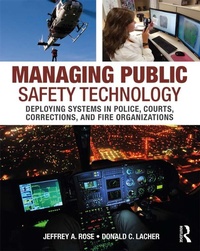
Managing Public Safety Technology
Deploying Systems in Police, Courts, Corrections, and Fire Organizations
Published on 8. December 2016
374 pages
978-1-315-39784-9 (ISBN)
Description

Divided into four sections-public safety agencies, key issues like interoperability and cybercrime, management skills, and emerging trends like the transfer of military technologies to civilian agencies, Managing Public Safety Technology illustrates how essential managing technology is to the success of any project. Based on the authors' years of experience dealing with information systems and other tools, this book offers guidance for line personnel, supervisors, managers, and anyone dealing with public safety technology.
Designed for current or future public safety personnel, especially those in management, Managing Public Safety Technology can also be used for undergraduate and graduate public safety management and leadership programs.
Designed for current or future public safety personnel, especially those in management, Managing Public Safety Technology can also be used for undergraduate and graduate public safety management and leadership programs.
Reviews / Votes
Heretofore, there was little systematic guidance for public agency practitioners and/or educators in navigating the murky waters of publicly-funded technology procurement. Authors Lacher and Rose now provide that much-needed guidance and wisdom about this process from concept to fruition. This book is a must-read for everyone in academia and the public sector. -Paul Cappitelli, Executive Director of the California Commission on Peace Officer Standards and Training (Retired)This book is a must-read for all public safety personnel who are tasked with a technology project. Millions of tax payer dollars are spent on public safety technology projects. This book provides practical guidelines and examples that will help you save time and money. -Detective Laren Leichliter, San Bernardino County Sheriff's Department, San Bernardino County Safety Employees' Benefit Association (President), California Peace Officer Standards and Training (POST) Commission (Chair)
More details
Language
English
Place of publication
London
United Kingdom
Publishing group
Taylor & Francis Ltd
Target group
College/higher education
Product notice
Reflowable
Illustrations
18 Tables, black and white; 1 Line drawings, black and white; 46 Halftones, black and white; 47 Illustrations, black and white
File size
5,94 MB
ISBN-13
978-1-315-39784-9 (9781315397849)
Copyright in bibliographic data and cover images is held by Nielsen Book Services Limited or by the publishers or by their respective licensors: all rights reserved.
Schweitzer Classification
Other editions
Additional editions
Jeffrey Rose | Donald Lacher
Managing Public Safety Technology
Deploying Systems in Police, Courts, Corrections, and Fire Organizations
Book
12/2016
1st Edition
Anderson Publishing
€95.31
Shipment within 15-20 days
Jeffrey Rose | Donald Lacher
Managing Public Safety Technology
Deploying Systems in Police, Courts, Corrections, and Fire Organizations
Book
12/2016
1st Edition
Routledge
€297.12
Shipment within 10-20 days
Persons
Jeffrey A. Rose has an extensive background in training law enforcement officers, as well as a bachelor's degree in human resource management and a master's degree in education. He has taught numerous courses throughout the country on diverse topics, including criminal justice, administration, budgets, human resource management, and technology. He is a Captain with the San Bernardino County Sheriff Department (California), where he has been a member of the department for over 30 years. Captain Rose has worked in a variety of assignments including Corrections, Patrol, Investigations, Watch Commander, and numerous administrative and managerial positions. He is currently the Commander of one of the largest jails in the State of California, and was previously the Commander of the Emergency Operations Division and the Sheriff Regional Training Center (Academy).
Donald C. Lacher is Chair of the Criminal Justice Management program at the Union Institute and University. He retired at the rank of Captain from the Monrovia (California) Police Department after 31 years of honorable service, including management of both the Services and Operations Divisions. At the rank of Lieutenant he served as the Tactical Response Team Commander, Watch Commander, Detective Bureau Commander, DRE Program Coordinator, and Explorer Advisor. Captain Lacher earned a bachelor's degree in Criminal Justice from California State University-Los Angeles and a master's degree in organizational management from the University of La Verne. He is also a graduate of POST Center for Leadership Development-Command College.
Donald C. Lacher is Chair of the Criminal Justice Management program at the Union Institute and University. He retired at the rank of Captain from the Monrovia (California) Police Department after 31 years of honorable service, including management of both the Services and Operations Divisions. At the rank of Lieutenant he served as the Tactical Response Team Commander, Watch Commander, Detective Bureau Commander, DRE Program Coordinator, and Explorer Advisor. Captain Lacher earned a bachelor's degree in Criminal Justice from California State University-Los Angeles and a master's degree in organizational management from the University of La Verne. He is also a graduate of POST Center for Leadership Development-Command College.
Content
PREFACE
ACKNOWLEDGMENTS
DEDICATION
ABOUT THE AUTHORS
FOREWORD
ACRONYMS
UNIT ONE - OVERVIEW OF PUBLIC SAFETY ORGANIZATIONS
Chapter One: Public Safety Technology
Chapter Two: Law Enforcement
Chapter Three: The Court System
Chapter Four: Corrections
Chapter Five: Fire Services
UNIT TWO - CURRENT PRACTICES IN PUBLIC SAFETY ORGANIZATIONS
Chapter Six: Social Media and Public Safety. What is Your Role?
Chapter Seven: Body-Worn Camera Technology
Chapter Eight: Biometrics and Public Safety
Chapter Nine: Use of Force Technology
Chapter Ten: Predictive Policing
Chapter Eleven: Aviation Technology
UNIT THREE - MANAGING PUBLIC SAFETY TECHNOLOGY
Chapter Twelve: So You Want to Manage Technology?
Chapter Thirteen: The Budget Process and Learning How to Fund Your Project
Chapter Fourteen: Developing the Technology Project
Chapter Fifteen: Do You Really Need This Technology?
Chapter Sixteen: Creating a Project Plan
Chapter Seventeen: How to Acquire Technology
Chapter Eighteen: Installation, Maintenance & Closure of Your Project... The Final Steps
UNIT FOUR - EMERGING TRENDS IN PUBLIC SAFETY TECHNOLOGY
Chapter Nineteen: The Future of Public Safety Technology
Chapter Twenty: Case Studies of Public Safety Technology
APPENDICES
Appendix One: Social Media Terminology
Appendix Two: Information Technology Glossary
Appendix Three: Technology Grant
Appendix Four: Sample Request for Proposal
ACKNOWLEDGMENTS
DEDICATION
ABOUT THE AUTHORS
FOREWORD
ACRONYMS
UNIT ONE - OVERVIEW OF PUBLIC SAFETY ORGANIZATIONS
Chapter One: Public Safety Technology
Chapter Two: Law Enforcement
Chapter Three: The Court System
Chapter Four: Corrections
Chapter Five: Fire Services
UNIT TWO - CURRENT PRACTICES IN PUBLIC SAFETY ORGANIZATIONS
Chapter Six: Social Media and Public Safety. What is Your Role?
Chapter Seven: Body-Worn Camera Technology
Chapter Eight: Biometrics and Public Safety
Chapter Nine: Use of Force Technology
Chapter Ten: Predictive Policing
Chapter Eleven: Aviation Technology
UNIT THREE - MANAGING PUBLIC SAFETY TECHNOLOGY
Chapter Twelve: So You Want to Manage Technology?
Chapter Thirteen: The Budget Process and Learning How to Fund Your Project
Chapter Fourteen: Developing the Technology Project
Chapter Fifteen: Do You Really Need This Technology?
Chapter Sixteen: Creating a Project Plan
Chapter Seventeen: How to Acquire Technology
Chapter Eighteen: Installation, Maintenance & Closure of Your Project... The Final Steps
UNIT FOUR - EMERGING TRENDS IN PUBLIC SAFETY TECHNOLOGY
Chapter Nineteen: The Future of Public Safety Technology
Chapter Twenty: Case Studies of Public Safety Technology
APPENDICES
Appendix One: Social Media Terminology
Appendix Two: Information Technology Glossary
Appendix Three: Technology Grant
Appendix Four: Sample Request for Proposal
