

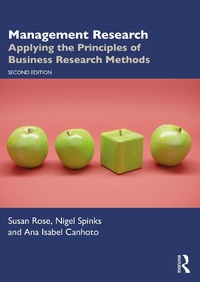
Management Research
Applying the Principles of Business Research Methods
2nd Edition
Published on 5. December 2023
482 pages
978-1-003-80579-3 (ISBN)
Description

Management Research: Applying the Principles of Business Research Methods supports new researchers on every step of the research journey, from defining a project to communicating its findings, as well as balancing the technical aspects of research with the management of the project itself. Structured around the key stages of a research project, the text reflects the richness and diversity of current business and management research, both in its presentation of methods as well as its choice of examples drawn from different industries and organizations.
This book explains the design, selection, development and implementation of appropriate research strategies in different management contexts and disciplines, providing practical guidance to the new researcher in carrying out ethical and inclusive research in today's organizational and business environments, whilst also introducing a range of research methods and techniques. Each chapter includes learning outcomes and in-chapter call out boxes with real-life research examples to illustrate concepts and provide basis for discussion, as well as 'next steps' activities to help readers apply the content to their own live research projects. This second edition has been updated throughout to include the following:
* Enhanced pedagogical features such as discussion questions and online quizzes
* New international examples and research-in-practice cases
* Greater emphasis on topics such as diversity and inclusion through the research process, data collection and privacy, digitalisation, and the process of writing up research.
Management Research provides essential reading for undergraduate and postgraduate students undertaking a dissertation, thesis, or research project, as well as professionals currently practising in the field.
Extensive instructor and student resources support the work online, including an instructor's manual, PowerPoint lecture slides, a question bank and downloadable MS Excel and SPSS data sets.
This book explains the design, selection, development and implementation of appropriate research strategies in different management contexts and disciplines, providing practical guidance to the new researcher in carrying out ethical and inclusive research in today's organizational and business environments, whilst also introducing a range of research methods and techniques. Each chapter includes learning outcomes and in-chapter call out boxes with real-life research examples to illustrate concepts and provide basis for discussion, as well as 'next steps' activities to help readers apply the content to their own live research projects. This second edition has been updated throughout to include the following:
* Enhanced pedagogical features such as discussion questions and online quizzes
* New international examples and research-in-practice cases
* Greater emphasis on topics such as diversity and inclusion through the research process, data collection and privacy, digitalisation, and the process of writing up research.
Management Research provides essential reading for undergraduate and postgraduate students undertaking a dissertation, thesis, or research project, as well as professionals currently practising in the field.
Extensive instructor and student resources support the work online, including an instructor's manual, PowerPoint lecture slides, a question bank and downloadable MS Excel and SPSS data sets.
Reviews / Votes
"This book takes the reader through a logical and sequential process to make a success of any type of management research project, be they large or small, from defining the problem through to communicating the results. It is written in an engaging style, with lots of relevant examples to illustrate both theory and practice. It's a 'must-have' for students or practitioners seeking advice on the topic." Douglas West, Emeritus Professor, King's Business School, King's College London."This superbly comprehensive textbook has been updated for content and practical ease of use in an online world. This book brings together essential theoretical concepts together with practical real business world examples in a way that enables students to understand and implement the key concepts. The strong evidence-based approach and support material strongly supports anyone wanting to embark on a business research project, which makes this an essential read for both students and managers." Deborah Roberts, Professor of Marketing and Innovation Management, The University of York, School for Business and Society
More details
Edition
2nd edition
Language
English
Place of publication
London
United Kingdom
Publishing group
Taylor & Francis Ebooks
Target group
College/higher education
Professional and scholarly
Illustrations
67 Tables, black and white; 100 Line drawings, black and white; 100 Illustrations, black and white
ISBN-13
978-1-003-80579-3 (9781003805793)
Copyright in bibliographic data and cover images is held by Nielsen Book Services Limited or by the publishers or by their respective licensors: all rights reserved.
Schweitzer Classification
Other editions
Additional editions

Susan Rose | Nigel Spinks | Ana Isabel Canhoto
Management Research
Applying the Principles of Business Research Methods
Book
12/2023
2nd Edition
Routledge
€263.80
Shipment within 10-20 days
Susan Rose | Nigel Spinks | Ana Isabel Canhoto
Management Research
Applying the Principles of Business Research Methods
Book
12/2023
2nd Edition
Routledge
€84.20
Shipment within 10-20 days
Previous edition
E-Book
09/2017
1st Edition
Routledge
€59.49
Available for download
Persons
Susan Rose is Professor Emerita, Henley Business School, University of Reading, UK.
Nigel Spinks is Lecturer in Systems and Processes, Henley Business School, University of Reading, UK.
Ana Isabel Canhoto is Professor of Digital Business, University of Sussex Business School, UK.
Nigel Spinks is Lecturer in Systems and Processes, Henley Business School, University of Reading, UK.
Ana Isabel Canhoto is Professor of Digital Business, University of Sussex Business School, UK.
Content
List of figures
List of tables
Preface
Acknowledgements
Glossary
PART I Define
1 Researching in business and management
1.1 Introduction
1.2 Defining management research
1.3 The relationship between research and practice
1.4 The relationship between research and theory
1.5 Research and philosophy
1.6 Reflexivity and the researcher
2 Formulating your research problem
2.1 Introduction
2.2 A problem-solving view of research
2.3 Choosing a research problem
2.4 Developing your research questions
3 Reviewing the Literature
3.1 Introduction
3.2 Undertaking a critical review
3.3 Search
3.4 Capture
3.5 Synthesize
3.6 Present
PART II Design
4 Designing your research
4.1 Introduction
4.2 Integrating theory into your research
4.3 What are quantitative, qualitative or mixed methods?
4.4 Linking research design to your research questions
4.5 Time horizon
4.6 Primary and secondary data
4.7 Quality in Research
5 Conducting research ethically and inclusively
5.1 Introduction
5.2 Ethics in research
5.3 Avoidance of harm or loss of dignity
5.4 Transparency and honesty
5.5 Right to privacy
5.6 Inclusivity in research
5.7 Ethics in online research
5.8 The role of codes of ethics and gaining ethical approval
5.9 Researcher integrity
5.10 Identifying the ethical dimensions of your own research project
6 Quantitative Research Designs
6.1 Introduction
6.2 Experimental and quasi-experimental designs
6.3 Natural experiments and correlational studies
6.4 Survey studies
6.5 Content analysis
6.6 Data-driven quantitative research
6.7 Choosing a quantitative research design
7 Qualitative and Mixed Methods Research Designs
7.1 Introduction
7.2 Ethnography
7.3 Grounded theory
7.4 Case study research design
7.5 Action research
7.6 Interview studies
7.7 Qualitative approaches to language analysis
7.8 Choosing a qualitative research design
7.9 Mixed method research designs
8 Planning and managing your research project
8.1 Introduction
8.2 Selecting a research design
8.3 Planning your research project
8.4 Managing your research project
8.5 Keeping a research diary
8.6 Preparing a research proposal
PART III Collect
9 Sampling
9.1 Introduction
9.2 What is a sample?
9.3 Sampling methods
9.4 Sampling in quantitative, qualitative, and mixed-methods research
9.5 Sample size
9.6 Accessing and recruiting your sample
10 Collecting data using questionnaires
10.1 Introduction
10.2 Why and when to use a questionnaire
10.3 The questionnaire design process
10.4 Identify relevant concepts/variables
10.5 Formulate your questions and decide the level of measurement
10.6 Structure and lay out the questionnaire
10.7 Pre-test and pilot the questionnaire
10.8 Administer and distribute the questionnaire
11 Collecting data using in-depth interviews
11.1 Introduction
11.2 Individual interviews
11.3 Group interviews
11.4 Capturing and storing your interview data
12 Collecting data using diaries and naturally occurring data
12.1 Introduction
12.2 Diaries and other researcher-instigated documents
12.3 Collecting data by observation
12.4 Collecting data through social media
12.5 Collecting documents and other records
12.6 Big data
12.7 Artefacts
PART IV Analyse
13 Analysing quantitative data
13.1 Introduction
13.2 Entering your data
13.3 Preparing your data for analysis
13.4 Exploring and describing your data
13.5 Answering your research questions
13.6 Presenting your findings
13.7 Summary of chart types used in this chapter
13.8 Summary of statistical tests used in this chapter
14 Analysing qualitative data
14.1 Introduction
14.2 Preparing and organizing your data
14.3 Coding your data
14.4 Using computers in qualitative data analysis
14.5 Using visualization to make connections
14.6 Answering your research question
14.7 Drawing and verifying conclusions
14.8 Reporting qualitative data analysis
PART V Communicate
15 Reporting your research
15.1 Introduction
15.2 Writing for an academic qualification
15.3 Writing for an academic journal
15.4 Writing for a practitioner audience
15.5 The process of writing
15.6 Presenting your research project
15.7 Other ways of disseminating your research
List of tables
Preface
Acknowledgements
Glossary
PART I Define
1 Researching in business and management
1.1 Introduction
1.2 Defining management research
1.3 The relationship between research and practice
1.4 The relationship between research and theory
1.5 Research and philosophy
1.6 Reflexivity and the researcher
2 Formulating your research problem
2.1 Introduction
2.2 A problem-solving view of research
2.3 Choosing a research problem
2.4 Developing your research questions
3 Reviewing the Literature
3.1 Introduction
3.2 Undertaking a critical review
3.3 Search
3.4 Capture
3.5 Synthesize
3.6 Present
PART II Design
4 Designing your research
4.1 Introduction
4.2 Integrating theory into your research
4.3 What are quantitative, qualitative or mixed methods?
4.4 Linking research design to your research questions
4.5 Time horizon
4.6 Primary and secondary data
4.7 Quality in Research
5 Conducting research ethically and inclusively
5.1 Introduction
5.2 Ethics in research
5.3 Avoidance of harm or loss of dignity
5.4 Transparency and honesty
5.5 Right to privacy
5.6 Inclusivity in research
5.7 Ethics in online research
5.8 The role of codes of ethics and gaining ethical approval
5.9 Researcher integrity
5.10 Identifying the ethical dimensions of your own research project
6 Quantitative Research Designs
6.1 Introduction
6.2 Experimental and quasi-experimental designs
6.3 Natural experiments and correlational studies
6.4 Survey studies
6.5 Content analysis
6.6 Data-driven quantitative research
6.7 Choosing a quantitative research design
7 Qualitative and Mixed Methods Research Designs
7.1 Introduction
7.2 Ethnography
7.3 Grounded theory
7.4 Case study research design
7.5 Action research
7.6 Interview studies
7.7 Qualitative approaches to language analysis
7.8 Choosing a qualitative research design
7.9 Mixed method research designs
8 Planning and managing your research project
8.1 Introduction
8.2 Selecting a research design
8.3 Planning your research project
8.4 Managing your research project
8.5 Keeping a research diary
8.6 Preparing a research proposal
PART III Collect
9 Sampling
9.1 Introduction
9.2 What is a sample?
9.3 Sampling methods
9.4 Sampling in quantitative, qualitative, and mixed-methods research
9.5 Sample size
9.6 Accessing and recruiting your sample
10 Collecting data using questionnaires
10.1 Introduction
10.2 Why and when to use a questionnaire
10.3 The questionnaire design process
10.4 Identify relevant concepts/variables
10.5 Formulate your questions and decide the level of measurement
10.6 Structure and lay out the questionnaire
10.7 Pre-test and pilot the questionnaire
10.8 Administer and distribute the questionnaire
11 Collecting data using in-depth interviews
11.1 Introduction
11.2 Individual interviews
11.3 Group interviews
11.4 Capturing and storing your interview data
12 Collecting data using diaries and naturally occurring data
12.1 Introduction
12.2 Diaries and other researcher-instigated documents
12.3 Collecting data by observation
12.4 Collecting data through social media
12.5 Collecting documents and other records
12.6 Big data
12.7 Artefacts
PART IV Analyse
13 Analysing quantitative data
13.1 Introduction
13.2 Entering your data
13.3 Preparing your data for analysis
13.4 Exploring and describing your data
13.5 Answering your research questions
13.6 Presenting your findings
13.7 Summary of chart types used in this chapter
13.8 Summary of statistical tests used in this chapter
14 Analysing qualitative data
14.1 Introduction
14.2 Preparing and organizing your data
14.3 Coding your data
14.4 Using computers in qualitative data analysis
14.5 Using visualization to make connections
14.6 Answering your research question
14.7 Drawing and verifying conclusions
14.8 Reporting qualitative data analysis
PART V Communicate
15 Reporting your research
15.1 Introduction
15.2 Writing for an academic qualification
15.3 Writing for an academic journal
15.4 Writing for a practitioner audience
15.5 The process of writing
15.6 Presenting your research project
15.7 Other ways of disseminating your research
