

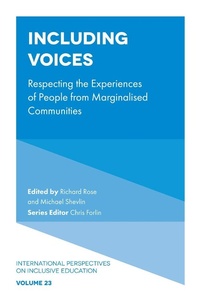
Including Voices
Respecting the Experiences of People from Marginalised Communities
Published on 7. June 2024
272 pages
978-1-83797-719-2 (ISBN)
Description

While much has been written about inclusive education systems, researchers have mainly focused upon policies and practices to encourage access and participation for children with disabilities or special educational needs. Yet it is evident that the population of individuals and in some cases whole communities who have been denied access to schooling is much wider and more complex.
The relationships that exist between poverty, class, sexuality, caste, gender, and exclusion from education are visible in many countries; these factors interacting to perpetuate exclusion.
Including Voices considers the challenges and successes surrounding the development of equitable education by presenting the experiences of individuals who have themselves been the subjects of marginalisation. Through the presentation of research and an examination of exclusionary conditions, and the ways in which these are being challenged, the editors and authors present an important debate focused upon human rights and practical application of inclusive practices.
A unique feature of Including Voices is the discussion generated about how the voices of individuals from marginalised communities and those who support them have been obtained, analysed, and reported. The editors provide a framework for encouragement of the respectful use of voices to further the cause of research that is inclusive.
The relationships that exist between poverty, class, sexuality, caste, gender, and exclusion from education are visible in many countries; these factors interacting to perpetuate exclusion.
Including Voices considers the challenges and successes surrounding the development of equitable education by presenting the experiences of individuals who have themselves been the subjects of marginalisation. Through the presentation of research and an examination of exclusionary conditions, and the ways in which these are being challenged, the editors and authors present an important debate focused upon human rights and practical application of inclusive practices.
A unique feature of Including Voices is the discussion generated about how the voices of individuals from marginalised communities and those who support them have been obtained, analysed, and reported. The editors provide a framework for encouragement of the respectful use of voices to further the cause of research that is inclusive.
More details
Series
Language
English
Place of publication
Bingley
United Kingdom
Target group
Professional and scholarly
File size
2,48 MB
ISBN-13
978-1-83797-719-2 (9781837977192)
Copyright in bibliographic data and cover images is held by Nielsen Book Services Limited or by the publishers or by their respective licensors: all rights reserved.
Schweitzer Classification
Other editions
Additional editions
Richard Rose | Michael Shevlin
Including Voices
Respecting the Experiences of People from Marginalised Communities
Book
06/2024
Emerald Publishing Limited
€133.50
Shipment within 3-4 weeks
Persons
Richard Rose is Professor Emeritus in Inclusive Education at the University of Northampton, UK.
Michael Shevlin is Professor in Inclusive Education and Director of the Trinity Centre for People with Intellectual Disabilities at Trinity College, University of Dublin, Ireland.
Michael Shevlin is Professor in Inclusive Education and Director of the Trinity Centre for People with Intellectual Disabilities at Trinity College, University of Dublin, Ireland.
Content
Chapter 1. Introduction: Challenging Assumptions: Voices from marginalised communities; Richard Rose and Michael Shevlin
REIMAGINING VOICES
Chapter 2. Voices as Aesthetic Material: Celebrating that disAbled, Marginalised Voices (are) Matter; Yvon Bonenfant
Chapter 3. Lived Experiences of Persons with Disabilities who are Doubly Disadvantaged; Jayanthi Narayan and Shree Ram Mittal
Chapter 4. The experiences of families on the autism spectrum in rural coastal communities in England; Ivana Lessner Listiakova and Dr. David Preece
Chapter 5. Access the Voices of First Generation Learners From a Tribal Community in Maharashtra, India; Ratika Malkani
Chapter 6. Creating Insight about Inclusion together with Young People with Profound Intellectual and Multiple Disabilities; Joanna Grace and Melanie Nind
DISRUPTIVE VOICES
Chapter 7. Embracing the Disruptive Voice; Vivian Rath
Chapter 8. The Story of Disha- Journey of an Indian Transgender Breaking Free; Sujata Bhan
Chapter 9. The Power of Participatory Action Research to Hearing the Voices of Children with Disabilities in Conflict Situations. A Case Study from Palestine; Alison MacKenzie, Mohammed Owaineh, and Christine Bower
Chapter 10. A disrupted life: A study of young people who experience Traumatic Brain Injury in higher education in the Republic of Ireland; Teresa Shiels, Neil Kenny, and Patricia Mannix McNamara
Chapter 11. Honouring 'that what is most important': Listening to the voices of young people with experiences of mental health difficulties; Emma Farrell
Chapter 12. Exploring the paradigm of co-produced research within the context of the COVID pandemic; Neil Kenny, Stuart Neilson, Jane O'Kelly, Jessica K. Doyle and Joan McDonald
ENABLING VOICES
Chapter 13. Informing poetry pedagogy: Listening to the voices of university students with intellectual disabilities; John Kubiak
Chapter 14. I'm trying to mix, but it's really hard to talk and explain ideas: Inclusion of students with Down Syndrome in Higher Education; Denise E. De Souza and Athena Vongalis-Macrow
Chapter 15. Researching with student teachers from working class backgrounds: Issues of identity, positionality, and disclosure, and reflections on research praxis;Elaine Keane, Manuela Heinz, and Andrea Lynch.
Chapter 16. Graduates' Perceptions of an American Post-Secondary Education Program's Value for Individuals with Intellectual Disabilities; Kristina N. Randall, Joseph B. Ryan, and Alex Carlson
Chapter 17. The Representation of Traveller Students Across Different School Contexts in Ireland; Emer Smyth and Joanne Banks
Chapter 18. Go With the FLOO - Authentic Voices in Research With Families Where One or More Parents Have an Intellectual Disability; Leo Cardinaal, Jane Strugar Kolesnik, Mark Koning, Marja W. Hodes, and Alice Schippers
REIMAGINING VOICES
Chapter 2. Voices as Aesthetic Material: Celebrating that disAbled, Marginalised Voices (are) Matter; Yvon Bonenfant
Chapter 3. Lived Experiences of Persons with Disabilities who are Doubly Disadvantaged; Jayanthi Narayan and Shree Ram Mittal
Chapter 4. The experiences of families on the autism spectrum in rural coastal communities in England; Ivana Lessner Listiakova and Dr. David Preece
Chapter 5. Access the Voices of First Generation Learners From a Tribal Community in Maharashtra, India; Ratika Malkani
Chapter 6. Creating Insight about Inclusion together with Young People with Profound Intellectual and Multiple Disabilities; Joanna Grace and Melanie Nind
DISRUPTIVE VOICES
Chapter 7. Embracing the Disruptive Voice; Vivian Rath
Chapter 8. The Story of Disha- Journey of an Indian Transgender Breaking Free; Sujata Bhan
Chapter 9. The Power of Participatory Action Research to Hearing the Voices of Children with Disabilities in Conflict Situations. A Case Study from Palestine; Alison MacKenzie, Mohammed Owaineh, and Christine Bower
Chapter 10. A disrupted life: A study of young people who experience Traumatic Brain Injury in higher education in the Republic of Ireland; Teresa Shiels, Neil Kenny, and Patricia Mannix McNamara
Chapter 11. Honouring 'that what is most important': Listening to the voices of young people with experiences of mental health difficulties; Emma Farrell
Chapter 12. Exploring the paradigm of co-produced research within the context of the COVID pandemic; Neil Kenny, Stuart Neilson, Jane O'Kelly, Jessica K. Doyle and Joan McDonald
ENABLING VOICES
Chapter 13. Informing poetry pedagogy: Listening to the voices of university students with intellectual disabilities; John Kubiak
Chapter 14. I'm trying to mix, but it's really hard to talk and explain ideas: Inclusion of students with Down Syndrome in Higher Education; Denise E. De Souza and Athena Vongalis-Macrow
Chapter 15. Researching with student teachers from working class backgrounds: Issues of identity, positionality, and disclosure, and reflections on research praxis;Elaine Keane, Manuela Heinz, and Andrea Lynch.
Chapter 16. Graduates' Perceptions of an American Post-Secondary Education Program's Value for Individuals with Intellectual Disabilities; Kristina N. Randall, Joseph B. Ryan, and Alex Carlson
Chapter 17. The Representation of Traveller Students Across Different School Contexts in Ireland; Emer Smyth and Joanne Banks
Chapter 18. Go With the FLOO - Authentic Voices in Research With Families Where One or More Parents Have an Intellectual Disability; Leo Cardinaal, Jane Strugar Kolesnik, Mark Koning, Marja W. Hodes, and Alice Schippers
