

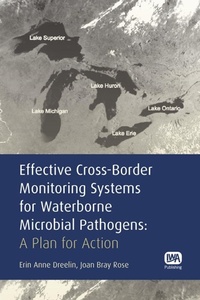
Effective Cross-Border Monitoring Systems for Waterborne Microbial Pathogens
A Plan for Action
Published on 14. May 2008
210 pages
978-1-78040-189-8 (ISBN)
Description

This book provides a real-world analysis of how to quantify and prioritize water-based microbial threats to human health, how to design data collection systems that truly support management decisions, and how to build a comprehensive monitoring program when dealing with cross-boundary issues. International borders and cross-boundary issues complicate water resource management. Even if nations or jurisdictions agree on the nature and source of the problem, differing legal frameworks complicate cross-border management, as the procedural steps and time necessary to implement a solution vary among entities.
Waterborne pathogens transcend political boundaries and challenge the use of traditional political jurisdictions in meeting public policy objectives to protect human health. Disease outbreaks caused by waterborne pathogens continue to occur, even in the developed world. There has been a pronounced trend toward new and increasingly complex institutions and policies to address regional water quality management issues. However, many questions continue to arise regarding the effective management of regional resources. These questions include how to design effective monitoring strategies and what can be learned from previous successes and failures. The Laurentian Great Lakes offers a model system for exploring these questions.
This book will be a valuable reference source for researchers and graduate students working in environmental science, microbiology, engineering, and biological sciences, as well as all those concerned with water quality monitoring programs.
Waterborne pathogens transcend political boundaries and challenge the use of traditional political jurisdictions in meeting public policy objectives to protect human health. Disease outbreaks caused by waterborne pathogens continue to occur, even in the developed world. There has been a pronounced trend toward new and increasingly complex institutions and policies to address regional water quality management issues. However, many questions continue to arise regarding the effective management of regional resources. These questions include how to design effective monitoring strategies and what can be learned from previous successes and failures. The Laurentian Great Lakes offers a model system for exploring these questions.
This book will be a valuable reference source for researchers and graduate students working in environmental science, microbiology, engineering, and biological sciences, as well as all those concerned with water quality monitoring programs.
More details
Language
English
Place of publication
London
United Kingdom
Target group
College/higher education
Professional and scholarly
File size
3,32 MB
ISBN-13
978-1-78040-189-8 (9781780401898)
Copyright in bibliographic data and cover images is held by Nielsen Book Services Limited or by the publishers or by their respective licensors: all rights reserved.
Schweitzer Classification
Other editions
Additional editions
Joan B. Rose | Erin A. Dreelin
Effective Cross-Border Monitoring Systems for Waterborne Microbial Pathogens
Book
05/2008
IWA Publishing
€166.38
Shipment within 3-4 weeks
Content
- Cover
- Copyright
- Contents
- Preface
- 1. Transboundary Monitoring of International Waters: Critical Questions for Microbial Water Quality
- 1.1 Introduction
- 1.2 The Great Lakes Basin
- 1.3 Microbial Pathogens and the Great Lakes
- 1.4 Great Lakes Management Framework
- 1.4.1 Management in the Great Lakes Region
- 1.4.2 Management Challenges
- 1.5 Cross-border issues
- 1.6 Critical Questions for Microbial Monitoring
- 1.7 References
- 2. Transboundary Water Quality Management in the Great Lakes
- 2.1 Introduction
- 2.2 Boundary Waters Treaty
- 2.3 Great Lakes Water Quality Agreement
- 2.4 National Water Quality Programs
- 2.4.1 United States
- 2.4.2 Canada
- 2.5 State and Provincial Programs
- 2.5.1 Great Lakes States Compact
- 2.5.2 Canada-Provincial Agreements
- 2.6 Pathogen Issues Identified
- 2.7 References
- 3. Bacteriological Monitoring in the Great Lakes: A Historical perspective to inform the Present
- 3.1 Introduction
- 3.2 The 1914 IJC bacteriological study
- 3.2.1 The Approach for the Assessment
- 3.2.2 Major Findings
- 3.2.2.1 Rainy River, Rainy Lake and Lake of the Woods
- 3.2.2.2 Thunder Bay Lake Superior
- 3.2.2.3 St. Mary's River
- 3.2.2.4 Lower end of Lake Huron,
- 3.2.2.5 St. Clair River
- 3.2.2.6 Lake St. Clair
- 3.2.2.7 Detroit River
- 3.2.2.8 Lake Erie
- 3.2.2.9 Upper Niagara River
- 3.2.2.10 Lower Niagara River and western Lake Ontario
- 3.2.2.11 Eastern Lake Ontario and St. Lawrence River
- 3.2.2.12 St. John River between Edmunston and Grand Falls
- 3.2.3 Impact of Study
- 3.3 Current Monitoring Efforts
- 3.3.1 Drinking Water and Wastewater
- 3.3.2 Beach Monitoring
- 3.3.3 Other Monitoring Efforts
- 3.4 Conclusion
- 3.5 References
- 4. Societal Changes and their Impact on Waterborne Infections in the United States and Canada: A Broad and Critical Perspective
- 4.1 Introduction
- 4.2 Background
- 4.3 Infectious Disease Spread by Water
- 4.4 Waterborne Infections in U.S. and Canada
- 4.5 Societal Changes
- 4.5.1 Population-Related Factors
- 4.5.1.1 Demographics
- 4.5.1.2 Urbanization
- 4.5.1.3 Grouping of Susceptibles
- 4.5.1.4 Foodborne Diseases
- 4.5.2 Municipal Factors
- 4.5.2.1 Municipal Waterworks
- 4.5.2.2 Wastewaters
- 4.5.2.3 Pharmaceuticals
- 4.5.2.4 Microbicide Use
- 4.5.2.5 Environmental Toxins
- 4.5.2.6 Land Applications of Municipal Solid Wastes
- 4.5.3 Agricultural and Animal Husbandry
- 4.5.4 The Commercial/Industrial Sector
- 4.5.4.1 Power Generation
- 4.5.4.2 Manufacturing and Mining
- 4.5.5 Climate Change
- 4.5.6 Other Factors
- 4.6 Conclusion
- 4.8 References
- 5. Managing Human Impacts on Water Quality: Role of Integrated Ocean Observing Systems
- 5.1 Summary
- 5.2 Introduction
- 5.3 Health Risks in an Ecosystem Context
- 5.3.1 Climate, People and Coastal Ecosystems
- 5.3.2 Managing Human Use in the Context of Natural Variability and Change
- 5.4 The Global Ocean Observing System
- 5.4.1 Purpose
- 5.4.2 An End-to-End System
- 5.4.3 The Coastal Component of the Global Ocean Observing System
- 5.5 Ecosystem-Based Approaches to Managing Health Risks
- 5.5.1 Harmful Algal Bloom Observing Systems
- 5.5.1.1 Gulf of Mexico
- 5.5.1.2 Detection
- 5.5.1.3 Prediction
- 5.5.2 Fresh and Brackish Water Ecosystems
- 5.5.3 Beach Closures in the Great Lakes
- 5.5.3.1 The Decision Making Process
- 5.5.3.2 Detection
- 5.5.3.3 Prediction
- 5.5.4 Toward More Informed Decisions Through Rapid Detection and Timely Prediction
- 5.6 Conclusions
- 5.7 References
- 6. A HACCP approach to manage water safety for large water basins
- 6.1 Introduction
- 6.1.1 Application of HACCP to cross-border water resourcesmanagement
- 6.1.2 Why create a HACCP-based risk management system
- 6.2 Creating the HACCP plan
- 6.2.1 The first step: Commit the resources to the task (Step 1)
- 6.2.2 The Scoping Phase: Explicit identification of water uses, users and their requirements (Steps 2 and 3)
- 6.2.3 Developing a conceptual model of the system from a watersafety perspective (Steps 4 and 5)
- 6.3 Principles
- 6.3.1 The Risk Assessment Phase "What are the risks?"(Principle 1)
- 6.3.2 The Risk Management Planning Phase "How do we managethe risks?" (Principles 2 to 5)
- 6.3.3 The validation and verification phase "How do we know therisk is managed?" (Principles 6 and 7)
- 6.3.3.1 Validation
- 6.3.3.2 Verification
- 6.4 Record keeping
- 6.5 Supporting programs
- 6.6 Benefits of the HACCP approach
- 6.7 References
- 7. Transboundary Monitoring of Large Basin Systems for Waterborne Microbial Pathogens
- 7.1 Introduction
- 7.1.1 Microbial Threats, Society and Science: Why We Need to Monitor our Water
- 7.2 Traditional Monitoring Approaches for Microorganisms
- 7.2.1 The Current Water Standards and Guidelines for Microorganisms
- 7.2.2 The Indicators
- 7.3 Advanced Microbial Risk Frameworks and Water Quality Tools
- 7.3.1 The Microbial Risk Framework: Quantitative Microbial Risk Assessment
- 7.3.2 New Technologies
- 7.4 Planning a Large Scale Waterbasin Monitoring Program
- 7.4.1 Background
- 7.4.2. Steps Associated with Large Scale Water Quality Monitoring Programs
- 7.5 Concluding Remarks
- 7.5.1 The European Blue Flag Campaign
- 7.5.2 The US Information Collection Rule
- 7.5.3 Recommendations for the Implementation of Microbiological Monitoring of Transboundary Waters
- 7.6 References
- Index
