

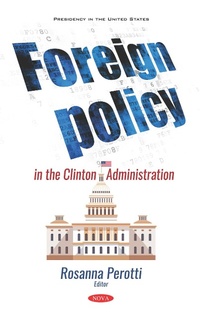
Foreign Policy in the Clinton Administration
Published on 20. March 2019
358 pages
978-1-5361-4798-8 (ISBN)
Description

Bill Clinton came to the presidency during the first moments of the post-Cold War era, when the United States and the international system were at a crossroads. Faced with the choice of either retreating from the world or acting as "world policeman," Clinton chose a path of unabashed "practical internationalism." His foreign policy embraced globalization, free trade and the promotion of democracy abroad, while acknowledging American limits. Scholarly and pubic interest in Clinton's foreign policy have peaked recently, as the shape of the Trump administration's foreign policy has unfolded. Today's populist nationalists might be seen as reacting to the Clinton agenda: They have attacked free trade and internationalism as a "bad deal" for US workers, striking out not only at trade agreements, but at immigration, refugee acceptance, US intervention, and international institutions such as the International Criminal Court and the Kyoto Protocol. Today, advocates of free trade and international engagement warn that the United States must continue to take a leadership role in steering the international agreements and institutions that it helped to create, as a way of advancing American prosperity and security. This is the reason the Clinton administration's foreign policy legacy continues to be important today. To understand "America First," we must first understand the underpinnings of globalization and the policy of practical internationalism. During Clinton's time in office and not long after, many scholars struggled to find coherence to the administration's foreign policy legacy, despite the administration's continued assertions of an overarching strategy. Today, it is more apparent than ever that 1) Clinton's foreign policy had a cohesive theme, 2) his internationalism sowed the seeds of our current "America First" brand of populism, and 3) Clinton's successes and failures hold important lessons for policymakers today. The introduction to this edited volume explores these themes, and the remainder of the book's seventeen chapters, authored by scholars of comparative politics, international relations and history, expand on particular policies. With the Trump administration midterm assessments coming in Fall 2018 and Winter 2019, there will be heightened interest in the background of such issues as engagement with North Korea; terrorism; nuclear proliferation; relations with China, India, and Japan; peacemaking in Northern Ireland; cooperation with NATO and the UN; and the difficulty of pursuing peace in the Middle East.
More details
Other editions
Additional editions
Rosanna Perotti
Foreign Policy in the Clinton Administration
Book
02/2019
Nova Science Publishers Inc
€303.55
Shipment within 15-20 days
Content
- Intro
- Contents
- Introduction
- Reassessing "Practical Internationalism" in the Era of "America First"
- A Coherent Foreign Policy?
- Successes and Failures
- The Plan of This Book
- From Practical Internationalism to America First
- Endnotes
- I. The Clinton Foreign Policy Legacy
- Chapter 1
- Practical Internationalism: The Foreign Policy of the Clinton Administration as Viewed from Europe
- Endnote
- Chapter 2
- Doing the Right Thing in a Pragmatic Way
- Chapter 3
- The Foreign Policy of the Clinton Administration: The Pursuit of Order in the Post-Cold War Era
- The Architectural Metaphor
- The Intellectual Foundation of the Clinton Administration's Foreign Policy
- Clinton's Foreign Policy Assessed
- Conclusion
- Endnotes
- II. Defense Policy
- Chapter 4
- Clinton and the Origins of the Militarization of National Security Policy
- Introduction
- Clinton's National Security Team
- Problems with the Pentagon
- International Criminal Court
- Landmines Ban
- Ban on Combat for Teenagers
- Comprehensive Test Ban Treaty
- Other Failures
- Problems for the Bureaucracy
- National Security Success
- Postscript
- Endnotes
- Chapter 5
- US Nuclear Proliferation Policy during the Clinton Administration
- History
- The Clinton Record
- Conclusion
- Endnotes
- III. Asia: Economic and Security Issues
- Chapter 6
- Clinton and China: From Confrontation to Engagement
- Endnote
- Chapter 7
- Japan's Dual Challenge: A Democrat in the White House and the Growing Shadow of China
- Prelude to the Lost Decade
- Two Issues between President Clinton and Japan
- The Trade Dispute
- Security Relations
- It's China, Stupid!
- Conclusion: The United States and Japan after Clinton
- Endnotes
- Chapter 8
- Engaging with North Korea: Clinton's Legacy
- Background Briefing: Negotiating with a Difficult Partner
- Analysis: Why It Happened the Way It Happened
- Competing Agenda I: The Middle East Peace Process
- Competing Agenda II: "The Parallel Lives"
- Conclusion
- Endnotes
- Chapter 9
- The Transformation of Indo-American Relations under President William Jefferson Clinton
- The Context of Relations
- The Residual Character of Indo-American Relations
- The Belated Clinton Transformation
- Nuclear Attention
- The Clinton Legacy in South Asia
- Endnotes
- IV. Iraq and Anti-Terrorism
- Chapter 10
- US Foreign Policy toward the Iraqi Kurds during the Clinton Administration
- Endnotes
- Chapter 11
- Slouching towards Baghdad: Clinton's Policy towards Iraq
- Foreign Policy Context: The End of the Cold War
- Clinton's First Term
- The Inspections/Sanctions Regime
- US Policy Shifts from Containment to Regime Change
- Conclusion
- Endnotes
- Chapter 12
- Toward 9/11: Confronting Terrorism, from Clinton to Bush
- Government Secrecy, Accountability, and Informed Citizens
- Media Partisanship and the Quest for Reliable Knowledge
- Failures to Prevent 9/11
- From Reagan to Clinton: Emergence of a "Terrorism Triangle"
- Clinton's First Term: Dealing with Terrorism, 1993-1996
- Clinton Addresses Terrorism, 1997-2001
- Presidential Transition: From Clinton to George W. Bush
- Conclusion
- Endnotes
- V. Northern Ireland
- Chapter 13
- President Clinton and Northern Ireland: Gulliver in Lilliput
- Introduction
- The US and Northern Ireland before Clinton
- The Clinton Years
- Intra-Administration Policy Development
- The Case against Clinton's Activism
- Conclusion
- Endnotes
- Chapter 14
- Bringing Hope to Northern Ireland's Civil Society: 1992-2000
- Economic Incentives: The Washington Investment Conference
- Clinton's Visit to Belfast and Derry
- Impact of Clinton's Visit
- Conclusion
- Endnotes
- VI. The United Nations and Multilateralism
- Chapter 15
- Private and Public Diplomacy: The US Permanent Representative to the United Nations in the Clinton Years
- Clinton's Foreign Policy Agenda
- The Albright Years at the UN
- The Holbrooke Years at the UN
- Conclusion
- Author's Note
- Endnotes
- Chapter 16
- The Clinton Administration and the United Nations: From "Assertive Multilateralism" to "Burden Shifting" and Rediscovery(
- "Assertive Multilateralism"
- Assertive Multilaterlaism Gives Way to "Burden-Sharing"
- The Clinton Administration's Unilateral Removal of Boutros-Ghali
- Clinton Administration's "Rediscovery" of the United Nations
- Conclusion
- Endnotes
- Chapter 17
- Getting from Mogadishu to Sarajevo:
- The "Maturing" of the Clinton Administration's UN Policy
- Somalia
- Presidential Decision Directives 25 and 56
- Haiti and Bosnia
- Conclusion
- Endnotes
- About the Contributors
- Subject Index
- Name Index
- Blank Page
