

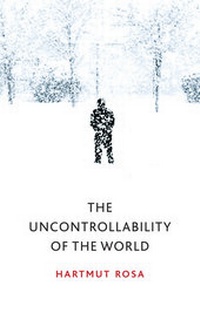
The Uncontrollability of the World
Description

Our lives are played out on the border between what we can control and that which lies outside our control. But because we late-modern human beings seek to make the world controllable, we tend to encounter the world as a series of objects that we have to conquer, master or exploit. And precisely because of this, 'life,' the experience of feeling alive and truly encountering the world, always seems to elude us. This in turn leads to frustration, anger and even despair, which then manifest themselves in, among other things, acts of impotent political aggression. For Rosa, to encounter the world and achieve resonance with it requires us to be open to that which extends beyond our control. The outcome of this process cannot be predicted, and this is why moments of resonance are always concomitant with moments of uncontrollability.
This short book - the sequel to Rosa's path-breaking work on social acceleration and resonance - will be of great interest students and scholars in sociology and the social sciences and to anyone concerned with the nature of modern social life.
More details
Other editions
Additional editions
Persons
Hartmut Rosa is Professor of Sociology at the Friedrich-Schiller-Universität Jena, Germany, and Director of the Max Weber Center for Advanced Cultural and Social Studies, Erfurt, Germany. His many books include Social Acceleration and Resonance.
Content
Beyond Control vii
Introduction: On Snow 1
1 The World as a Point of Aggression 5
2 Four Dimensions of Controllability 15
3 The Paradoxical Flipside: The Mysterious Withdrawal of the World 19
4 The World as a Point of Resonance 30
5 Five Theses on the Controllability of Things and the Uncontrollability of Experience 40
6 To Take Control or to Let Things Happen? The Basic Conflict of Modernity at Six Stages of Life 60
7 Control as an Institutional Necessity: The Structural Dimension of the Basic Conflict of Modernity 86
8 The Uncontrollability of Desire and the Desire for the Uncontrollable 102
9 The Monstrous Return of the Uncontrollable 110
Conclusion 117
Notes 118
1
The World as a Point of Aggression
The starting point for my reflections is the insight that human beings are always already situated in a world, always already au monde, as the French phenomenologist Maurice Merleau-Ponty puts it. The first glimmer of awareness when we open our eyes in the morning or awake from anesthesia, and presumably even the first conscious impression of a newborn, is the perception that "there is something," that something is present.1 We can understand this presence as the ur-form of what we gradually come to experience, explore, and conceive of as world, although it essentially precedes the distinction between subject and world. From this original impression that "something is present," I have sought to develop a sociology of our relationship to the world that assumes that subject and world are not the precondition, but the result of our relatedness to this presence. Little by little, in the course of our development, we learn from this "something" to distinguish between ourselves as experiencing subjects and the world as that which we encounter. The way in which the two are related is constitutive of both what we are as human beings and what we encounter as world. Hence, whenever I refer in what follows to (experiencing) subjects and (encountered) objects, these are to be understood as the two poles-the "self pole" and "world pole," so to speak-of the relationship that constitutes them.
The fundamental question of a sociology of our relationship to the world is, how is this something that is present constituted? Is it benevolent and redemptive, promising and seductive, cold and indifferent, or even threatening and dangerous? In contrast to philosophers, psychologists, and even theologians, who all grapple professionally with the question of the human being's place in the cosmos or our relationship to the universe, to nature, and so on,2 I start from the assumption that the way we are related to the world is not determined simply by the fact of our being human, but rather depends on the social and cultural conditions into which we have been socialized. We learn and become habituated to a certain practical attitude toward the world that goes far beyond our cognitive "worldview," our conscious assumptions and convictions about what exists in the world and what the world is all about, what it all comes down to. The first guiding thesis that I would like to develop in this essay is that, for late modern human beings, the world has simply become a point of aggression.3 Everything that appears to us must be known, mastered, conquered, made useful. Expressed abstractly, this sounds banal at first-but it isn't. Lurking behind this idea is a creeping reorganization of our relationship to the world that stretches far back historically, culturally, economically, and institutionally but in the twenty-first century has become newly radicalized, not least as a result of the technological possibilities unleashed by digitalization and by the demands for optimization and growth produced by financial market capitalism and unbridled competition.
I will expand upon this phenomenon in greater detail in what follows. For now, I would simply like to illustrate it with a few brief examples. Let us consider our relationship to our own body. Everything that we perceive about it tends to be subject to the pressures of optimization. We climb onto the scale: we should lose weight. We look into the mirror: we have to get rid of that pimple, those wrinkles. We take our blood pressure: it should be lower. We track our steps: we should walk more. Our insulin level, our bustline: we invariably encounter such things as a challenge to do better, even if it is a challenge we can ignore or reject. Moreover, we ought to be calmer, more relaxed, more mindful, more environmentally conscious. Even those things we encounter outside ourselves take on the character of a challenge: Mountains have to be scaled, tests passed, career ladders climbed, lovers conquered, places visited and photographed ("You have to see it!"), books read, films watched, and so on. This attitude can even be found-not just latently, but manifestly-in situations where we don't appear to be bent on "conquest" at all. Patrons of the famous German tourist bar Ballermann 6 on Mallorca "destroy" buckets of beer and sangria, while members of church choirs have to flawlessly "master Mendelssohn." More and more, for the average late modern subject in the "developed" western world, everyday life revolves around and amounts to nothing more than tackling an ever-growing to-do list. The entries on this list constitute the points of aggression that we encounter as the world: grocery shopping, checking in on a sickly relative, doctors' appointments, work, birthday parties, yoga classes-all matters to be settled, attended to, mastered, completed, resolved, gotten out of the way.
At this point we are surely inclined to wonder: Isn't this normal? Haven't things always been this way? Haven't human beings always encountered the world and reality as resistance?4 My theory is that the normalization and naturalization of our aggressive relationship to the world is the result of a social formation, three centuries in the making, that is based on the structural principle of dynamic stabilization and on the cultural principle of relentlessly expanding humanity's reach. This may sound complicated, but the basic ideas are very simple. In my view, the character and dynamics of a social formation can only be understood in terms of the interplay between the structures and institutions that constitute it and the cultural forces that drive it: its fears, promises, and desires. The first-the structural dimension-can well be described using the means of empirical scientific observation, that is, from a third-person perspective, such as we use to observe and describe, say, the orbits of the planets. What this perspective is incapable of capturing, however, is the dynamic, energetic aspects of society. Social life plays out, and social change occurs, solely on the basis of the hopes and fears of the people who live in a certain formation; and these driving forces, these promises and apprehensions, can be reconstructed hermeneutically, in cultural terms, only from a firstperson perspective. I have elaborated both my structural and my cultural analysis of modernity at great length in a number of previous books.5 Here, then, I would like to offer only a brief summary.
Since the eighteenth century, life in the modern, "western" world has undergone a structural change at every level, as a result of which the basic institutional structure of modern society can be maintained only through constant escalation. A modern society, as I define it, is one that can stabilize itself only dynamically, in other words one that requires constant economic growth, technological acceleration, and cultural innovation in order to maintain its institutional status quo. In terms of cultural perception, this escalatory perspective has gradually turned from a promise into a threat. Growth, acceleration, and innovation no longer seem to assure us that life will always get better; they have come instead to be seen as an apocalyptic, claustrophobic menace. If we fail to be better, faster, more creative, more efficient, and so on, we will lose our jobs, businesses will close, tax revenues will decline while expenditures increase, there will be budget crises, we won't be able to maintain our healthcare system, our pension levels, and our cultural institutions, the scope of potential political action will grow ever narrower, and in the end the entire political system will appear to have lost its legitimacy. All this can be observed in the early twenty-first century, for example in Greece, which has been plagued by a prolonged recession. At both the individual and the collective level, what generates this will to escalation is not the promise of improvement in our quality of life, but the unbridled threat that we will lose what we have already attained. To argue that modernity is driven by an increasing demand-higher, faster, farther-is to misunderstand its structural reality. This game of escalation is perpetuated not by a lust for more, but by the fear of having less and less. It is never enough not because we are insatiable, but because we are, always and everywhere, moving down the escalator. Whenever and wherever we stop to take a break, we lose ground against a highly dynamic environment, with which we are always in competition. There are no longer any niches or plateaus that allow us even to pause, let alone say "that's enough." This can be seen empirically in the fact that a majority of parents in the "developed" world report that they are no longer motivated by the hope that their children will have it better than they do, but by the desire to do everything they possibly can so that they don't have it worse.
Because modern societies can stabilize themselves only dynamically, that is, through escalation, they are structurally and institutionally compelled to bring more and more of the world under control and within reach, technologically, economically, and politically: to develop resources, open markets, activate social and psychological potentials, enhance technological capabilities, deepen...
