

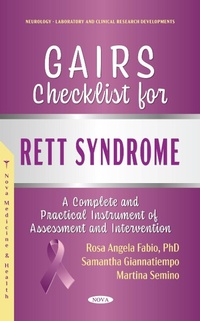
GAIRS Checklist For Rett Syndrome: A Complete and Practical Instrument of Assessment and Intervention
Published on 15. November 2021
267 pages
978-1-68507-414-2 (ISBN)
Description

The purpose of the book is to present the GAIRS (Global Assessment and Intervention in Rett Syndrome) Checklist, an easy-to-use, short and accessible tool for every health-care professional in order to assess all the abilities of Rett girls but also to identify patients needing next-step evaluation and treatment. Thanks to the hierarchical order of all the targets assessed in each area of the GAIRS, this checklist can be a useful instrument not only for assessment but also for intervention.
More details
Other editions
Additional editions
Rosa Angela Fabio
GAIRS Checklist For Rett Syndrome
A Complete and Practical Instrument of Assessment and Intervention
Book
12/2021
Nova Science Publishers Inc
€256.99
Shipment within 15-20 days
Content
- Intro
- Contents
- Chapter 1
- Characteristics and Challenges in the Evaluation of Patients with Rett Syndrome
- 1.1. Rett Syndrome
- 1.1.1. Stages of Development in RTT
- 1.2. They Know More Than They Are Able to Express - Methodological Issues in the Assessment of Patients with Rett Syndrome
- 1.3. The Role of Context
- 1.4. Assessment Scales in Rett Syndrome
- Conclusion
- Chapter 2
- A New Scale for the Global Assessment of Rett Syndrome: GAIRS
- 2.1. Task Analysis to Assess Behavioral, Cognitive, and Emotional Abilities
- 2.2. Task Analysis to Assess Behavioral, Cognitive, and Emotional Abilities in Rett Syndrome
- Chapter 3
- Description of Assessment Procedure with GAIRS
- 3.1. Basic Behaviors - Prerequisites: Assessment
- 3.1.1. Assessment of Spontaneous Eye Contact
- 3.1.2. Assessment of Eye Contact on Request
- 3.1.3. Assessment of the Ability to Look at Objects
- 3.1.4. Assessment of Tracking Objects and Faces
- 3.1.5. Assessment of Functional Gestures
- 3.1.6. Assessing Cooperation with Simple Spoken Request
- 3.1.7. Assessing the Ability to Sit Long Enough to Complete a Task
- 3.1.8. Assessment of Object Permanence
- 3.1.9. Assessing of the Ability to Wait for Their Turn before Starting an Activity
- 3.1.10. Assessing of the Ability to Communicate Basic Needs
- 3.2. Neuropsychological Area
- 3.2.1. Assessment of Selective Attention
- 3.2.2. Assessment of Types and Intensity of Stereotypes
- 3.2.3. Assessment of Lateralization
- 3.2.4. Assessment of Temporal Orientation
- 3.2.5. Assessment of Spatial Orientation
- 3.2.6. Assessment of Memory Span
- 3.2.7. Assessment of Logical Sequences
- 3.2.8. Assessment of Categorization
- 3.3. Basic Cognitive Concepts: Assessment
- 3.3.1. Assessment Basic Cognitive Concepts
- 3.3.2. Assessment of Color Discrimination
- 3.3.3. Assessment of Geometric Forms
- 3.3.4. Assessment of Measure Concepts
- 3.3.5. Assessment of Spatial Concepts
- 3.3.6. Assessment of Human body Discrimination
- 3.3.7. Assessment of time Concepts on Images
- 3.3.8. Assessment Cause-Effect Relationship
- 3.4. Advanced Cognitive Concepts
- 3.4.1. Assessment of Global Words Recognition
- 3.4.2. Assessment of Syllable Recognition
- 3.4.3 Assessment of Recompleting Words Through Syllables
- 3.4.4. Assessment of Alphabetic Symbols Recognition
- 3.4.5. Assessment of Recompleting Words with Alphabetic Symbols
- 3.4.6. Assessment of Recognition of Words Representing Actions
- 3.4.7. Assessment of the Ability of Using Words to Communicate
- 3.4.8. Assessment of Math Pre-Requisite Concepts
- 3.4.9. Assessment of Number Recognition
- 3.4.10. Assessment of Biunivocal Relationship between Number and Quantity
- 3.5. Communication
- 3.5.1. Assessment of the Ability to Express a Basic Need at a Physiological Level
- 3.5.2. Assessment of the Ability to Recognize and Express a Basic need Through Pictures
- 3.5.3. Assessment of the Ability to Understand the Biunivocal Relationship between the Physiological Level of the Need and the Picture That Represents It
- 3.5.4. Assessment of the Ability to Recognize and Express a Basic Need Through Words
- 3.5.5. Assessment of the Ability to Understanding the Biunivocal Relationship of a Basic Need between a Picture and the Word That Expresses It
- 3.6. Emotional Area
- 3.6.1. Assessment of the Ability to Identify Emotions
- 3.6.2. Assessment of the Ability to Express Emotions
- 3.7. Handwriting Motricity Area
- 3.7.1. Assessment of Musculoskeletal Alterations
- 3.7.2. Assessment of Eye Coordination during Motor Tasks
- 3.7.3. Assessment of Lateralization
- 3.7.4. Assessment of Reaching Movement
- 3.7.5. Assessment of Touching Ability
- 3.7.6. Assessment of Grasping Ability
- 3.7.7. Assessment of Releasing Ability
- 3.7.8. Assessment of Repositioning Movement
- 3.7.9. Assessment of Bimanual Coordination
- 3.7.10. Assessment of Ability to Push and Pull an Object
- 3.8. Handwriting Motricity Area
- 3.8.1. Assessment of Grasping of Pencil
- 3.8.2. Assessment of Drawing Patterns
- 3.8.3. Assessment of Use of School Tools
- 3.9. Gross Motor Area
- 3.9.1. Assessment of Standing Ability
- 3.9.2. Assessment of Sitting Ability
- 3.9.3. Assessment of Parachute Reactions
- 3.9.4. Assessment of the Ability to Roll from Supine Position to One Side
- 3.9.5. Assessment of Rolling Supine - Prone Movement
- 3.9.6. Assessment of the Ability to Move from Supine to Sitting on the Floor
- 3.9.7. Assessment of the Ability to Move from Sitting on the Floor to Standing
- 3.9.8. Assessment of the Ability to Move from Sitting on a Chair to Standing
- 3.9.9. Assessment of the Ability to Move from Standing Position to Sitting on the Floor
- 3.9.10. Assessment of the Ability to Move from Standing Position to Sitting on a Chair
- 3.9.11. Assessment of Walking Ability
- 3.9.12. Assessment of Body Spatial Orientation in Standing
- 3.9.13. Assessment of Stepping Ability
- 3.9.14. Assessment of Running Ability
- 3.9.15. Assessment of Climbing Upstairs Ability
- 3.9.16. Assessment of Descending Stairs Ability
- 3.9.17. Assessment for Jumping Ability
- 3.9.18. Training for Picking up an Object from the Ground (Small Ball)
- 3.9.19. Assessment of the Ability to Play with a Ball
- 3.9.20. Assessment of the Ability to Walk on a Slope
- 3.10. Autonomy Area
- 3.10.1. Assessment of Eating
- 3.10.2. Assessment of Drinking
- 3.10.2.1. Assessment of Cough Episodes or Breathing Difficulties during the Meals
- 3.10.2.2. Assessment of Types of Food Consistencies Usually Eaten
- 3.10.2.3. Assessment of Washing
- 3.10.2.4. Assessment of Toilet Personal Autonomy
- 3.10.2.5. Assessment of Dressing
- 3.10.3. Playing Area
- 3.10.4. Socialization Area
- 3.10.5. Advanced Autonomy Area
- Chapter 4
- GAIRS Training
- 4.1. Introduction
- 4.2. The Psychological Bases of Cognitive Empowerment
- 4.3. Biological Bases of Cognitive Empowerment
- 4.4. Operational Principles of Cognitive Empowerment
- 4.4.1. When to Modify
- 4.4.2. Where to Modify
- 4.4.3. Who Can Modify?
- 4.4.4. Basic Methods of Cognitive Empowerment
- 4.4.5. Unconditional Acceptance
- 4.4.6. Rules
- 4.4.7. Reinforcement
- 4.4.8. Containment
- 4.4.9. Shaping
- 4.4.10. Fading
- 4.4.11. Prompting
- 4.4.12. Hierarchy
- 4.4.13. Automatism
- 4.4.14. Abstraction
- 4.4.15. Economy
- 4.5. Description of Training Procedure with GAIRS
- 4.5.1. Basic Behaviours - Prerequisites: Intervention
- 4.5.1.1. Training of Spontaneous Eye Contact
- 4.5.1.2. Training of Eye Contact on Request
- 4.5.1.3. Training of the Ability to Look at Objects
- 4.5.1.4. Training of Tracking Objects and Faces
- 4.5.1.5. Training of Functional Gestures
- 4.5.1.6. Training of Cooperation with Simple Requests
- 4.5.1.7. Training of Sitting Long Enough to Complete a Task
- 4.5.1.8. Training of Object Permanence
- 4.5.1.9. Training of the Ability to Wait for Their Turn before Starting an Activity
- 4.5.1.10. Training of the Ability to Communicate Basic Needs
- 4.5.2. Neuropsychological Area
- 4.5.2.1. Training of Selective Attention
- 4.5.2.2. Training of Intensity and Type of Stereotypies
- 4.5.2.3. Training of Lateralization
- 4.5.2.4. Training of Temporal Orientation
- 4.5.2.5. Training of Spatial Concepts
- 4.5.2.6. Training of Memory Span
- 4.5.2.7. Training of Logical Sequences
- 4.5.2.8. Training of Categorization
- 4.5.3. Basic Cognitive Concepts
- 4.5.3.1. Training of Object Recognition
- 4.5.3.2. Training of Color Discrimination
- 4.5.3.3. Training of Geometric Form Discrimination
- 4.5.3.4. Training of Measure Concept Discrimination
- 4.5.3.5. Training of Spatial Concept Discrimination
- 4.5.3.6. Training of Human Body Discrimination
- 4.5.3.7. Training of Time Concept
- 4.5.3.8. Training of Cause-Effect Relationship
- 4.5.4. Advanced Cognitive Concepts
- 4.5.4.1. Training of Global Word Recognition
- 4.5.4.2. Training of Syllable Recognition
- 4.5.4.3. Training of Recompleting Words Through Syllables
- 4.5.4.4. Training of Alphabetic Symbol Recognition
- 4.5.4.5. Recompleting Words with Alphabetic Symbols
- 4.5.4.6. Training of Words Representing Actions
- 4.5.4.7. Training of the Ability of Using Word to Communicate
- 4.5.4.8. Training of Math Prerequisite Concepts
- 4.5.4.9. Training of Recognition of Numbers
- 4.5.4.10. Training of Biunivocal Relationship between Number and Quantity
- 4.5.5. Communication
- 4.5.5.1. Training of Expressing a Basic Need at a Physiological Level
- 4.5.5.2. Training of the Ability to Recognize and Express Basic Needs Through Pictures
- 4.5.5.3. Training of the Ability to Understand the Biunivocal Relationship between the Physiological Level of the Need and the Picture that Represents It
- 4.5.5.4. Training of the Ability to Recognize and Express a Basic Need Through Words
- 4.5.5.5. Training of the Ability to Understand the Biunivocal Relationship of a Basic Need between a Picture and the Word that Expresses It
- 4.5.6. Emotional Area
- 4.5.6.1. Training to Identify Emotions
- 4.5.6.2. Training to Express Emotion
- 4.5.7. Handwriting Motricity Area
- 4.5.7.1. Training of Musculoskeletal Alterations
- 4.5.7.2. Training in Hand-Eye Coordination during Motor Tasks
- 4.5.7.3. Training in Lateralization
- 4.5.7.4. Training in Reaching Movements
- 4.5.7.5. Training of Touching Ability
- 4.5.7.6. Training of Grasping Ability
- 4.5.7.7. Training of Releasing Ability
- 4.5.7.8. Training of Repositioning Movement
- 4.5.7.9. Training Bimanual Coordination
- 4.5.7.10. Training of Ability to Push and Pull an Object
- 4.5.8. Handwriting Motricity Area
- 4.5.8.1. Training to Grasp a Pencil
- 4.5.8.2. Training to Draw patterns
- 4.5.8.3. Training in the Use of School Tools
- 4.5.9. Gross Motor Area
- 4.5.9.1. Training in Standing Ability
- 4.5.9.2. Training of Sitting Ability
- 4.5.9.3. Training of Parachute Reactions
- 4.5.9.4. Training in the Ability to Move Rolling from Supine Position to one Side
- 4.5.9.5. Training in Rolling Supine - Prone Movement
- 4.5.9.6. Training in the Ability to Move from Supine to Sitting on the Floor
- 4.5.9.7. Training in the Ability to Move from Sitting on the Floor to Standing
- 4.5.9.8. Training on the Ability to Move from Sitting on a Chair to Standing
- 4.5.9.9. Training in the Ability to Move from Standing Position to Sitting on the Floor
- 4.5.9.10. Training in the Ability to Move from Standing Position to Sitting on a Chair
- 4.5.9.11. Training in Walking Ability
- 4.5.9.12. Training in Body Spatial Orientation in Standing
- 4.5.9.13. Training in Stepping Ability
- 4.5.9.14. Training in Running Ability
- 4.5.9.15. Training in Climbing Upstairs Ability
- 4.5.9.16. Training in Descending Stairs Ability
- 4.5.9.17. Training in Jumping Ability
- 4.5.9.18. Training in Picking up an Object from the Ground (Small Ball)
- 4.5.9.19. Training in the Ability to Play with a Ball
- 4.5.9.20. Training in the Ability to Walk on a Slope
- 4.5.10. Autonomy Area
- 4.5.10.1.
- 4.5.10.1.1. Eating
- 4.5.10.1.2. Drinking
- 4.5.10.1.3. Washing
- 4.5.10.1.4. Personal Toilet Autonomy
- 4.5.10.1.5. Dressing
- 4.5.10.2. Playing Area
- 4.5.10.3. Socialization Area
- 4.5.10.4. Advanced Autonomy Area
- Chapter 5
- Examples and Applications of the GAIRS Scale
- Conclusion
- References
- Appendix: GAIRS Scale and Scoring
- Global Assessment and Intervention in Rett Syndrome (GAIRS) Checklist
- GAIRS Areas
- Basic Behaviours - Prerequisites
- Neuropsychological Area
- Basic Cognitive Concepts
- Advanced Cognitive Area
- Communication
- Emotional Area
- Motor Area
- Handwriting Motricity Area
- Gross Motor Area
- Autonomy Area
- Scoring
- About the Authors
- Index
- Blank Page
