

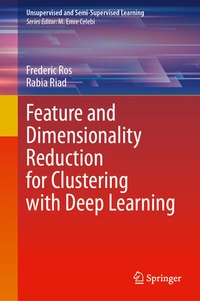
Feature and Dimensionality Reduction for Clustering with Deep Learning
Description

This book presents an overview of recent methods of feature selection and dimensionality reduction that are based on Deep Neural Networks (DNNs) for a clustering perspective, with particular attention to the knowledge discovery question. The authors first present a synthesis of the major recent influencing techniques and "tricks" participating in recent advances in deep clustering, as well as a recall of the main deep learning architectures. Secondly, the book highlights the most popular works by "family" to provide a more suitable starting point from which to develop a full understanding of the domain. Overall, the book proposes a comprehensive up-to-date review of deep feature selection and deep clustering methods with particular attention to the knowledge discovery question and under a multi-criteria analysis. The book can be very helpful for young researchers, non-experts, and R&D AI engineers.
More details
Other editions
Additional editions
Persons
Frederic Ros has an engineering degree in Microelectronics and Automation, a master's in Robotics from Montpellier University, and a Ph.D. from ENGREF (Ecole Nationale du Genie Rural des Eaux et Forets, now AgroParistech), Paris. He began his career in 1991 as a research scientist working on the field of image analysis for robotics and artificial systems from IRSTEA (now INRAE). He managed the vision activity in GEMALTO (now THALES) for 14 years which is the world leader in the smart card industry. He was particularly involved in applied developments (related to machine vision, AI, data analysis, fuzzy logic, and supervised classification algorithms) with the aim of providing adaptive and self-tuning systems corresponding to the growing complexity of industrial processes and especially multidisciplinary interactions. Professor at Orleans University, he has been an associate researcher at PRISME laboratory (signal and image processing) for 15 years, focusing his research on machine learning algorithms in the big data context. In parallel, he has headed an innovation park for 12 years and recently designed and structured a digital start-up incubator.
Rabia Riad received the Habilitation degree (HDR) in 2022, from the Ibn Zohr University - Morocco, and the Ph.D. degree in Computer Science from the University of Orleans - France, in 2015. He was a Postdoctoral Fellow at the University of Orleans between 2016 and 2018. Since 2018, he has been with Ibn Zohr University as an Assistant Professor, where he is currently an Associate Professor, since 2022. His research interests include computer vision, artificial intelligence, data analysis, and supervised and unsupervised classification algorithms.
Content
Introduction.- Representation Learning in high dimension.- Review of Feature selection and clustering approaches.- Towards deep learning.- Deep learning architectures for feature extraction and selection.- Unsupervised Deep Feature selection techniques.- Deep Clustering Techniques.- Issues and Challenges.- Conclusion.
