

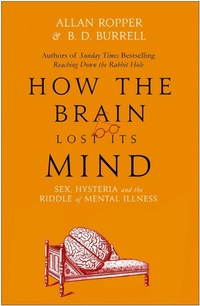
How The Brain Lost Its Mind
Sex, Hysteria and the Riddle of Mental Illness
Published on 2. January 2020
256 pages
978-1-78649-182-4 (ISBN)
Description

'Hugely entertaining' Guardian
'Fascinating' Mail on Sunday
In 1882, Jean-Martin Charcot was the premiere physician in Paris, having just established a neurology clinic at the infamous Salpetriere Hospital, a place that was called a 'grand asylum of human misery'. Assessing the dismal conditions, he quickly upgraded the facilities, and in doing so, revolutionized the treatment of mental illness.
Many of Charcot's patients had neurosyphilis (the advanced form of syphilis), a disease of mad poets, novelists, painters, and musicians, and a driving force behind the overflow of patients in Europe's asylums. A sexually transmitted disease, it is known as 'the great imitator' since its symptoms resemble those of almost any biological disease or mental illness. It is also the perfect lens through which to peel back the layers to better understand the brain and the mind. Yet, Charcot's work took a bizarre turn when he brought mesmerism - hypnotism - into his clinic, abandoning his pursuit of the biological basis of illness in favour of the far sexier and theatrical treatment of female 'hysterics', whose symptoms mimic those seen in brain disease, but were elusive in origin. This and a general fear of contagion set the stage for Sigmund Freud, whose seductive theory, Freudian analysis, brought sex and hysteria onto the psychiatrist couch, leaving the brain behind.
How The Brain Lost Its Mind tells this rich and compelling story, and raises a host of philosophical and practical questions. Are we any closer to understanding the difference between a sick mind and a sick brain? The real issue remains: where should neurology and psychiatry converge to explore not just the brain, but the nature of the human psyche?
'Fascinating' Mail on Sunday
In 1882, Jean-Martin Charcot was the premiere physician in Paris, having just established a neurology clinic at the infamous Salpetriere Hospital, a place that was called a 'grand asylum of human misery'. Assessing the dismal conditions, he quickly upgraded the facilities, and in doing so, revolutionized the treatment of mental illness.
Many of Charcot's patients had neurosyphilis (the advanced form of syphilis), a disease of mad poets, novelists, painters, and musicians, and a driving force behind the overflow of patients in Europe's asylums. A sexually transmitted disease, it is known as 'the great imitator' since its symptoms resemble those of almost any biological disease or mental illness. It is also the perfect lens through which to peel back the layers to better understand the brain and the mind. Yet, Charcot's work took a bizarre turn when he brought mesmerism - hypnotism - into his clinic, abandoning his pursuit of the biological basis of illness in favour of the far sexier and theatrical treatment of female 'hysterics', whose symptoms mimic those seen in brain disease, but were elusive in origin. This and a general fear of contagion set the stage for Sigmund Freud, whose seductive theory, Freudian analysis, brought sex and hysteria onto the psychiatrist couch, leaving the brain behind.
How The Brain Lost Its Mind tells this rich and compelling story, and raises a host of philosophical and practical questions. Are we any closer to understanding the difference between a sick mind and a sick brain? The real issue remains: where should neurology and psychiatry converge to explore not just the brain, but the nature of the human psyche?
Reviews / Votes
Absorbing and scholarly... A twin biography of psychiatry and neurology, their study charts this uneasy relationship from marriage to divorce to reconciliation even as fundamental questions about the nature of mental illness remain... Hugely entertaining. * Guardian * A rollicking ride, patient by patient, through the history of two conditions, hysteria and neurosyphilis. * The Times * Central to this book is the ongoing dispute regarding which mental illnesses can be attributed to physical abnormalities within the brain and which originate in the mind, or consciousness. The authors emphasise that in many cases we still cannot be sure... Along the way, their investigations exhume some unforgettable scenes and characters... Fascinating * Mail on Sunday * Rich, compassionate and passionate... Sceptical of the excesses of both psychological and biological reductionism, it is a refreshing call for an intellectual reset and disciplinary rapprochement. -- Anne Harrington * Nature * This aptly titled book picks up where Oliver Sacks left off in examining the behavioral characteristics of neurobehavioral syndromes in an effort to span the gap that has historically separated the twin disciplines of the brain, neurology and psychiatry. * Jeffrey A. Lieberman, author of Shrinks: The Untold Story of Psychiatry * Through tales of eminent physicians and their suffering patients, replete with sex, drugs, and magnetically-induced hypnotism, we learn how a bacterium that deprived countless souls of their reason also helped scientists discover a role for brain biology in mental illness. * Alan Jasanoff, PhD, author of The Biological Mind * Ropper and Burrell have written an insightful, fantastically readable analysis of what was once called "hysteria." Also, by studying how things can go wrong, we learn a great deal about the working of the human mind when things go right. * Elizabeth Loftus, author of Eyewitness Testimony *More details
Edition
Main
Language
English
Place of publication
London
United Kingdom
Target group
College/higher education
Professional and scholarly
File size
2,60 MB
ISBN-13
978-1-78649-182-4 (9781786491824)
Copyright in bibliographic data and cover images is held by Nielsen Book Services Limited or by the publishers or by their respective licensors: all rights reserved.
Schweitzer Classification
Other editions
Additional editions
Book
01/2021
Atlantic Books
€33.61
Shipment within 3-4 weeks
Book
01/2020
Atlantic Books
€42.27
Article exhausted; check different version
Person
Dr Allan H. Ropper is Professor of Neurology at Harvard Medical School and Raymond D. Adams Master Clinician of the Department of Neurology at Brigham and Women's Hospital. He is also a deputy editor of the New England Journal of Medicine and a fellow of the American Academy of Neurology, Royal College of Physicians, and the American College of Physicians. Dr Ropper is an author of the most widely consulted textbook of neurology, Principles of Neurology, currently in its eleventh edition, and co-author with B.D. Burrell of Reaching Down the Rabbit Hole.
B.D. Burrell is a member of the mathematics faculty at the University of Massachusetts Amherst. A teacher and writer, he is the author is several books, including Postcards from the Brain Museum, The Words We Live By, and, jointly with Dr Allan H. Ropper, Reaching Down the Rabbit Hole.
B.D. Burrell is a member of the mathematics faculty at the University of Massachusetts Amherst. A teacher and writer, he is the author is several books, including Postcards from the Brain Museum, The Words We Live By, and, jointly with Dr Allan H. Ropper, Reaching Down the Rabbit Hole.
Content
0: INTRODUCTION 1: A CLINICAL LESSON 2: WHAT IS A DISEASE? 3: PYGMALION AND GALATEA 4: THE INVENTION OF HYSTERIA 5: THE PAPUAN IDOL 6: HEARTS OF DARKNESS 7: THE SOUL OF A NEW DISEASE 8: THE UNSETTLED TERRITORIES OF THE MIND 9: THE DIFFICULT CASE OF ANNA O. 10: THE DEVIL AND ADRIAN LEVERKUEHN 11: SEX AND THE NEW WOMAN 12: WINNING THE BATTLE AND LOSING THE WAR 13: THE PSYCHIC INTERPRETATION OF DISEASE 14: A BEAUTIFUL NAME FOR A HORRIBLE DISEASE 15: MEDICINAL LOBOTOMY: THE INVENTION OF THORAZINE 16: THE FEVERED DREAM OF A SCIENTIFIC PSYCHOLOGY 17: THE LESSONS OF NEUROSYPHILIS
