

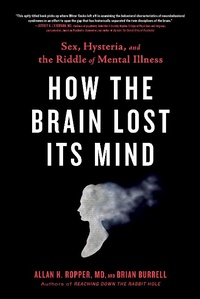
How the Brain Lost Its Mind
Sex, Hysteria, and the Riddle of Mental Illness
Published on 20. August 2019
256 pages
978-0-7352-1457-6 (ISBN)
Description

A noted neurologist challenges the widespread misunderstanding of brain disease and mental illness.
How the Brain Lost Its Mind tells the rich and compelling story of two confounding ailments, syphilis and hysteria, and the extraordinary efforts to confront their effects on mental life. How does the mind work? Where does madness lie, in the brain or in the mind? How should it be treated?
Throughout the nineteenth century, syphilis--a disease of mad poets, musicians, and artists--swept through the highest and lowest rungs of European society like a plague. Known as "the Great Imitator," it could produce almost any form of mental or physical illness, and it would bring down a host of famous and infamous characters--among them Guy de Maupassant, Vincent van Gogh, the Marquis de Sade, Friedrich Nietzsche, and Al Capone. It was the first truly psychiatric disease and it filled asylums to overflowing. At the same time, an outbreak of bizarre behaviors resembling epilepsy, but with no identifiable source in the body, strained the diagnostic skills of the great neurologists. It was referred to as hysteria.
For more than a century, neurosyphilis stood out as the archetype of a brain-based mental illness, fully understood but largely forgotten, and today far from gone. Hysteria, under many different names, remains unexplained and epidemic. These two conditions stand at opposite poles of the current debate over the role of the brain in mental illness. Hysteria led Freud to insert sex into psychology. Neurosyphilis led to the proliferation of mental institutions. The problem of managing the inmates led to the abuse of lobotomy and electroshock therapy, and ultimately the overuse of psychotropic drugs.
Today we know that syphilitic madness was a destructive disease of the brain while hysteria and, more broadly, many varieties of mental illness reside solely in the mind. Or do they? Afflictions once written off as "hysterical" continue to elude explanation. Addiction, alcoholism, autism, ADHD, Tourette syndrome, depression, and sociopathy, though regarded as brain-based, have not been proven to be so.
In these pages, the authors raise a host of philosophical and practical questions. What is the difference between a sick mind and a sick brain? If we understood everything about the brain, would we understand ourselves? By delving into an overlooked history, this book shows how neuroscience and brain scans alone cannot account for a robust mental life, or a deeply disturbed one.
How the Brain Lost Its Mind tells the rich and compelling story of two confounding ailments, syphilis and hysteria, and the extraordinary efforts to confront their effects on mental life. How does the mind work? Where does madness lie, in the brain or in the mind? How should it be treated?
Throughout the nineteenth century, syphilis--a disease of mad poets, musicians, and artists--swept through the highest and lowest rungs of European society like a plague. Known as "the Great Imitator," it could produce almost any form of mental or physical illness, and it would bring down a host of famous and infamous characters--among them Guy de Maupassant, Vincent van Gogh, the Marquis de Sade, Friedrich Nietzsche, and Al Capone. It was the first truly psychiatric disease and it filled asylums to overflowing. At the same time, an outbreak of bizarre behaviors resembling epilepsy, but with no identifiable source in the body, strained the diagnostic skills of the great neurologists. It was referred to as hysteria.
For more than a century, neurosyphilis stood out as the archetype of a brain-based mental illness, fully understood but largely forgotten, and today far from gone. Hysteria, under many different names, remains unexplained and epidemic. These two conditions stand at opposite poles of the current debate over the role of the brain in mental illness. Hysteria led Freud to insert sex into psychology. Neurosyphilis led to the proliferation of mental institutions. The problem of managing the inmates led to the abuse of lobotomy and electroshock therapy, and ultimately the overuse of psychotropic drugs.
Today we know that syphilitic madness was a destructive disease of the brain while hysteria and, more broadly, many varieties of mental illness reside solely in the mind. Or do they? Afflictions once written off as "hysterical" continue to elude explanation. Addiction, alcoholism, autism, ADHD, Tourette syndrome, depression, and sociopathy, though regarded as brain-based, have not been proven to be so.
In these pages, the authors raise a host of philosophical and practical questions. What is the difference between a sick mind and a sick brain? If we understood everything about the brain, would we understand ourselves? By delving into an overlooked history, this book shows how neuroscience and brain scans alone cannot account for a robust mental life, or a deeply disturbed one.
More details
Other editions
Additional editions
Allan H. Ropper | Brian Burrell
How the Brain Lost Its Mind
Sex, Hysteria, and the Riddle of Mental Illness
Book
07/2021
Avery Publishing Group Inc.,U.S.
€17.50
Shipment within 15-20 days
Allan H. Ropper | Brian Burrell
How the Brain Lost Its Mind
Sex, Hysteria, and the Riddle of Mental Illness
Book
08/2019
Avery Publishing Group
€25.02
Article exhausted; check different version
Persons
Allan H. Ropper, M.D., is Professor of Neurology at Harvard Medical School and Raymond D. Adams Master Clinician of the Department of Neurology at Brigham and Women's Hospital. He is also a deputy editor of the New England Journal of Medicine and a fellow of the American Academy of Neurology, Royal College of Physicians, and the American College of Physicians. Dr. Ropper is an author of the most widely consulted textbook of neurology, Principles of Neurology, currently in its eleventh edition, and co-author with Brian David Burrell of Reaching Down the Rabbit Hole.
Brian David Burrell is a member of the mathematics faculty at the University of Massachusetts Amherst. A teacher and writer, he is the author is several books, including Postcards from the Brain Museum, The Words We Live By, and, jointly with Dr. Allan H. Ropper, Reaching Down the Rabbit Hole. He is an authority on brain collections worldwide, and has discussed his work on NBC's Today Show, C-SPAN's Booknotes, and NPR's Morning Edition.
Brian David Burrell is a member of the mathematics faculty at the University of Massachusetts Amherst. A teacher and writer, he is the author is several books, including Postcards from the Brain Museum, The Words We Live By, and, jointly with Dr. Allan H. Ropper, Reaching Down the Rabbit Hole. He is an authority on brain collections worldwide, and has discussed his work on NBC's Today Show, C-SPAN's Booknotes, and NPR's Morning Edition.
