

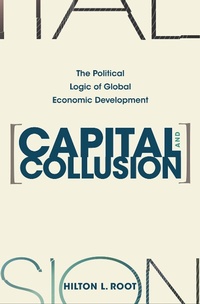
Capital and Collusion
Description

Why does capital formation often fail to occur in developing countries? Capital and Collusion explores the political incentives that either foster growth or steal nations' growth prospects.
Hilton Root examines the frontier between risk and uncertainty, analyzing the forces driving development in both developed and undeveloped regions. In the former, he argues, institutions reduce everyday economic risks to levels low enough to make people receptive to opportunities for profit, stimulating developments in technology and science. Not so in developing countries. There, institutions that specialize in sharing risk are scarce. Money hides under mattresses and in teapots, creating a gap between a poor nation's savings and its investment. As a consequence, the developing world faces a growing disconnect between the value of its resources and the availability of finance.
What are the remedies for eliminating this disparity? Root shows us how to close the growing wealth gap among nations by building institutions that convert uncertainty into risk. Comparing China to India, Latin America to East Asia, and contemporary to historical cases, he offers lessons that can help the World Bank and the International Monetary Fund to tackle the political incentives that are the source of poor governance in developing nations.
More details
Other editions
Additional editions
Person
Content
PART I: Analytical Perspectives 1
CHAPTER ONE: Risk, Uncertainty, and Social Progress 3
CHAPTER TWO: Social Foundations of Policy Credibility 17
CHAPTER THREE: Politics and Economic Structure: The Economic Logic of Autocracy 35
CHAPTER FOUR: An Amazing Economy of Information: The Financial System 48
PART II: Regional and National Complexity 57
CHAPTER FIVE: Closing the Social Productivity Gap in East Asia 59
CHAPTER SIX: The Price of Exclusion: Latin America's Explosive Debt 89
CHAPTER SEVEN: Why Not India?New Century, New Country 114
CHAPTER EIGHT: Pakistan on the Edge 157
CHAPTER NINE: China's Capitalist Dream: Between Hierarchy and Market 187
PART III: Conclusion 219
CHAPTER TEN: Mobilizing the State as Public Risk Manager 221
CONCLUSION: Uncertainty, Competition, and Collusion in Early Capital
Accumulation 246
Acknowledgments 249
Appendix 1 Data Sources 251
Appendix 2 Variables 252
Notes 253
References 307
Index 327
