

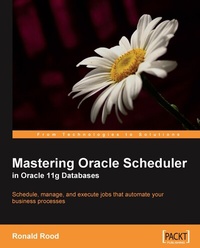
Mastering Oracle Scheduler in Oracle 11g Databases
Schedule, manage, and execute jobs in Oracle 11g Databases that automate your business processes using Oracle Scheduler with this book and eBook
Published on 13. January 2025
240 pages
978-1-84719-599-9 (ISBN)
Description

Schedule, manage, and execute jobs that automate your business processes
Key Features
Automate jobs from within the Oracle database with the built-in Scheduler
Boost database performance by managing, monitoring, and controlling jobs more effectively
Contains easy-to-understand explanations, simple examples, debugging tips, and real-life scenarios
Book DescriptionScheduler (DBMS_SCHEDULER) is included in Oracle Database and is a tool for the automation, management, and control of jobs. It enables users to schedule jobs running inside the database such as PL/SQL procedures or PL/SQL blocks, as well as jobs running outside the database like shell scripts. Scheduler ensures that jobs are run on time, automates business processes, and optimizes the use of available resources. You just need to specify a fixed date and time and Scheduler will do the rest. What if you don't know the precise time to execute your job? Nothing to worry about, you can specify an event upon which you want your job to be done and Scheduler will execute your job at the appropriate time. Although scheduling sounds quite easy, it requires programming skills and knowledge to set up such a powerful, intelligent scheduler for your project. This book is your practical guide to DBMS_SCHEDULER for setting up platform-independent schedules that automate the execution of time-based or event-based job processes. It will show you how to automate business processes, and help you manage and monitor those jobs efficiently and effectively. It explains how Scheduler can be used to achieve the tasks you need to make happen in the real world. With a little understanding of how the Scheduler can be used and what kind of control it gives, you will be able to recognize the real power that many known enterprise-class schedulers n with serious price tags n cannot compete with. You will see how running a specific program can be made dependent on the successful running of certain other programs, and how to separate various tasks using the built-in security mechanisms. You will learn to manage resources to balance the load on your system, and gain increased database performance.What you will learn
Create simple as well as complex jobs and schedule their execution according to your specific needs
Manage jobs independently of any particular platform so that they can be moved from one system to another easily
Create chains to link related programs, based on contingent outcomes
Flag the Scheduler to raise events when unexpected events occur
Manage logs to find out when jobs ran and analyze the runtime behavior based on recorded execution times
Combine your resource manager and Scheduler to get maximum throughput for managing thousands of jobs at a time
Run jobs on machines that do not have a running database using the remote job agent
Learn to debug jobs and make sure jobs run as expected
Who this book is forThis book is intended for Administrators and Developers who currently use tools like cron, DBMS_JOB, and the task manager, but who now want more control or who have a need to scale up to tools that can handle the network. Complex tasks can be built that easily control business process and enable the completion of important tasks in limited time. The reader is expected to have some experience of Oracle Database Management, and a working knowledge of SQL and PL/SQL.
Key Features
Automate jobs from within the Oracle database with the built-in Scheduler
Boost database performance by managing, monitoring, and controlling jobs more effectively
Contains easy-to-understand explanations, simple examples, debugging tips, and real-life scenarios
Book DescriptionScheduler (DBMS_SCHEDULER) is included in Oracle Database and is a tool for the automation, management, and control of jobs. It enables users to schedule jobs running inside the database such as PL/SQL procedures or PL/SQL blocks, as well as jobs running outside the database like shell scripts. Scheduler ensures that jobs are run on time, automates business processes, and optimizes the use of available resources. You just need to specify a fixed date and time and Scheduler will do the rest. What if you don't know the precise time to execute your job? Nothing to worry about, you can specify an event upon which you want your job to be done and Scheduler will execute your job at the appropriate time. Although scheduling sounds quite easy, it requires programming skills and knowledge to set up such a powerful, intelligent scheduler for your project. This book is your practical guide to DBMS_SCHEDULER for setting up platform-independent schedules that automate the execution of time-based or event-based job processes. It will show you how to automate business processes, and help you manage and monitor those jobs efficiently and effectively. It explains how Scheduler can be used to achieve the tasks you need to make happen in the real world. With a little understanding of how the Scheduler can be used and what kind of control it gives, you will be able to recognize the real power that many known enterprise-class schedulers n with serious price tags n cannot compete with. You will see how running a specific program can be made dependent on the successful running of certain other programs, and how to separate various tasks using the built-in security mechanisms. You will learn to manage resources to balance the load on your system, and gain increased database performance.What you will learn
Create simple as well as complex jobs and schedule their execution according to your specific needs
Manage jobs independently of any particular platform so that they can be moved from one system to another easily
Create chains to link related programs, based on contingent outcomes
Flag the Scheduler to raise events when unexpected events occur
Manage logs to find out when jobs ran and analyze the runtime behavior based on recorded execution times
Combine your resource manager and Scheduler to get maximum throughput for managing thousands of jobs at a time
Run jobs on machines that do not have a running database using the remote job agent
Learn to debug jobs and make sure jobs run as expected
Who this book is forThis book is intended for Administrators and Developers who currently use tools like cron, DBMS_JOB, and the task manager, but who now want more control or who have a need to scale up to tools that can handle the network. Complex tasks can be built that easily control business process and enable the completion of important tasks in limited time. The reader is expected to have some experience of Oracle Database Management, and a working knowledge of SQL and PL/SQL.
All prices
More details
Edition
Digital original
Language
English
Place of publication
Birmingham
United Kingdom
Edition type
Digital original
File size
3,62 MB
ISBN-13
978-1-84719-599-9 (9781847195999)
Copyright in bibliographic data and cover images is held by Nielsen Book Services Limited or by the publishers or by their respective licensors: all rights reserved.
Schweitzer Classification
Other editions
Additional editions
Book
06/2009
Packt Publishing
€50.60
Shipment within 3-4 weeks
Person
Rood Ronald :
Ronald Rood has been an IT professional for over 20 years. His roots are in the Bull gcos8 mainframes where he played with assembly language until Oracle and UNIX came across his path. He eagerly joined the Oracle community and became a skilled innovating DBA and trouble shooter. Ronald's real power is in the combination of the rich UNIX world and Oracle. There is no such thing as a problem that can not be solved; it just might take a little time. Next to C, PRO*C, lots of scripting languages and - of course - PL/SQL, he also speaks Dutch, English, German, and some French. In his private time that he shares with his family with two children he likes to take an occasional dive (from the sky), fly radio controlled models, ride recumbent, and work as a volunteer for a local Water Scouts group. Currently Ronald is one of the Ciber oracle consultants in The Netherlands and cooperates in many projects for many large companies. Before writing this book Ronald wrote oracle related articles for the Dutch oracle user group magazine. On his blog you can find some short articles about various items, mostly oracle related. Ronald Rood has been interviewed by Oracle about Oracle Scheduler. Listen to it here here.
Ronald Rood has been an IT professional for over 20 years. His roots are in the Bull gcos8 mainframes where he played with assembly language until Oracle and UNIX came across his path. He eagerly joined the Oracle community and became a skilled innovating DBA and trouble shooter. Ronald's real power is in the combination of the rich UNIX world and Oracle. There is no such thing as a problem that can not be solved; it just might take a little time. Next to C, PRO*C, lots of scripting languages and - of course - PL/SQL, he also speaks Dutch, English, German, and some French. In his private time that he shares with his family with two children he likes to take an occasional dive (from the sky), fly radio controlled models, ride recumbent, and work as a volunteer for a local Water Scouts group. Currently Ronald is one of the Ciber oracle consultants in The Netherlands and cooperates in many projects for many large companies. Before writing this book Ronald wrote oracle related articles for the Dutch oracle user group magazine. On his blog you can find some short articles about various items, mostly oracle related. Ronald Rood has been interviewed by Oracle about Oracle Scheduler. Listen to it here here.
Content
Table of Contents

