

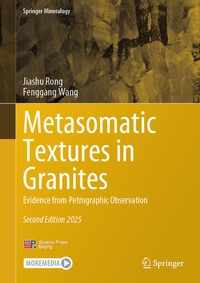
Metasomatic Textures in Granites
Description

Jiashu Rong graduated from Beijing Geological Institute in 1953. In 1955 he was sent to the former Soviet Union to learn regional geological survey by means of aero-photos. In 1957 he went to Nanling Regional Survey Expedition, Guangzhou, to apply the aero-photos and began to research on granites in Nanling region. As a summary of the work, he edited a book entitled "Preliminary Research on Nanling Intrusions", which was published in 1959 by Chinese Geological Publishing House. In 1962 he was appointed head of granite research group in Petrological Department under Geological Institute, Chinese Academy of Geological Science. In 1965 he was transferred to Guangdong on prospecting for uranium deposits. In 1973 he was shifted to Beijing Research Institute of Uranium Geology, CNNC, studying on uranium deposits and uraniferous granites. In 1995 he retired. He has published 21 articles in scientific journals and has won five National or Ministerial Science and Technology Progress Award.
Fenggang Wang graduated from Northeastern University in 2002, with the bachelor of geological mineral exploration and he obtained his master from Beijing Research Institute of Uranium Geology in 2008. Now, he is a professor at the Beijing Research Institute of Uranium Geology, CNNC. His research interest is mainly in the field of uranium deposit geology, petrology and mineralogy.
More details
Other editions
Additional editions
Previous edition
Persons
Jiashu Rong graduated from Beijing Geological Institute in 1953. In 1955 he was sent to the former Soviet Union to learn regional geological survey by means of aero-photos. In 1957 he went to Nanling Regional Survey Expedition, Guangzhou, to apply the aero-photos and began to research on granites in Nanling region. As a summary of the work, he edited a book entitled "Preliminary Research on Nanling Intrusions", which was published in 1959 by Chinese Geological Publishing House. In 1962 he was appointed head of granite research group in Petrological Department under Geological Institute, Chinese Academy of Geological Science. In 1965 he was transferred to Guangdong on prospecting for uranium deposits. In 1973 he was shifted to Beijing Research Institute of Uranium Geology, CNNC, studying on uranium deposits and uraniferous granites. In 1995 he retired. He has published 21 articles in scientific journals and has won five National or Ministerial Science and Technology Progress Award.
Fenggang Wang graduated from Northeastern University in 2002, with the bachelor of geological mineral exploration and he obtained his master from Beijing Research Institute of Uranium Geology in 2008. Now, he is a professor at the Beijing Research Institute of Uranium Geology, CNNC. His research interest is mainly in the field of uranium deposit geology, petrology and mineralogy.
Content
Chapter 1 Two major patterns of single mineral replacement in granites.- Chapter 2 Two major patterns.
