

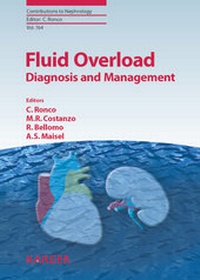
Fluid Overload
Diagnosis and Management.
1st Edition
Published on 5. May 2010
244 pages
978-3-8055-9417-2 (ISBN)
Available for download
Description

Fluid overload is often observed in patients with heart failure and secondary oliguric states. A thorough assessment of the fluid status of the patient may help guide the therapy and prevent complications induced by inappropriate therapeutic strategies. The present publication is divided into four parts: Definition and Classification, Pathophysiology, Diagnosis and Therapy. In the first section, the authors present new definitions for heart failure, acute kidney injury and cardiorenal syndromes to facilitate the process of understanding the complex link between the heart and the kidney. Subsequently, different conditions leading to fluid overload are described, followed by an account of emerging diagnostic tools, therapies and technologies devoted to the treatment of patients with severe fluid-related disorders. Clearly structured and written, the present book is a practical tool for physicians and professionals involved in the management and care of patients with combined heart and kidney disorders. Moreover, it also serves as a reference textbook for medical students, residents and fellows dealing in everyday practice with fluid overloaded and oliguric patients.
More details
Other editions
Additional editions
Book
05/2010
1st Edition
S. Karger
€99.50
Article exhausted; check different version
Persons
Content
- Cover
- Contents
- Preface
- Definition and Classification
- Heart Failure: Pathophysiology and Clinical Picture
- Abstract
- Pump Dysfunction and Cardiac Remodeling
- Neurohormonal Activation
- Salt and Water Retention
- Clinical Pictures
- Conclusions
- References
- Heart Failure Classifications - Guidelines
- Abstract
- Time Course of the Clinical Presentation of Heart Failure
- Classifications Based on the Severity of Heart Failure Symptoms and Structural Changes within the Heart
- Classifications Based on Signs of Heart Failure
- Heart Failure with Preserved and Reduced Ejection Fraction (Systolic and Diastolic Heart Failure)
- Acute and Decompensated Heart Failure
- Heart Failure Etiology and Comorbidities
- Conclusions
- References
- Acute Kidney Injury: Classification and Staging
- Abstract
- Introduction
- RIFLE and AKIN
- AKI and Fluid Balance
- AKI and the Cardiorenal Syndromes
- Conclusions
- References
- Cardiorenal Syndromes: Definition and Classification
- Abstract
- Introduction
- Results
- Conclusions
- References
- Pathophysiology
- Oliguria and Fluid Overload
- Abstract
- Oliguria
- Fluid Overload
- References
- Pathophysiology of Fluid Retention in Heart Failure
- Abstract
- Arterial Underfilling Hypothesis
- Sympathetic Nervous System
- Renin-Angiotensin-Aldosterone System
- Arginine Vasopressin
- Endothelin and TNF-a
- Natriuretic Peptides
- Conclusions
- References
- Fluid Overload as a Biomarker of Heart Failure and Acute Kidney Injury
- Abstract
- Heart Failure
- Acute Kidney Injury
- Conclusion
- Acknowledgements
- References
- Fluid Balance Issues in the Critically Ill Patient
- Abstract
- Pathophysiology of Fluid Shifts in Critically Ill Patients: Beyond the 'Third Space'
- Liberal/Standard and Restrictive/Conservative Approaches for Fluid Management
- Cumulative Fluid Balance and Morbidity and Mortality in Critically Ill Patients
- Initial versus Cumulative Fluid Administration
- How Does Fluid Accumulation Contribute to Organ Dysfunction?
- Recommendations for Clinical Practice and Research
- References
- Prerenal Azotemia in Congestive Heart Failure
- Abstract
- The Concept of Kidney Reserve - Pre-Prerenal State
- Pathophysiology of Prerenal Failure in Congestive Heart Failure
- Diagnosis of Prerenal Failure
- Management of Prerenal Azotemia in Congestive Heart Failure
- Gaps in Knowledge and Future Directions
- Conclusion
- Acknowledgements
- References
- Diagnosis
- Use of Biomarkers in Evaluation of Patients with Heart Failure
- Abstract
- Biomarkers in Heart Failure
- Conclusion
- References
- Oliguria, Creatinine and Other Biomarkers of Acute Kidney Injury
- Abstract
- Oliguria
- Creatinine and Urea
- Novel Biomarkers and Early Acute Kidney Injury Diagnosis
- References
- Current Techniques of Fluid Status Assessment
- Abstract
- History
- Physical Exam
- Orthostatic Vital Signs
- Auscultation as a Predictor of Volume Status
- Rapid Objective Measures of Blood Volume
- Acoustic Cardiography
- Chest Radiography
- Natriuretic Peptides
- Bioimpedance
- Bioimpedance Vector Analysis
- Thoracic Ultrasound
- Vena Cava Diameter Ultrasound
- Conclusions
- References
- Bioelectric Impedance Measurement for Fluid Status Assessment
- Abstract
- Tools for Detecting Hydration
- Basic Patterns of BIVA
- BIVA in Hemodialysis
- BIVA in Peritoneal Dialysis
- BIVA in Congestive Heart Failure
- BIVA in Critically Ill Patients
- BIVA in Localized Edema
- Conclusions
- References
- Therapy
- Diuretic Therapy in Fluid-Overloaded and Heart Failure Patients
- Abstract
- Introduction
- Management Issues in Fluid-Overloaded Heart Failure Patients
- Diagnostic Challenges
- Tackling Diuretic Resistance
- Ultrafiltration
- Conclusions
- References
- Pharmacological Therapy of Cardiorenal Syndromes and Heart Failure
- Abstract
- Introduction
- Novel Regimens in the Pharmacological Therapy of Type 1 CRS
- Conclusions
- References
- Extracorporeal Fluid Removal in Heart Failure Patients
- Abstract
- Introduction
- Epidemiology and Clinical Features of Acutely Decompensated Heart Failure
- Consequences of Fluid Overload
- Rationale for the Use of Ultrafiltration in Heart Failure
- Clinical Studies of Ultrafiltration in Heart Failure
- Conclusions
- References
- Technical Aspects of Extracorporeal Ultrafiltration: Mechanisms, Monitoring and Dedicated Technology
- Abstract
- Extracorporeal Ultrafiltration Techniques
- Ultrafiltration Equipment
- Ultrafiltration Prescription and Monitoring
- Towards Wearable Ultrafiltration Devices
- Conclusions
- References
- Use of Brain Natriuretic Peptide and Bioimpedance to Guide Therapy in Heart Failure Patients
- Abstract
- Rationale for Lowering Natriuretic Peptides in Acute Decompensated Heart Failure
- Use of Bioimpedance Vector Analysis and Brain Natriuretic Peptide to Guide Therapy in Patients with Acute Decompensated Heart Failure
- Conclusion
- References
- Fluid Management in Pediatric Intensive Care
- Abstract
- Pediatric Fluid Overload
- Diuretics
- Renal Replacement Therapy in Critical Care Infants
- Pediatric Nutrition
- References
- Fluid Assessment and Management in the Emergency Department
- Abstract
- Water and Sodium Metabolism
- Fluid Assessment in the Emergency Department
- New Perspectives: Bioimpedance Vector Analysis
- References
- Author Index
- Subject Index

