

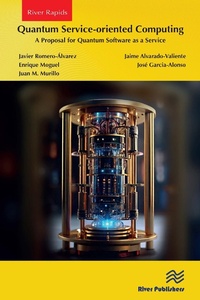
Quantum Service-oriented Computing: A Proposal for Quantum Software as a Service
1st Edition
Published on 14. October 2024
136 pages
978-87-7004-642-8 (ISBN)
Description

This book is an analysis of quantum computing, covering everything from its foundational principles to practical applications in the development of quantum services. It offers a technical and complex overview to provide the necessary knowledge to any researcher, scientist or developer who wants to get into service-oriented quantum computing.
The field of quantum computing has evolved rapidly in recent years, with the potential to revolutionize the way we approach complex problems in various fields. This comprehensive guide covers the fundamental principles of quantum computing and its practical applications in the development of quantum services.
Beyond theoretical knowledge, the book goes on to explore some of the challenges that quantum software developers face in today's landscape. It addresses issues related to low-level abstractions and the absence of integration, deployment and quality assurance mechanisms in quantum software engineering. Also, it explores the principles of service-oriented computing applied to quantum computing, revealing architectural patterns adapted to quantum computing and discussing standardization and accessibility in this field. It also provides insight into streamlining the deployment process through a DevOps approach for continuous deployment of quantum services.
This book will serve as a guide for all researchers, scientists and developers by providing them with an understanding of the current limitations and problems in quantum computing-oriented software development, and how to address them with software engineering techniques and tools applied to quantum computing.
The field of quantum computing has evolved rapidly in recent years, with the potential to revolutionize the way we approach complex problems in various fields. This comprehensive guide covers the fundamental principles of quantum computing and its practical applications in the development of quantum services.
Beyond theoretical knowledge, the book goes on to explore some of the challenges that quantum software developers face in today's landscape. It addresses issues related to low-level abstractions and the absence of integration, deployment and quality assurance mechanisms in quantum software engineering. Also, it explores the principles of service-oriented computing applied to quantum computing, revealing architectural patterns adapted to quantum computing and discussing standardization and accessibility in this field. It also provides insight into streamlining the deployment process through a DevOps approach for continuous deployment of quantum services.
This book will serve as a guide for all researchers, scientists and developers by providing them with an understanding of the current limitations and problems in quantum computing-oriented software development, and how to address them with software engineering techniques and tools applied to quantum computing.
More details
Edition
1. Auflage
Language
English
Place of publication
Gistrup
Denmark
Target group
Professional and scholarly
Illustrations
8 Tables, black and white; 20 Line drawings, color; 12 Line drawings, black and white; 20 Illustrations, color; 12 Illustrations, black and white
ISBN-13
978-87-7004-642-8 (9788770046428)
Copyright in bibliographic data and cover images is held by Nielsen Book Services Limited or by the publishers or by their respective licensors: all rights reserved.
Schweitzer Classification
Other editions
Additional editions
Javier Romero-Alvarez | Jaime Alvarado-Valiente | Enrique Moguel
Quantum Service-oriented Computing: A Proposal for Quantum Software as a Service
A Proposal for Quantum Software as a Service
Book
10/2024
1st Edition
River Publishers
€113.20
Article not available for order
Persons
Javier Romero-Alvarez obtained a degree in Software Engineering in 2020 and a Master's in Computer Engineering in 2022 from the University of Extremadura. Currently, he is a PhD student at the same university, focusing his research on quantum computing for the past 3 years. He began his research career while still a student in the Software Engineering program, working in the Quercus Software Engineering Group, where he undertook projects related to the development of chatbots and service-oriented computing. He has participated in different research projects related to quantum computing, such as the projects "QServ: Quantum Service Engineering development, quality, testing & security of quantum microservices" and "QHealth: Quantum Pharmacogenetics Applied to Ageing". These projects aim to integrate quantum aspects into the classical world, seeking ways to bridge both realms and provide real-world applications.
Jaime Alvarado-Valiente is a PhD student and scientific research fellow at the University of Extremadura, Spain. He obtained his degree in Computer Engineering Degree from the University of Extremadura in 2020 and a Master's of Computer Engineering in 2022. He has been associated with the Quercus Software Engineering Group research group since 2018, where he has developed all his research work. His work and projects within the group have been related to Web Engineering, Service Oriented Computing, and Chatbots development. In addition, he has served as a substitute professor for 9 months in the Department of Computer and Telematic Systems Engineering at the Polytechnic School of Caceres. For about three years he has been researching quantum computing as part of his doctoral thesis, participating in several national projects within the field of quantum computing, such as the projects QServ and QHealth. He was awarded a pre-doctoral contract for doctoral training (FPI) associated with the mentioned QServ project, a proposal developed jointly with the University of Castilla-La Mancha and the University of Deusto for the development of service technology that supports the construction of hybrid classical/quantum systems granted by the Spanish Ministry of Science and Innovation.
Enrique Moguel is a Computer Engineer from the University Carlos III of Madrid (UC3M) and obtained a Master's in Computer Engineering from the University of Extremadura where he won the awards for best academic record and best final master's project by SISTEDES. He has a PhD in Computer Science cum laude from the University of Extremadura where he won the extraordinary doctoral prize of the university, the award for the best doctoral thesis in Spain in the field of SISTEDES and the award for Innovation in the Drone Sector by the Enaire Foundation. He has experience in the private sector having worked in companies such as Everis, Telefonica I+D, Airbus, Tecnocom, or Guardia Civil. Currently, he is an Associate Professor at the University of Extremadura, where he combines his teaching and research work. He belongs to the Quercus Group. His main contributions to research and technology transfer have been in the areas of smart systems, the Internet of Things, eHealth, and quantum software engineering. This research work has resulted in more than 60 papers in specialized journals and international and national conferences; 1 patent; 2 utility models. He is co-author of several books and book chapters; is a founding partner of two technology-based companies; etc.
Jose Garcia-Alonso got his degree in Computer Science (2007) from the University of Extremadura. Then, he started his research career in the Quercus Software Engineering Group. In 2014, he got his PhD degree with international mention and nowadays he occupies the position of "Profesor Titular de Universidad" at the University of Extremadura. His research interests have revolved around service engineering, mobile computing, the Internet of Things, and quantum software engineering. In terms of knowledge transfer to industry and society, he is a founding partner of three technology-based companies and has a utility model. In addition, he started a new research line around the use of services to improve the quality of life of aging people. This multidisciplinary topic has also materialized in numerous publications, including several works in different research areas like nursing or gerontology. But more importantly, this research line has been funded with more than 2 million euros from different projects. These projects, alongside an interest in quantum computing, allowed Jose Garcia-Alonso to lead the new research line of quantum service engineering inside his group. Although this line started less than four years ago, it has already materialized in several publications in international conferences and in indexed journals.
Juan M. Murillo is currently a Full Professor in the field of Software Engineering at the University of Extremadura. He develops his research activity within the Quercus Group which he contributed to creating in 1995. Currently, he leads the SPILab team which is focused on the development of service technology for mobile devices. Regarding the involvement in services to society, Professor Murillo and his lab are members of the Spanish Network of Excellence Science and Engineering Services. He is also a member of the management board of SISTEDES. With respect to knowledge transfer to industry and society, he was a co-founder and CEO of GLOIN S.L. From 2018, the practical problems faced in the field of health have led him to open a new research direction related to the development of software for quantum systems and its integration with classical service-oriented ones. In this field of quantum software engineering, Juan M. Murillo is currently involved in the development of the QHealth project, which deals with the modeling of systems in the field of pharmacogenomics for the development of precision medicine. Also, as part of the work in this field, he is leading the QServ project.
Jaime Alvarado-Valiente is a PhD student and scientific research fellow at the University of Extremadura, Spain. He obtained his degree in Computer Engineering Degree from the University of Extremadura in 2020 and a Master's of Computer Engineering in 2022. He has been associated with the Quercus Software Engineering Group research group since 2018, where he has developed all his research work. His work and projects within the group have been related to Web Engineering, Service Oriented Computing, and Chatbots development. In addition, he has served as a substitute professor for 9 months in the Department of Computer and Telematic Systems Engineering at the Polytechnic School of Caceres. For about three years he has been researching quantum computing as part of his doctoral thesis, participating in several national projects within the field of quantum computing, such as the projects QServ and QHealth. He was awarded a pre-doctoral contract for doctoral training (FPI) associated with the mentioned QServ project, a proposal developed jointly with the University of Castilla-La Mancha and the University of Deusto for the development of service technology that supports the construction of hybrid classical/quantum systems granted by the Spanish Ministry of Science and Innovation.
Enrique Moguel is a Computer Engineer from the University Carlos III of Madrid (UC3M) and obtained a Master's in Computer Engineering from the University of Extremadura where he won the awards for best academic record and best final master's project by SISTEDES. He has a PhD in Computer Science cum laude from the University of Extremadura where he won the extraordinary doctoral prize of the university, the award for the best doctoral thesis in Spain in the field of SISTEDES and the award for Innovation in the Drone Sector by the Enaire Foundation. He has experience in the private sector having worked in companies such as Everis, Telefonica I+D, Airbus, Tecnocom, or Guardia Civil. Currently, he is an Associate Professor at the University of Extremadura, where he combines his teaching and research work. He belongs to the Quercus Group. His main contributions to research and technology transfer have been in the areas of smart systems, the Internet of Things, eHealth, and quantum software engineering. This research work has resulted in more than 60 papers in specialized journals and international and national conferences; 1 patent; 2 utility models. He is co-author of several books and book chapters; is a founding partner of two technology-based companies; etc.
Jose Garcia-Alonso got his degree in Computer Science (2007) from the University of Extremadura. Then, he started his research career in the Quercus Software Engineering Group. In 2014, he got his PhD degree with international mention and nowadays he occupies the position of "Profesor Titular de Universidad" at the University of Extremadura. His research interests have revolved around service engineering, mobile computing, the Internet of Things, and quantum software engineering. In terms of knowledge transfer to industry and society, he is a founding partner of three technology-based companies and has a utility model. In addition, he started a new research line around the use of services to improve the quality of life of aging people. This multidisciplinary topic has also materialized in numerous publications, including several works in different research areas like nursing or gerontology. But more importantly, this research line has been funded with more than 2 million euros from different projects. These projects, alongside an interest in quantum computing, allowed Jose Garcia-Alonso to lead the new research line of quantum service engineering inside his group. Although this line started less than four years ago, it has already materialized in several publications in international conferences and in indexed journals.
Juan M. Murillo is currently a Full Professor in the field of Software Engineering at the University of Extremadura. He develops his research activity within the Quercus Group which he contributed to creating in 1995. Currently, he leads the SPILab team which is focused on the development of service technology for mobile devices. Regarding the involvement in services to society, Professor Murillo and his lab are members of the Spanish Network of Excellence Science and Engineering Services. He is also a member of the management board of SISTEDES. With respect to knowledge transfer to industry and society, he was a co-founder and CEO of GLOIN S.L. From 2018, the practical problems faced in the field of health have led him to open a new research direction related to the development of software for quantum systems and its integration with classical service-oriented ones. In this field of quantum software engineering, Juan M. Murillo is currently involved in the development of the QHealth project, which deals with the modeling of systems in the field of pharmacogenomics for the development of precision medicine. Also, as part of the work in this field, he is leading the QServ project.
Content
1. Introduction to Quantum Computing 2. Challenges in Software Development and Deployment of Quantum Services 3. Quantum Computing as a Service 4. Architectural Design Patterns for Quantum Computing 5. Generation of Quantum Services 6. DevOps for Quantum Computing 7. Quality aspects on Quantum Software Development 8. Conclusions and Future Directions
