

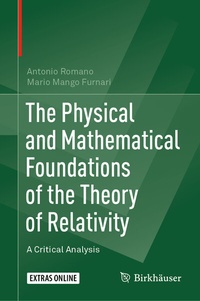
The Physical and Mathematical Foundations of the Theory of Relativity
Description

This unique textbook offers a mathematically rigorous presentation of the theory of relativity, emphasizing the need for a critical analysis of the foundations of general relativity in order to best study the theory and its implications. The transitions from classical mechanics to special relativity and then to general relativity are explored in detail as well, helping readers to gain a more profound and nuanced understanding of the theory as a whole.
After reviewing the fundamentals of differential geometry and classical mechanics, the text introduces special relativity, first using the physical approach proposed by Einstein and then via Minkowski's mathematical model. The authors then address the relativistic thermodynamics of continua and electromagnetic fields in matter - topics which are normally covered only very briefly in other treatments - in the next two chapters. The text then turns to a discussion of general relativity by means of the authors' unique criticalapproach, underlining the difficulty of recognizing the physical meaning of some statements, such as the physical meaning of coordinates and the derivation of physical quantities from those of space-time. Chapters in this section cover the model of space-time proposed by Schwarzschild; black holes; the Friedman equations and the different cosmological models they describe; and the Fermi-Walker derivative.Well-suited for graduate students in physics and mathematics who have a strong foundation in real analysis, classical mechanics, and general physics, this textbook is appropriate for a variety of graduate-level courses that cover topics in relativity. Additionally, it will interest physicists and other researchers who wish to further study the subtleties of these theories and understand the contemporary scholarly discussions surrounding them.
Reviews / Votes
"This book is very useful for universities as text book for undergraduate and post graduate students of physics and mathematics. . strongly recommend this book for a textbook in any university." (P. K. Sahoo, zbMATH 1435.83002, 2020)
More details
Other editions
Additional editions
Persons
Mario Mango Furnari is a senior researcher at Istituto di cibernetica "Edoardo Caianiello."
