

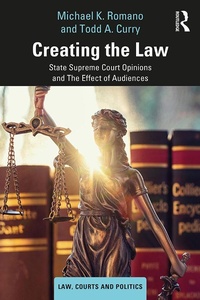
Creating the Law
State Supreme Court Opinions and The Effect of Audiences
1st Edition
Published on 30. August 2019
198 pages
978-0-429-86787-3 (ISBN)
Description

Written opinions are the primary means by which judges communicate with external actors. These sentiments include the parties to the case itself, but also more broadly journalists, public officials, lawyers, other judges, and increasingly, the mass public. In Creating the Law, Michael K. Romano and Todd A. Curry examine the extent to which judges tailor their language in order to avoid retribution during their retention, and how institutional variations involving intra-chamber dynamics may influence the written word of a legal opinion.
Using an extensive dataset that includes the text of all death penalty and education decisions issued by state supreme courts from 1995-2010, Romano and Curry are the first to examine the connection between retention incentives and language choices. They utilize text analysis techniques developed in the field of communications and apply them to the text of judicial decisions. In doing so, they find that judges write with their audience in mind, and emphasize duelling strategies of justification and persuasion in order to please diverse audiences that may be paying attention. Furthermore, the process of drafting a majority opinion is a team exercise, and when more individuals are involved in its crafting, the product will reflect this complexity.
This book gives students the tools for understanding how institutional variation affects judicial outcomes and shows how language relates to decision-making in the judiciary more specifically.
Using an extensive dataset that includes the text of all death penalty and education decisions issued by state supreme courts from 1995-2010, Romano and Curry are the first to examine the connection between retention incentives and language choices. They utilize text analysis techniques developed in the field of communications and apply them to the text of judicial decisions. In doing so, they find that judges write with their audience in mind, and emphasize duelling strategies of justification and persuasion in order to please diverse audiences that may be paying attention. Furthermore, the process of drafting a majority opinion is a team exercise, and when more individuals are involved in its crafting, the product will reflect this complexity.
This book gives students the tools for understanding how institutional variation affects judicial outcomes and shows how language relates to decision-making in the judiciary more specifically.
Reviews / Votes
"Romano and Curry add to a growing literature on judicial decision-making that moves beyond simply studying judge votes to examine opinion content. in this book, they provide a clear theoretical explanation for how the language in state high court opinions is influenced by strategic concerns related to their colleagues on the bench and relevant external actors. The book will be highly valuable to scholars of law, judicial politics, and political communications." - Michael P Fix, Georgia State University"One of the first comprehensive books about opinion-writing on state high courts, Romano and Curry capture the motivations of state high court justices in this stage by focusing on the justices as representatives of specific audiences. In examining the detail of the language used in opinions, the authors bring together our understanding of political communication and judicial decision-making as we learn that justices change how they write opinions for the audiences most important to them. This new understanding of opinion-writing and novel approach to studying it add much to the literature. This work will serve as an important base to scholars who will examine the intersections of state high courts, opinion-writing, and political communication in the future." - Meghan E. Leonard, Associate Professor, Illinois State University
In Creating the Law, Romano and Curry turn a laser-sharp focus toward a heretofore unexplored aspect of state supreme court politics: the linguistic strategies of justification and persuasion utilized by justices when crafting opinions. This pathbreaking study includes fascinating discussions of the justices' framing strategies for minimizing adverse reactions from various audiences, the ubiquitous influence of retention politics, the impact of language on unanimity, and differences between signed and per curiam opinions. Without question, this innovative new research breaks new ground theoretically and empirically and thus is an essential must-read in the fields of political science and law." - Melinda Gann Hall, Michigan State University
More details
Series
Edition
1. Auflage
Language
English
Place of publication
London
United Kingdom
Publishing group
Taylor & Francis Ltd
Target group
College/higher education
Illustrations
14 Tables, black and white; 39 Line drawings, black and white; 1 Halftones, black and white; 40 Illustrations, black and white
ISBN-13
978-0-429-86787-3 (9780429867873)
Copyright in bibliographic data and cover images is held by Nielsen Book Services Limited or by the publishers or by their respective licensors: all rights reserved.
Schweitzer Classification
Other editions
Additional editions
Michael K. Romano | Todd A. Curry
Creating the Law
State Supreme Court Opinions and The Effect of Audiences
Book
09/2019
1st Edition
Routledge
€175.70
Shipment within 10-20 days
Michael K. Romano | Todd A. Curry
Creating the Law
State Supreme Court Opinions and The Effect of Audiences
Book
09/2019
1st Edition
Routledge
€53.90
Shipment within 10-20 days
Book
09/2019
Routledge
Unfortunately, price unknown
Available (delivery time upon request)
Persons
Michael K. Romano received his Ph.D. in 2014 from Western Michigan University and is an Assistant Professor in the Political Science Department at Shenandoah University. His research focuses on how elite actors - specifically judges in both the federal and state courts in the United States and members of Congress - craft language in order to affect policy goals and political outcomes. His work has been published in Justice System Journal, Social Science Quarterly, and PS: Political Science & Politics.
Todd A. Curry received his Ph.D. in political science at Western Michigan University in 2012, and is an Assistant Professor in the Political Science Department at University of Texas, El Paso. His primary area of research is State Courts of Last Resort in the United States, as well as indigenous peoples and the law and diversity in higher education. His work has been published in Justice System Journal, American Review of Politics, PS: Political Science & Politics, and The Journal of Politics.
Todd A. Curry received his Ph.D. in political science at Western Michigan University in 2012, and is an Assistant Professor in the Political Science Department at University of Texas, El Paso. His primary area of research is State Courts of Last Resort in the United States, as well as indigenous peoples and the law and diversity in higher education. His work has been published in Justice System Journal, American Review of Politics, PS: Political Science & Politics, and The Journal of Politics.
Content
1. Introduction 2. Judicial Representation, Written Opinions, and Audiences 3. Writing for An Audience: Framing and Opinion Content 4. Accommodating for Dissent: The Effect of Minority Voices on Majority Opinions 5. Efficiency or Strategy: Per Curiam Usage on State Supreme Courts 6. The Political Ramifications of Opinion Content: Unanimity and Strategic Writing 7. Conclusion Appendix A Appendix B
