

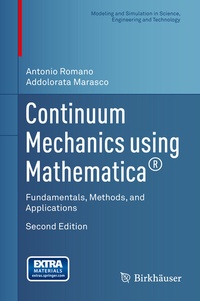
Continuum Mechanics using Mathematica®
Description

Reviews / Votes
"[The authors] bring a fresh quality to this subject. Their book of 11 chapters rigorously and clearly introduces various attributes often lacking in other books. Starting with basic linear algebra, the book migrates smoothly to curvilinear coordinates. There, the authors analyze different coordinates and introduce singular surfaces important in porous media analysis. From that point onward the authors present balance and constitutive equations common to other classical books. However, this book resourcefully goes a step further by applying Mathematica in order to clarify key concepts; this attractive feature is one of the book's strengths. In each Mathematica case, the authors define the aim of the program, description of the problem, and relative algorithm. All chapters are well written, particularly the last four on wave propagation, linear elasticity, and other topics including shock waves, Rayleigh waves, and SH waves. Given this book's elucidative and concise approach, the scientific community should look forward to reading the second volume, to treat mixtures, phase change, magnetoelastic bodies, and other important topics. Summing Up: Highly recommended. Graduate students through professionals."
-Choice (Review of the first edition)
"The book will be an invaluable reference for all those with active interest in the areas of continuum mechanics and its fundamental applications: balance laws, constitutive axioms, linear elasticity, fluid dynamics, waves, etc. It may serve as a supplement to any of the standard textbooks for undergraduate students, graduate students, and researchers in applied mathematics, mathematical physics, and engineering."
-Zentralblatt MATH (Review of the first edition)
More details
Other editions
Additional editions
Persons
Content
1. Elements of Linear Algebra.- 2. Vector Analysis.- 3. Finite and Infinitesimal Deformations.- 4. Kinematics.- 5. Balance Equations.- 6. Constitutive Equations.- 7. Symmetry Groups: Solids and Fluids.- Wave Propagation.- 8. Fluid Mechanics.- 9. Linear Elasticity.- 10. Other Approaches to Thermodynamics.- 11. Fluid Dynamics and Meteorology.- 12. Fluid Dynamics and Ship Motion.- Appendix. A Brief Introduction to Weak Solutions.- Index.
