

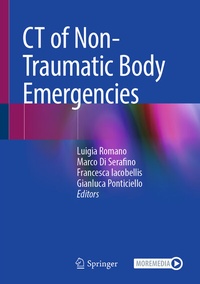
CT of Non-Traumatic Body Emergencies
Description

The book aims to evaluate the diagnostic value of CT in patients with non traumatic body emergencies regarding neck, chest, abdomen, pelvis and extremities.
The multidisciplinary adopted CT protocols are clearly discussed because they play an essential role in diagnostic imaging for detecting different features essential for the differential diagnosis of diverse patologies.
The CT findings are correlated with clinical parameters that might correctly orientate the patients management. An ideal imaging method should ensure availability, high diagnostic accuracy, low invasiveness, low execution time, and low costs. Computed Tomography (CT) represents the "standard" imaging technique in the patient with non traumatic body emegencies due to the high diagnostic performance when a correct imaging protocol is adopted, despite radiation dose exposure and intravenous contrast agent administration. Technological advances in the field, lead to the development of post-processing techniques and dual-energy technology (DECT).
DECT offers slight advantages over traditional CT by scanning the same anatomical structures with different energy and allowing them to improve the contrast resolution, adopting lower radiation and contrast medium doses.
More details
Other editions
Additional editions
Persons
1) Luigia Romano
Director of Emergency Radiological Department-AORN Cardarelli-Vice
Vice-Chairman Italian Radiological Society-SIRM
Professor at Qualified Radiological School of Federico II University
Professor of Radiological Medical Technicians University Course of L.Vanvitelli University.
2) Marco Di Serafino
Director of Ultrasound Unit of Emergency Radiological Department.
Member of Ultrasound Section of Italian Radiological Society-SIRM;
Professor of Radiological Medical Technicians University Course of L. Vanvitelli University.
3) Francesca Iacobellis
Consultant Radiologist at the Department of General and Emergency Radiology, Antonio Cardarelli Hospital, Naples, Italy
Member of the Board of Directors of the Emergency Radiology Section of the Italian Society of Medical and Interventional Radiology (SIRM)
Secretary of the Executive Committee of the European Society of Emergency Radiology (ESER)
Professor at the Degree Course in Medical Radiology Techniques, for Imaging and Radiotherapy, University of Campania "L. Vanvitelli"
4) Gianluca Ponticiello
Director of TC Unit of Emergency Radiological Department.
Professor of Radiological Medical Technicians University Course of L. Vanvitelli University
Content
Introduction.- Patient approach in emergency settings: imaging protocols.- Neck and chest.- Abdomen.- Liver and biliary system.- Pelvis.- Retroperitoneum.- The extremities.- Sepsis.- Multiple Organ Dysfunction Syndrome.- Emergencies in pregnancy.- "Tips and tricks" in reading the CT body emergency examination.
