

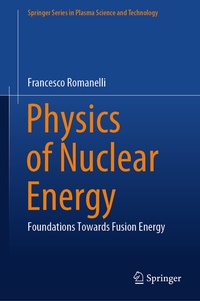
Physics of Nuclear Energy
Description

This textbook provides a comprehensive exploration of nuclear energy physics, focusing on the fundamentals of both nuclear physics and fusion energy production. The book includes the basics of quantum mechanics with applications to radioactive decay, nuclear reactions, and radiation penetration, as well as principles of magnetic confinement fusion.
Chapters cover the topics of statistical descriptions of many-body systems, cross-sections, electromagnetism, and special relativity. The author looks into nuclear reactions, fission reactors, plasma dynamics, the power balance in fusion reactors, magnetic field production, and engineering constraints. Additionally, he addresses edge plasma dynamics and the nuclear related challenges of fusion such as tritium breeding, and neutron-resistant material development.
The book is an essential resource for graduate students in engineering and researchers in nuclear energy. It provides a solid foundation in both theoretical and practical aspects of nuclear fusion, enabling readers to design fusion reactors and address the engineering challenges associated with them. Whether readers are scholars or practitioners in industrial engineering or related fields, this book provides valuable insights for advancing their understanding of nuclear energy.
More details
Other editions
Additional editions
Person
Francesco Romanelli is a professor of the physics of nuclear energy at the Industrial Engineering Department, the University of Rome "Tor Vergata", and the president of the consortium for the construction of the Divertor Tokamak Test (DTT) facility. He directed the activities in magnetic confinement fusion physics (1996-2006) at the Italian National Agency for New Technologies, Energy and Sustainable Economic Development, also known as ENEA, the Joint European Torus (2006-2014), and the European Fusion Development Agreement (2010-2014). He coordinated the preparation of the European Fusion Energy Roadmap. As well, Prof. Romanelli is the author or coauthor of more than 1,000 scientific publications.
Content
1. Introduction to nuclear energy.- 2. The statistical description of many body systems.- 3. The cross section.- 4. Electromagnetism and special relativity.- 5. The experimental evidence of quantum mechanics.- 6. The theoretical basis of quantum mechanics.- 7. The structure of the nucleus and the radioactive decay processes.- 8. Nuclear reactions.- 9. Fission reactors.- 10. The penetration of radiation through matter.- 11. Introduction to plasmas.- 12. Collisions in plasmas.- 13. Toroidal magnetic con?nement.- 14. Power balance of fusion power plants.- 15. Particle motion in electric and magnetic ?elds.- 16. Forces between currents and ?ux balance.- 17. Plasma equilibrium.- 18. Scrape-off Layer dynamics.- 19. The nuclear challenges of a fusion power plant.- Glossary.- Appendix.
