

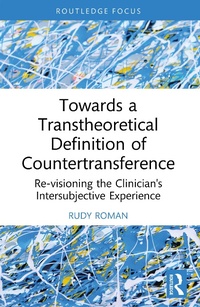
Towards a Transtheoretical Definition of Countertransference
Re-visioning the Clinician's Intersubjective Experience
1st Edition
Published on 21. November 2022
126 pages
978-1-000-83074-3 (ISBN)
Description

This book explores the analyst's countertransference experience in clinical settings from a number of theoretical perspectives in order to develop a transtheoretical definition of countertransference.
Stemming from an examination of the definition of countertransference itself, the author utilizes a philosophical hermeneutic approach to ask how pathological countertransference develops, how analysts separate themselves from the patient's experience, and what analysts should do to prevent their countertransference response from interfering with treatment. Through the unique hermeneutic methodology, philosophical themes within selected writings are explored as a way of gaining a deeper meaning and understanding of countertransference. By re-interpreting these selected writings in a new light, the book develops a transtheoretical definition and approach to countertransference. As such, the author offers a timely reassessment of the meaning and understanding of countertransference as it has evolved over the past century, going from being considered an obstacle to treatment brought on by the analyst's unconscious conflicts to being understood as a way of communicating and understanding the patient's unconscious material. It also provides a unique pathway through various depth psychological, therapeutic, and theoretical approaches to countertransference, foregrounding the significance and therapeutic value of the concept and seeking a new transtheoretical definition.
This volume will appeal to scholars and researchers of psychology and mental health.
Stemming from an examination of the definition of countertransference itself, the author utilizes a philosophical hermeneutic approach to ask how pathological countertransference develops, how analysts separate themselves from the patient's experience, and what analysts should do to prevent their countertransference response from interfering with treatment. Through the unique hermeneutic methodology, philosophical themes within selected writings are explored as a way of gaining a deeper meaning and understanding of countertransference. By re-interpreting these selected writings in a new light, the book develops a transtheoretical definition and approach to countertransference. As such, the author offers a timely reassessment of the meaning and understanding of countertransference as it has evolved over the past century, going from being considered an obstacle to treatment brought on by the analyst's unconscious conflicts to being understood as a way of communicating and understanding the patient's unconscious material. It also provides a unique pathway through various depth psychological, therapeutic, and theoretical approaches to countertransference, foregrounding the significance and therapeutic value of the concept and seeking a new transtheoretical definition.
This volume will appeal to scholars and researchers of psychology and mental health.
More details
Series
Edition
1. Auflage
Language
English
Place of publication
London
United Kingdom
Publishing group
Taylor & Francis Ltd
Target group
College/higher education
Illustrations
1 Halftones, black and white; 1 Illustrations, black and white
ISBN-13
978-1-000-83074-3 (9781000830743)
Copyright in bibliographic data and cover images is held by Nielsen Book Services Limited or by the publishers or by their respective licensors: all rights reserved.
Schweitzer Classification
Other editions
Additional editions
Rudy Roman
Towards a Transtheoretical Definition of Countertransference
Re-visioning the Clinician's Intersubjective Experience
Book
05/2024
1st Edition
Routledge
€31.30
Shipment within 10-20 days
Rudy Roman
Towards a Transtheoretical Definition of Countertransference
Re-visioning the Clinician's Intersubjective Experience
Book
11/2022
1st Edition
Routledge
€70.90
Shipment within 10-20 days
Person
Dr. Rudy Roman is a clinical assistant professor of psychiatry and the behavioral sciences with Keck School of Medicine of the University of Southern California, USA, and an adjunct assistant professor with the School of Rossier also at the University of Southern California, USA. He has a private practice in Long Beach, California, USA, and has been providing mental health services for over 14 years.
Content
Introduction 1. Transference 2. Countertransference From a Depth Psychological Perspective 3. Countertransference and Jungian Analysis 4. Countertransference Dreams 5. Countertransference From a Cognitive-Behavioral Approach 6. Humanistic Psychology and Countertransference 7. Transtheoretical Definition of Countertransference 8. Moving Forward: Implications and Recommendations
