

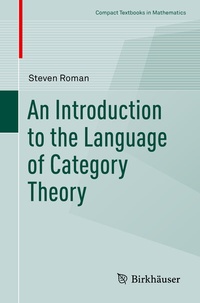
An Introduction to the Language of Category Theory
Published on 5. January 2017
XII, 169 pages
978-3-319-41917-6 (ISBN)
Description

This textbook provides an introduction to elementary category theory, with the aim of making what can be a confusing and sometimes overwhelming subject more accessible. In writing about this challenging subject, the author has brought to bear all of the experience he has gained in authoring over 30 books in university-level mathematics.
The goal of this book is to present the five major ideas of category theory: categories, functors, natural transformations, universality, and adjoints in as friendly and relaxed a manner as possible while at the same time not sacrificing rigor. These topics are developed in a straightforward, step-by-step manner and are accompanied by numerous examples and exercises, most of which are drawn from abstract algebra.
The first chapter of the book introduces the definitions of category and functor and discusses diagrams,duality, initial and terminal objects, special types of morphisms, and some special types of categories,particularly comma categories and hom-set categories. Chapter 2 is devoted to functors and naturaltransformations, concluding with Yoneda's lemma. Chapter 3 presents the concept of universality and Chapter 4 continues this discussion by exploring cones, limits, and the most common categorical constructions - products, equalizers, pullbacks and exponentials (along with their dual constructions). The chapter concludes with a theorem on the existence of limits. Finally, Chapter 5 covers adjoints and adjunctions.
Graduate and advanced undergraduates students in mathematics, computer science, physics, or related fields who need to know or use category theory in their work will find An Introduction to Category Theory to be a concise and accessible resource. It will be particularly useful for those looking for a more elementary treatment of the topic before tackling more advanced texts.
The goal of this book is to present the five major ideas of category theory: categories, functors, natural transformations, universality, and adjoints in as friendly and relaxed a manner as possible while at the same time not sacrificing rigor. These topics are developed in a straightforward, step-by-step manner and are accompanied by numerous examples and exercises, most of which are drawn from abstract algebra.
The first chapter of the book introduces the definitions of category and functor and discusses diagrams,duality, initial and terminal objects, special types of morphisms, and some special types of categories,particularly comma categories and hom-set categories. Chapter 2 is devoted to functors and naturaltransformations, concluding with Yoneda's lemma. Chapter 3 presents the concept of universality and Chapter 4 continues this discussion by exploring cones, limits, and the most common categorical constructions - products, equalizers, pullbacks and exponentials (along with their dual constructions). The chapter concludes with a theorem on the existence of limits. Finally, Chapter 5 covers adjoints and adjunctions.
Graduate and advanced undergraduates students in mathematics, computer science, physics, or related fields who need to know or use category theory in their work will find An Introduction to Category Theory to be a concise and accessible resource. It will be particularly useful for those looking for a more elementary treatment of the topic before tackling more advanced texts.
Reviews / Votes
"This book offers a fast, but very complete, introduction to the basic concepts in category theory, which any reader with a basic knowledge of abstract algebra will follow easily. . The theory is very well complemented by a list of proposed exercises at the end of every chapter. . This book is appropriate, as was said previously, for a fast introduction to category theory, and could be very useful for a short introductory course on categorical methods in advanced algebra." (Juan Antonio López-Ramos, Mathematical Reviews, July, 2017)"This book is, as promised in this series, a compact, easy to read and useful for lecturers introduction to the basic concepts of category theory. It is very convenient for self-studying and it can be used as starting point to read more advanced book on category theory. The book includes very nice and helpful diagrams, detailed explanation of the concepts and, in every chapter, a set of exercises that will help the reader to better understanding the text." (Blas Torrecillas, zbMATH 1360.18001, 2017)
More details
Series
Edition
1st ed. 2017
Language
English
Place of publication
Cham
Switzerland
Publishing group
Springer International Publishing
Target group
Primary & secondary/elementary & high school
Product notice
Reflowable
Illustrations
XII, 169 p. 176 illus., 5 illus. in color.
File size
4,16 MB
ISBN-13
978-3-319-41917-6 (9783319419176)
DOI
10.1007/978-3-319-41917-6
Schweitzer Classification
Other editions
Additional editions
Steven Roman
An Introduction to the Language of Category Theory
Book
01/2017
Birkhäuser
€74.89
Shipment within 10-15 days
Person
Steven Roman is Professor Emeritus of Mathematics at California State University Fullerton. He is the author of numerous other mathematics textbooks, including
Field Theory
(2006),
Advanced Linear Algebra
(2008),
Fundamentals of Group Theory
(2012),
Introduction to the Mathematics of Finance
(2012), and
An Introduction to Catalan Numbers
(2015).
Content
Preface.- Categories.- Functors and Natural Transformations.- Universality.- Cones and Limits.- Adjoints.- References.- Index of Symbols.- Index.
