

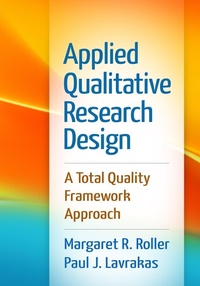
Applied Qualitative Research Design
A Total Quality Framework Approach
Published on 23. February 2015
398 pages
978-1-4625-1910-1 (ISBN)
Description

Graduate students and instructors in education, sociology, psychology, social work, management, communications, and nursing; researchers and evaluators seeking guidance for their qualitative research work. Serves as a text in master's- and doctoral-level Qualitative Methods or Dissertation/Proposal Writing courses, or as a supplement in Research Design courses.
More details
Other editions
Additional editions
Margaret R. Roller | Paul J. Lavrakas
Applied Qualitative Research Design
A Total Quality Framework Approach
Book
04/2015
1st Edition
Guilford Press
€70.00
Shipment within 15-20 days
Persons
Margaret R. Roller, MA, has been a research professional for 40 years. She is currently in private practice, where she works with some of the largest U.S. and global commercial and nonprofit organizations to find qualitative and quantitative research solutions. Ms. Roller has designed and conducted thousands of qualitative studies involving a wide assortment of methods, has presented and published numerous papers and articles on qualitative research design, and is the author of the widely read blog www.researchdesignreview.com. She serves on the exam development committee for the Marketing Research Association's Professional Researcher Certification.
Paul J. Lavrakas, PhD, a research psychologist, serves as a senior methodological research consultant for several public and private sector organizations. He is also a Senior Fellow at the independent research organization NORC at the University of Chicago, and a Visiting Scholar at Northern Arizona University. Dr. Lavrakas has used quantitative and qualitative research methods extensively throughout his more than 40 years as an active research practitioner. Past president of the American Association for Public Opinion Research, he served as Vice President and chief methodologist for Nielsen Media Research and was on the faculties of Northwestern University and Ohio State University. His many publications include, most recently, the coedited volume Online Panel Research: A Data Quality Perspective.
Paul J. Lavrakas, PhD, a research psychologist, serves as a senior methodological research consultant for several public and private sector organizations. He is also a Senior Fellow at the independent research organization NORC at the University of Chicago, and a Visiting Scholar at Northern Arizona University. Dr. Lavrakas has used quantitative and qualitative research methods extensively throughout his more than 40 years as an active research practitioner. Past president of the American Association for Public Opinion Research, he served as Vice President and chief methodologist for Nielsen Media Research and was on the faculties of Northwestern University and Ohio State University. His many publications include, most recently, the coedited volume Online Panel Research: A Data Quality Perspective.
Content
1. Making Sense of the Human Experience with Qualitative Research
1.1. Introduction
1.2. Unique Attributes Associated with Qualitative Research
1.3. The Total Quality Framework and the Reason for This Book
1.4. Overall Organization of the Book and Its Chapters
1.5. The Glossary
2. The Total Quality Framework
Chapter Preview
2.1. Introduction
2.2. Paradigms and Frameworks
2.3. What Is the Total Quality Framework?
2.4. Applying the Total Quality Framework
2.5. Chapter Summary
Suggested Further Reading
3. Interview Method: In-Depth Interviews
Chapter Preview
3.1. Introduction
3.2. Four Modes of the In-Depth Interview Method
3.3. Applying the Total Quality Framework Approach to the In-Depth Interview Method
3.4. Chapter Summary
3.5. Exercises and Discussion Topics
Suggested Further Reading
Web Resource
4. Interview Method: Focus Group Discussions
Chapter Preview
4.1. Introduction
4.2. Three Modes of the Group Discussion Method
4.3. Applying the Total Quality Framework Approach to the Group Discussion Method
4.4. Chapter Summary
4.5. Exercises and Discussion Topics
Suggested Further Reading
Web Resources
5. Observation Method: Ethnography
Chapter Preview
5.1. Introduction
5.2. Ethnography in the Digital Age
5.3. Applying the Total Quality Framework Approach to Ethnography
5.4. Chapter Summary
5.5. Exercises and Discussion Topics
Suggested Further Reading
Web Resources
6. Qualitative Content Analysis
Chapter Preview
6.1. Introduction
6.2. Computer-Assisted Qualitative Content Analysis
6.3. Applying the Total Quality Framework Approach to Qualitative Content Analysis
6.4. Chapter Summary
6.5. Exercises and Discussion Topics
Web Resources
7. Multiple Methods in Case-Centered Approaches: Case Study and Narrative Research
Chapter Preview
7.1. Introduction
7.2. Process in Case-Centered Research
7.3. The Total Quality Framework Approach to Case-Centered Research
7.4. Chapter Summary
7.5. Exercises and Discussion Topics
Suggested Further Reading
Web Resource
8. The Total Quality Framework Research Proposal and Other Practical Applications of the Total Quality Framework
Chapter Preview
8.1. Introduction
8.2. Section-by-Section Discussion of the Total Quality Framework Research Proposal
8.3. Evaluating Proposals Using the Total Quality Framework
8.4. Related Uses of the Total Quality Framework in Reviewing Research Reports
8.5. Chapter Summary
Glossary
References
Author Index
Subject Index
About the Authors
1.1. Introduction
1.2. Unique Attributes Associated with Qualitative Research
1.3. The Total Quality Framework and the Reason for This Book
1.4. Overall Organization of the Book and Its Chapters
1.5. The Glossary
2. The Total Quality Framework
Chapter Preview
2.1. Introduction
2.2. Paradigms and Frameworks
2.3. What Is the Total Quality Framework?
2.4. Applying the Total Quality Framework
2.5. Chapter Summary
Suggested Further Reading
3. Interview Method: In-Depth Interviews
Chapter Preview
3.1. Introduction
3.2. Four Modes of the In-Depth Interview Method
3.3. Applying the Total Quality Framework Approach to the In-Depth Interview Method
3.4. Chapter Summary
3.5. Exercises and Discussion Topics
Suggested Further Reading
Web Resource
4. Interview Method: Focus Group Discussions
Chapter Preview
4.1. Introduction
4.2. Three Modes of the Group Discussion Method
4.3. Applying the Total Quality Framework Approach to the Group Discussion Method
4.4. Chapter Summary
4.5. Exercises and Discussion Topics
Suggested Further Reading
Web Resources
5. Observation Method: Ethnography
Chapter Preview
5.1. Introduction
5.2. Ethnography in the Digital Age
5.3. Applying the Total Quality Framework Approach to Ethnography
5.4. Chapter Summary
5.5. Exercises and Discussion Topics
Suggested Further Reading
Web Resources
6. Qualitative Content Analysis
Chapter Preview
6.1. Introduction
6.2. Computer-Assisted Qualitative Content Analysis
6.3. Applying the Total Quality Framework Approach to Qualitative Content Analysis
6.4. Chapter Summary
6.5. Exercises and Discussion Topics
Web Resources
7. Multiple Methods in Case-Centered Approaches: Case Study and Narrative Research
Chapter Preview
7.1. Introduction
7.2. Process in Case-Centered Research
7.3. The Total Quality Framework Approach to Case-Centered Research
7.4. Chapter Summary
7.5. Exercises and Discussion Topics
Suggested Further Reading
Web Resource
8. The Total Quality Framework Research Proposal and Other Practical Applications of the Total Quality Framework
Chapter Preview
8.1. Introduction
8.2. Section-by-Section Discussion of the Total Quality Framework Research Proposal
8.3. Evaluating Proposals Using the Total Quality Framework
8.4. Related Uses of the Total Quality Framework in Reviewing Research Reports
8.5. Chapter Summary
Glossary
References
Author Index
Subject Index
About the Authors
