

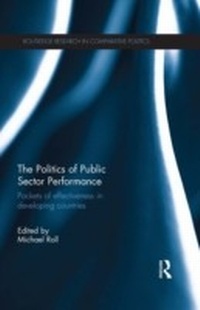
The Politics of Public Sector Performance
Pockets of Effectiveness in Developing Countries
1st Edition
Published on 10. January 2014
296 pages
978-1-317-93455-4 (ISBN)
Description

It is widely believed that the state in developing countries is weak. The public sector, in particular, is often regarded as corrupt and dysfunctional. This book provides an urgently needed corrective to such overgeneralized notions of bad governance in the developing world. It examines the variation in state capacity by looking at a particularly paradoxical and frequently overlooked phenomenon: effective public organizations or 'pockets of effectiveness' in developing countries.
Why do these pockets exist? How do they emerge and survive in hostile environments? And do they have the potential to trigger more comprehensive reforms and state-building? This book provides surprising answers to these questions, based on detailed case studies of exceptional public organizations and state-owned enterprises in Africa, Asia, the Caribbean, Latin America and the Middle East. The case studies are guided by a common analytical framework that is process-oriented and sensitive to the role of politics. The concluding comparative analysis develops a novel explanation for why some public organizations in the developing world beat the odds and turn into pockets of public sector performance and service delivery while most do not.
This book will be of strong interest to students and scholars of political science, sociology, development, organizations, public administration, public policy and management.
Why do these pockets exist? How do they emerge and survive in hostile environments? And do they have the potential to trigger more comprehensive reforms and state-building? This book provides surprising answers to these questions, based on detailed case studies of exceptional public organizations and state-owned enterprises in Africa, Asia, the Caribbean, Latin America and the Middle East. The case studies are guided by a common analytical framework that is process-oriented and sensitive to the role of politics. The concluding comparative analysis develops a novel explanation for why some public organizations in the developing world beat the odds and turn into pockets of public sector performance and service delivery while most do not.
This book will be of strong interest to students and scholars of political science, sociology, development, organizations, public administration, public policy and management.
Reviews / Votes
Michael Roll has put together a path-breaking volume that is certain to become the standard reference on its subject. Addressing the unjustly neglected topic of 'pockets of effectiveness' in otherwise under-performing states, it sets a stimulating agenda for future research.David Booth, Overseas Development Institute
It is easy to show that the reigning 'more market, less state' ideas about economic development strategy over the past three decades have at most a partial empirical validity. It is a lot more difficult to give implementable, non-obvious prescriptions for how to make state agencies work more effectively. Michael Roll's edited book does just that. Combining case studies with determined induction, Roll and co-authors present a clear analytical framework in terms of which they answer a question familiar to many who have encountered government agencies in middle-income countries: why do some (a few) agencies work effectively, while the majority do not? And how can a government go about creating and sustaining 'pockets of effectiveness'? Anyone who is concerned about improving the development prospects of middle-income countries - and who enjoys the company of articulate and provocative authors - should pay attention to its arguments.
Robert H. Wade, London School of Economics and Political Science
Surprisingly, pockets of effectiveness can emerge in the public sectors of even the worst governed countries. It is hugely important for reform that we understand why and how these exceptions emerge. In this volume Michael Roll brings together the latest research on 'pockets of effectiveness' in developing countries, work done both under his direction and by independent scholars of the subject. In doing so, Roll is able to synthesize conclusions that take our understanding of the topic to a new level.
David K. Leonard, Professor Emeritus, University of California, Berkeley
Debates on the public sector in developing countries are dominated by a combination of deep pessimism and calls for market reform. In this valuable and innovative comparative study Michael Roll provides an answer to why and how 'pockets of effectiveness' emerge in certain public organizations and why they persist. It is a breath of fresh air and a must read for academics and public servants. It should become a standard text book for students in the field of public management.
Edward Webster, Professor Emeritus, University of the Witwatersrand, Johannesburg
Whereas most public sector organizations in developing countries (and reforms to such) fail, Michael Roll reminds us that there are successes. And that these examples could be the key to more widespread success; through the lessons they offer, the inspiration they provide, and more. This timely book should have an important place on the shelf for anyone interested in governance and government in development.
Matthew Andrews, Harvard University
This book is an apt reminder that the blanket gloom through which we often judge the institutions of developing countries is in need of some critical re-examination. It offers invaluable insights into some institutional dynamics in the countries that are covered, especially Nigeria. Taking us beyond the anodyne prescription of 'good governance', it offers examples of institutional contexts in which positive and progressive change is possible. By addressing the key questions of how and why some public institutions function well, it opens the possibility to more fundamental change in African bureaucracies and beyond in the future.
Abdul Raufu Mustapha, University of Oxford
When assessing the role of the African state in the process of development today often observers emphasize incidents of bad governance, state failure and corruption. However, this process is complex and in remarkable cases it involves good governance and the effective performance of governmental institutions in the delivery of public goods. This book goes a long way towards disentangling this process in developing countries, teasing out evidence of 'pockets of effectiveness' in the delivery of public goods. It is destined to broaden the discussion on state effectiveness in the context of development.
Edmond J. Keller, University of California, Los Angeles
This innovative book analyses rare cases of well-performing public organizations in developing countries. It offers fascinating insights for researchers and inspiration for reform-minded practitioners.
Peter Eigen, Founder of Transparency International
This welcome and important volume begins to address our lack of knowledge about public agencies in developing countries that do well despite the most difficult of contexts. It examines the 'how' and 'why' of the emergence, and importantly the persistence, of these 'pockets of effectiveness'.
Colin Talbot, University of Manchester
It is a timely, welcome and important addition to the debate over politics, the state and its capacity, service delivery, governance and development - matters that are of immense policy relevance in developing countries. It emphasizes the importance of how and why nonperforming public organizations should learn from effective ones. It is therefore a must read for academics, students, politicians and bureaucrats, as well as the general reader, who are interested in the state and its capacity, governance and development.
Joseph R.A. Ayee, Professor and Independent Consultant, Legon, Ghana
More details
Series
Language
English
Place of publication
London
United Kingdom
Publishing group
Taylor & Francis Ltd
Target group
College/higher education
Illustrations
8 s/w Abbildungen, 19 s/w Tabellen, 8 s/w Zeichnungen
19 Tables, black and white; 8 Line drawings, black and white; 8 Illustrations, black and white
File size
2,71 MB
ISBN-13
978-1-317-93455-4 (9781317934554)
Copyright in bibliographic data and cover images is held by Nielsen Book Services Limited or by the publishers or by their respective licensors: all rights reserved.
Schweitzer Classification
Other editions
Additional editions
Michael Roll
The Politics of Public Sector Performance
Pockets of Effectiveness in Developing Countries
Book
08/2015
1st Edition
Routledge
€76.80
Shipment within 10-20 days
Michael Roll
The Politics of Public Sector Performance
Pockets of Effectiveness in Developing Countries
Book
12/2013
1st Edition
Routledge
€232.10
Shipment within 15-20 days
Person
Michael Roll is a University Fellow in the Department of Sociology at the University of Wisconsin--Madison, USA.
Content
1. Introduction Michael Roll 2. Pockets of effectiveness: review and analytical framework Michael Roll 3. Pockets of effectiveness: lessons from the long twentieth century in China and Taiwan Julia C. Strauss 4. An enduring pocket of effectiveness: the case of the National Development Bank of Brazil (BNDE) Eliza J. Willis 5. Turning Nigeria's drug sector around: the National Agency for Food and Drug Administration and Control (NAFDAC) A. Irene Pogoson and Michael Roll 6. Taming the menace of human trafficking: Nigeria's National Agency for the Prohibition of Traffic in Persons and Other Related Matters (NAPTIP) Antonia T. Simbine with Franca C. Attoh and Abubakar Oladeji 7. 'Confidence in our own abilities': Suriname's State Oil Company as a pocket of effectiveness Wil Hout 8. Defying the resource curse: explaining successful state-owned enterprises in rentier states Steffen Hertog 9. Comparative analysis: deciphering pockets of effectiveness Michael Roll
