

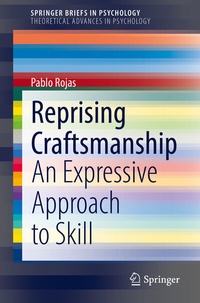
Reprising Craftsmanship
Description

Craftsmanship provides an insight into an inherently human dimension of work resulting from our immersion in an occupation or profession. The present book illustrates and defines the vital, social, aesthetic, and ethical dimensions involved in craftsmanship, which rejects a dissociation between handwork and wit, or between action and thought. This also contrasts with the neglect contemporary psychology has shown toward craftsmanship and its reduction to mere 'human factors.' Drawing on artistry as an emblem, the present account conveys that skilful action can only be renewed in a cycle involving both the personal and the transgenerational.
There is little doubt in psychological and anthropological literature that the current global crises cannot be separated from social predicaments; namely, from the commodification of craftsmanship. In this book, the development of skilful action attests to a fundamental involvement required to sustainably perpetuate human endeavours.The role of expressivity in reappropriating technical activity is key in showing the continuous revaluation of our ethics and aesthetics of work, practice, and creation. The overall arc of the volume shows a movement from responsivity to responsibility. In short, if we are to reformulate our relationship to work and craft, we need to see through our responsibility in technique. The particularities of craftsmanship described here aim to contribute to such reformulation.
More details
Other editions
Additional editions
Person
Pablo Rojas obtained his PhD in Social Sciences at l'École des Hautes Études en Sciences Sociales , Paris. He has studied the personal and intergenerational development of skill through the lens of aesthetics, anthropology, musicology, philosophy, and psychology. His work features an in-depth look into craftsmanship that relies on the cross-pollination of techniques. This pursuit has led him to work alongside commercial aircraft pilots, educators, psychotherapists, music performers, luthiers, writers, and woodworkers. His research interests include the development of technical activity, work-leisure relations, expression and value, tangible and intangible cultural heritage, and the presence of myth in everyday life. He is also a musician and an apprentice luthier.
Content
1 Expressivity and the development of skill.- 2 Physiognomy in motion.- 3 Expressivity and skill motifs.- 4 Technical rhythms and harmonies.- 5 Craftsmanship reprised.
