

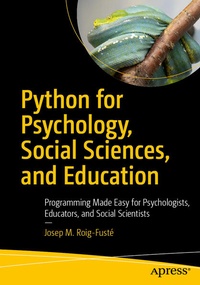
Python for Psychology, Social Sciences, and Education
Description

In recent years, computer technology has invaded all fields of science and human activity. It is necessary to find simple, yet powerful, methods to help you perform your work effectively and easily, without sacrificing methodological standards. This book is a practical guide for professionals, educators, and students eager to harness the power of programming. The book bridges the gap between technical computing and real-world applications in behavioral science, and makes Python accessible to those with little to no coding background. Python is a powerful and comprehensive language that serves professionals, including those reluctant to use a computer, and students looking for a free tool to improve learning and research capacity. The book is aimed at psychologists, psychiatrists, neuroscientists, educators, social scientists, and students in these fields, who have no prior programming experience but need to expand their computing knowledge.
What You Will Learn:
- Program in an accessible language with broad possibilities
- Implement concrete projects related to daily professional activities in psychology, social sciences, and education
- Explore possibilities for automating common tasks that are boring or require a lot of control
Who This Book Is For:
Psychologists, psychiatrists, neuroscientists, educators, social scientists, and students in these fields, who have no prior programming experience but need to expand their computing knowledge for their work
More details
Other editions
Additional editions
Person
Dr. Josep M. Roig-Fusté is a licensed Clinical Psychologist with over 40 years of experience across hospital, corporate, and private practice settings. He holds a bachelor's degree in Psychology from the Universitat de Barcelona, and a PhD in Medicine from the Universitat Autònoma de Barcelona. He also holds a degree in Clinical Psychology from the Ministry of Science and Innovation and a master's degree in Psychiatry from the Universitat Autònoma de Barcelona. In addition to his clinical work, Dr. Roig Fusté has spent the last three decades developing software for psychological applications-ranging from administration, correction of psychological tests, automatic generation of reports from psychological test data, and development of computerized cognitive rehabilitation tools. His programming journey began with QBasic and Visual Basic, and today he works primarily in Python 3.
Content
Chapter 1: Installation and First Steps in Python.- Chapter 2: Put into Practice What You Have Learned and More.- Chapter 3: Saving Information to the Hard Drive: Reading and Writing Files.- Chapter 4: Experimental Psychology.- Chapter 5: Clinical Psychology.- Chapter 6: Applications of Statistics and Data Mining.- Chapter 7: Python in Education.- Chapter 8: Cognitive Retraining.- Chapter 9: Social Research.- Chapter 10: Artificial Intelligence and Machine Learning or Deep Learning.- Chapter 11: Virtual Reality.- Chapter 12: Conclusions.- Appendix A.- References.
