

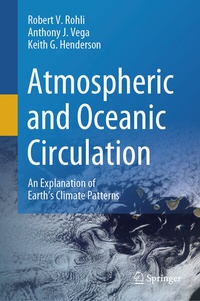
Atmospheric and Oceanic Circulation
Description

This book provides a one-stop shop for coastal and marine scientists to understand processes that generate atmospheric circulation as integrated with terrestrial and oceanic circulation processes to create an Earth-ocean-atmosphere climate system. It uses the process approach in the first half of the book to set the stage for understanding circulation systems and then for explaining the circulation processes themselves, with the second half of the book dedicated to showing how these processes play themselves out across the Earth's terrestrial and marine surface. The processes explained in the first half of the book assume no prior knowledge of meteorology or oceanography. The regional section includes the major continents or subcontinents, along with their surrounding ocean environs. It begins with the area with which many/most readers are likely most familiar -the USA and Canada. From there, the tour of the world continues, beginning with the places that have atmospheric and oceanic circulation features that are most similar to the USA and Canada, all in the Northern Hemisphere-Europe, Southwestern Asia, and then East Asia. From there, the discussion builds on principles illustrated in the first half of the book and demonstrated in the beginning of the regional section of the book, while also adding concepts and principles of importance in the tropical and subtropical latitudes, by describing circulation features of South and Southeast Asia. This discussion carries forward naturally for a discussion of Africa, which experiences similar features of subtropical and tropical latitudes. From there, previous material can be applied and built upon further in the discussion of Latin America and the Caribbean. Australia and Oceania are the next area covered, followed by the polar latitudes. The book concludes with a brief review of the major atmospheric and oceanic circulation features around the world and with a reminder of the cascading primary and secondary impacts of the climate system.
The book is intended to fill a niche as both a textbook and a reference source for non-atmospheric specialists. Its purpose is to help coastal, environmental, engineering, and planning professionals to get "up to speed" regarding atmospheric and oceanic circulations and their impacts around the world. This would allow more effective communication with climate modelers, atmospheric and marine environmental consultants, and media. Our book-writing experience allows us to implement "best practices" based on cognitive theory to facilitate learning in the geosciences.
More details
Other editions
Additional editions
Persons
Keith Henderson is a climatologist with B.S. and M.S. degrees in Geography from Pennsylvania State University and a Ph.D. in Geography from the University of North Carolina, Chapel Hill. He interacts actively with a broad range of environmental scientists. His research interests include synoptic climatology, climate variations, applied climatology, and natural resources.
Anthony J. Vega is a professor of Atmospheric Science in the Department of Geoscience at Pennsylvania Western-Clarion University. He received a Ph.D. in Geography (Climatology) from Louisiana State University, a M.S. in Meteorology from Mississippi State University, and a B.A. in Geography from the University of New Orleans. His research involves ocean-air teleconnections, tropical cyclone climatology, and synoptic climatology.
