

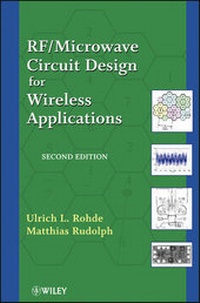
RF / Microwave Circuit Design for Wireless Applications
Description

More details
Other editions
Additional editions
Persons
Content
Preface
When I started 2 years ago to write a book on wireless technology—specifically, circuit design—I had hoped that the explosion of the technology had stabilized. To my surprise, however, the technology is far from settled, and I found myself in a constant chase to catch up with the latest developments. Such a chase requires a fast engine like the Concorde.
In the case of this somewhat older technology, speed still has not been surpassed by any other commercial approach. This tells us there is a lot of design technology that needs to be understood or modified to handle today's needs. Because of the very demanding calculation effort for the circuits, this book makes heavy use of the most modern CAD tools. Hewlett-Packard1 was kind enough to provide us with a copy of their advanced design system (ADS), which also comes with matching synthesis and a wideband CDMA library. Unfortunately, some of the mechanics of getting us started on the software collided with the already delayed schedule of this book, and we were only in a position to reference their advanced capability and not really demonstrate it. The use of this software, including the one from Eagleware, which was also provided to us, needed to be deferred to the next edition of this book. To meet time constraints and give a consistent presentation, we decided to stay with the Ansoft tools. One of the most time-consuming efforts was the actual modeling job, since we wanted to make sure all circuits would work properly. There are too many publications showing incomplete or nonworking designs.
On the positive side, trade journals give valuable insight in state-of-the-art designs, and I would recommend to all engineers to get a free subscription to them. Some of the major ones include Applied Microwave & Wireless, Electronic Design, Electronic Engineering Europe, Microwave Journal, Microwaves & RF, Microwave Product Digest (MPD), RF Design, and Wireless Systems Design.
There are also several conferences that have excellent proceedings, which can be obtained either in book or CD form: GaAs IC Symposium (annual; sponsored by IEEE-EDS, IEEE-MTT), IEEE International Solid-State Circuits Conference (annual), and IEEE MTT-S International Microwave Symposium (annual).
There may be other useful conferences along these lines that are being announced in the trade journals mentioned above, such as in England, Holland, and Germany, and workshops associated with conferences, such as the recent “Designing RF Receivers for Wireless Systems” associated with the IEEE MTT-S.
Other useful tools include courses such as Introduction to RF/MW Design, a four-day short course offered by Besser Associates.
Wireless design can be split into the digital part, which has to do with the various modulation and demodulation capabilities, advantages and disadvantages, and many analog technologies, of which most of this book is composed.
The analog part is complicated by the fact that we have three competing technologies. Given the fact that cost, space, and power consumption are issues for hand-held and battery-operated applications, CMOS has been a strong contestant in the area of cordless telephones because of the relaxed signal-to-noise-ratio specifications compared with cellular telephones. CMOS is much noisier than bipolar and GaAs technologies. One of the problems then is the input/output stage at UHF/SHF frequencies. Here, we find a fierce battle between silicon-germanium (SiGe) transistors and GaAs technology. Most prescalers are bipolar and most power amplifiers are based on GaAs FETs or LDMOS transistors for base stations. The most competitive technologies are the SiGe transistors and, of course, GaAs, the latter being the most expensive of the three mentioned. In the silicon-germanium area, IBM and Maxim seem to be the leaders, with many trying to catch up.
Another important issue is how to differentiate between hand-held or battery-operated applications and base stations. Most designers, who are tasked to look into battery-operated devices, ultimately resort to using available integrated circuits, which seem to change every 6–9 months, and new offerings occur. Given the multiple choices, we have not yet seen a systematic approach of how to select the proper IC families and their members. We have therefore decided to show some guidelines for the design applications of the ICs, mainly focusing on high-performance applications. In the case of high-performance applications, low power consumption is not that big an issue; dynamic range in its various forms tends to be more important. Most of these circuits are designed in discrete portions or use discrete parts. Anyone who has a reasonable antenna and has a line of sight to New York City, with the antenna connected to a spectrum analyzer, will immediately understand this. Between telephones, both cordless and cellular, high-powered pagers, and other services, the spectrum analyzer will be overwhelmed by these signals. IC applications for handsets and other applications already value their parts as “good.” Their third-order intercept points are better than –10 dBm, while the real professional having to design a fixed station is looking for at least +10 dBm, if not more. This applies not only to amplifiers but also to mixer and oscillator performances. We, therefore, decided to give examples of this dynamic range. The following brief survey of current ICs has been assembled for the purpose of showing typical specifications that have been assembled to show the practical needs. It is useful that large companies make both the cellular telephones and integrated circuits or their discrete implementation for base stations. We strongly believe that the circuits selected by us will be useful for all applications.
Chapter 1, as mentioned, is an introduction to the digital modulations that form the foundation of wireless radiocommunication and its performance evaluation. We decided to leave the information regarding actual implementation to more qualified individuals. Since the standards for these modulations are still in a state of flux, we felt that it would not be possible to attack all angles. Chapter 1 contains some very nice material from various sources including tutorial material from my German company, Rohde & Schwarz, in Munich—specifically, from the digital modulation portion of their 1998 Introductory Training for Sales Engineers CD. Note: On a few rare equations, we have used either a picture or an equation more than once so that the reader need not refer to a previous chapter for full understanding of a discussion.
Chapter 2 is a comprehensive introduction into the various semiconductor technologies that enables the designer to make an educated decision. Relevant material such as PIN diodes has also been covered. In many applications, the transistors are being used close to their electrical limits, such as a combination of low voltage and low current. The fT dependency, noise figure, and large-signal performance have to be evaluated. Another important application for diodes is their use as switches, as well as variable capacitances frequently referred to as tuning diodes. In order to better understand what the various parameters of semiconductors mean, we have included a variety of datasheets and some small applications showing which technology is best for what application. In linear applications, noise figure is extremely important; in nonlinear applications, the distortion products need to be known. Therefore, this chapter also includes not only the linear performance of semiconductors but also their nonlinear behavior, including even some details on parameter extraction. Given the number of choices the designer has today and the frequent lack of complete data from manufacturers, these are also important issues.
Chapter 3, the longest chapter, has the most detailed analysis and guidelines for discrete and integrated amplifiers providing deep insight into the semiconductor performance and circuitry necessary to get the best results from the devices. We deal with the properties of the amplifiers, gain stability, and matching, evaluated one-, two-, and three-stage amplifiers with internal dc coupling and feedback as are frequently found in integrated circuits. In doing so, we also provide examples of ICs currently in the market, knowing that every six months more sophisticated devices will appear. Another important topic in this chapter is the choice of bias point and matching for digital signal handling, and we provide insight into such complex issues as the adjacent channel power ratio, which is related to a form of distortion caused by the amplifier in its particular operating mode. To connect these amplifiers, impedance matching is a big issue, and we evaluate some useful couplers and broadband matching circuits useful to these high frequencies. Finally, we provide a tracking filter as preselector, using tuning diodes.
Chapter 4 is a detailed analysis of the available mixer circuits that are applicable to the wireless frequency range. The design also is supplied with the necessary mathematics to calculate the difference between insertion loss and noise figure, and receives insight into the differences between passive and active mixers, additive and multiplicative mixers, and other useful hints. We have also added some very clever circuits from companies such as Motorola and Siemens, as they are available as ICs.
Chapter 5, the oscillator section, is a logical next step to be considered, as many amplifiers turn out to oscillate. After a brief introduction explaining why voltage-controlled oscillators (VCOs) are needed, we cover the...
