

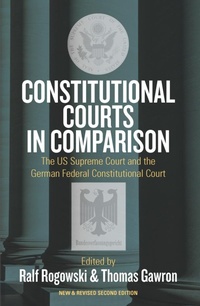
Constitutional Courts in Comparison
Description

Constitutional litigation in general attracts two distinct types of conflict: disputes of a highly politicized or culturally controversial nature and requests from citizens claiming a violation of a fundamental constitutional right. The side-by-side comparison between the U.S. Supreme Court and the German Federal Constitutional Court provides a novel socio-legal approach in studying constitutional litigation, focusing on conditions of mobilisation, decision-making and implementation.
This updated and revised second edition includes a number of new contributions on the political status of the courts in their democratic political cultures.
More details
Other editions
Additional editions
Persons
Ralf Rogowski is Director of the Law and Sociology Programme and Professor of Law in the School of Law at the University of Warwick. His recent books include The Shape of the New Europe (co-authored 2004), Die Wirkung des Bundesverfassungsgerichts (Co-authored with T. Gawron 2007), Reflexive Labour Law in the World Society (2013), and The Sustainability of the European Social Model (Co-edited 2015).
Content
Foreword (second edition)
Ralf Rogowski and Thomas Gawron
Foreword (first edition)
Mark Tushnet
List of Illustrations
List of Tables
Chapter 1. Constitutional Litigation as Dispute Processing - Comparing the U.S. Supreme Court and the German Federal Constitutional Court
Ralf Rogowski and Thomas Gawron
PART I: ACCESS AND CASE SELECTION
Chapter 2. Constitutional Litigation in the United States
Robert A. Kagan and Gregory Elinson
Chapter 3. Access to the German Federal Constitutional Court
Werner Heun
Chapter 4. Mobilization of the German Federal Constitutional Court
Erhard Blankenburg
PART II: DECISION MAKING
Chapter 5. The U.S. Supreme Court's Strategic Decision Making Process
Timothy Johnson and Maron Sorenson
Chapter 6. Decision making at the German Federal Constitutional Court
Uwe Kranenpohl
Chapter 7. Junior Varsity Judges? Law Clerks in the Decisional Process of the U.S. Supreme Court
Artemus Ward
Chapter 8. The Legal Assistants at the German Federal Constitutional Court: A "Black Box" of Research?
Otwin Massing
PART III: IMPLEMENTATION
Chapter 9. The Implementation of U.S. Supreme Court Decisions
Lawrence Baum
Chapter 10. Implementation of German Federal Constitutional Court Decisions - Judicial Orders and the Federal Legislature
Thomas Gawron and Ralf Rogowski
PART IV: COMPARATIVE PERSPECTIVES
Chapter 11. The U.S. Supreme Court and the German Federal Constitutional Court - Selection, Nomination and Election of Justices
Klaus Stüwe
Chapter 12. The Impact of the German Federal Constitutional Court on Consolidation and Quality of Democracy
Sascha Kneip
Chapter 13. Constitutional Courts in Changing Political Systems
Hans J. Lietzmann
List of Contributors
Index
