

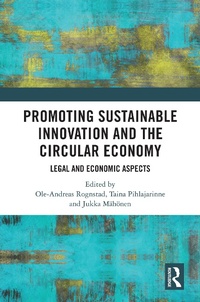
Promoting Sustainable Innovation and the Circular Economy
Legal and Economic Aspects
1st Edition
Published on 26. July 2024
222 pages
978-1-040-10470-5 (ISBN)
Description

The book explores the role of public market actors in sustainable and circular economy innovation and financing.
The shift to a circular economy requires active innovation, alongside radical changes in law, finance and policy considerations, since regulation is often tightly connected with the assumption of a linear model of consumption. Finance is crucial in creating sustainable and circular economy markets and innovations: public finance is important from the perspective of seeing the state as an engine for promoting sustainable innovations, but private funds are also required. Legislative initiatives for promoting repairs have been proposed or adopted in the EU, US and in Australia, representing remarkable steps forward but still leaving many obstacles without legislative intervention. This book examines circular economy regulation and policy on a comprehensive, general level, as well as assessing the regulatory possibilities of promoting the right to repair. Promotion of circular economy innovations as well as changing the practices and changing consumer patterns towards a more comprehensive adoption of CE are discussed from perspectives of legal, social and moral norms. The book critically evaluates current legislative reforms and assesses existing barriers to the circular economy and innovation in intellectual property law, consumer law and competition law.
Providing an in-depth analysis of this dynamic field, geared towards reconsidering both existing and prospective policies and regulatory regime, the book makes recommendations for solutions to legislative barriers. It is an indispensable resource for both researchers and practitioners working at the intersections of markets, innovations and sustainability.
The shift to a circular economy requires active innovation, alongside radical changes in law, finance and policy considerations, since regulation is often tightly connected with the assumption of a linear model of consumption. Finance is crucial in creating sustainable and circular economy markets and innovations: public finance is important from the perspective of seeing the state as an engine for promoting sustainable innovations, but private funds are also required. Legislative initiatives for promoting repairs have been proposed or adopted in the EU, US and in Australia, representing remarkable steps forward but still leaving many obstacles without legislative intervention. This book examines circular economy regulation and policy on a comprehensive, general level, as well as assessing the regulatory possibilities of promoting the right to repair. Promotion of circular economy innovations as well as changing the practices and changing consumer patterns towards a more comprehensive adoption of CE are discussed from perspectives of legal, social and moral norms. The book critically evaluates current legislative reforms and assesses existing barriers to the circular economy and innovation in intellectual property law, consumer law and competition law.
Providing an in-depth analysis of this dynamic field, geared towards reconsidering both existing and prospective policies and regulatory regime, the book makes recommendations for solutions to legislative barriers. It is an indispensable resource for both researchers and practitioners working at the intersections of markets, innovations and sustainability.
More details
Edition
1. Auflage
Language
English
Place of publication
London
United Kingdom
Publishing group
Taylor & Francis Ltd
Target group
Professional and scholarly
College/higher education
Illustrations
2 Tables, black and white
ISBN-13
978-1-040-10470-5 (9781040104705)
Copyright in bibliographic data and cover images is held by Nielsen Book Services Limited or by the publishers or by their respective licensors: all rights reserved.
Schweitzer Classification
Other editions
Additional editions
Ole-Andreas Rognstad | Taina Pihlajarinne | Jukka Maehoenen
Promoting Sustainable Innovation and the Circular Economy
Legal and Economic Aspects
Book
05/2026
1st Edition
Routledge
€57.50
Shipment within 10-20 days

Ole-Andreas Rognstad | Taina Pihlajarinne | Jukka Maehoenen
Promoting Sustainable Innovation and the Circular Economy
Legal and Economic Aspects
Book
08/2024
Routledgetaylor & Francis Group
Unfortunately, price unknown
Available (delivery time upon request)
Ole-Andreas Rognstad | Taina Pihlajarinne | Jukka Maehoenen
Promoting Sustainable Innovation and the Circular Economy
Legal and Economic Aspects
Book
07/2024
1st Edition
Routledge
€187.10
Shipment within 10-20 days
Persons
Ole-Andreas Rognstad is full professor at the Department of Private Law, and director of Centre of European law, University of Oslo. He teaches a whole range of subjects, including legal methodology and EU/EEA law and intellectual property law, in particular copyright law. His authorship includes a textbook on (Norwgian) copyright law, a monograph on Property Aspects of Intellectual Property, contributions to a (co-authored) textbook on EEA law as well as a large number of articles mainly in the field of intellectual property. He has chaired, and been a member of, a number of public dispute settlement resolution bodies in Norway and is a member of the European Copyright Society, Academia Europea and the Norwegian Academy of Science and Art.
Taina Pihlajarinne is a professor at the Helsinki University Faculty of Law. Her research interests are focused on the relationship between sustainability and private law, especially intellectual property rights. She has also written articles and books about technological development and IPRs. At this moment she leads the research project "Shaping, fixing and making markets via IPR: regulating sustainable innovation ecosystems" funded by the Academy of Finland.
Jukka Maehoenen is Professor of Cooperative Law at the University of Helsinki and Professor of Law at the University of Oslo. He is a sub-project principal investigator in the Research Council of Finland project Shaping, fixing and making markets via IPR: regulating sustainable innovation ecosystems (SHARE) and a work package leader in a Horizon Europe project Towards a New Zero Food Waste Mindset Based on Holistic Assessment (ToNoWaste). He holds LL.M. (Berkeley), M.Sc. (Econ.) (Turku), LL.Lic. (Turku) and LL.D. (Turku) degrees. His research interests are in accounting and auditing law, cooperative and company law, sustainability law and private global governance.
Taina Pihlajarinne is a professor at the Helsinki University Faculty of Law. Her research interests are focused on the relationship between sustainability and private law, especially intellectual property rights. She has also written articles and books about technological development and IPRs. At this moment she leads the research project "Shaping, fixing and making markets via IPR: regulating sustainable innovation ecosystems" funded by the Academy of Finland.
Jukka Maehoenen is Professor of Cooperative Law at the University of Helsinki and Professor of Law at the University of Oslo. He is a sub-project principal investigator in the Research Council of Finland project Shaping, fixing and making markets via IPR: regulating sustainable innovation ecosystems (SHARE) and a work package leader in a Horizon Europe project Towards a New Zero Food Waste Mindset Based on Holistic Assessment (ToNoWaste). He holds LL.M. (Berkeley), M.Sc. (Econ.) (Turku), LL.Lic. (Turku) and LL.D. (Turku) degrees. His research interests are in accounting and auditing law, cooperative and company law, sustainability law and private global governance.
Content
1. Introduction
2. Innovations and Small and Medium-sized Enterprises for Sustainability and the Circular Economy
3. Financial Risks of Unsustainability: Digital Innovations
4. Sustainability Policies to Incentivize Data Driven Innovation
5. Opening Up Big Data for Sustainability: What Role for Database Rights in the Fourth Industrial Revolution?
6. An Access and Transfer Right (ATR) - A Different Form of Right to Data for the Internet of Things
7. 'Data Ownership' Ambiguity - to the Detriment of Sustainable Innovation
8. The Right to Repair in the United States
9. The Right to Repair in Australia
10. Shifting Normality - Regulation of Planned and Premature Obsolescence in Europe
11. Conclusions
2. Innovations and Small and Medium-sized Enterprises for Sustainability and the Circular Economy
3. Financial Risks of Unsustainability: Digital Innovations
4. Sustainability Policies to Incentivize Data Driven Innovation
5. Opening Up Big Data for Sustainability: What Role for Database Rights in the Fourth Industrial Revolution?
6. An Access and Transfer Right (ATR) - A Different Form of Right to Data for the Internet of Things
7. 'Data Ownership' Ambiguity - to the Detriment of Sustainable Innovation
8. The Right to Repair in the United States
9. The Right to Repair in Australia
10. Shifting Normality - Regulation of Planned and Premature Obsolescence in Europe
11. Conclusions
