

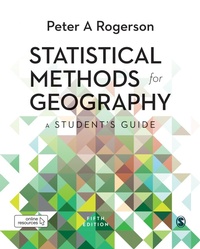
Statistical Methods for Geography
A Student's Guide
5th Edition
Published on 4. December 2019
432 pages
978-1-5297-0021-3 (ISBN)
Description

Statistical Methods for Geography is the essential introduction for geography students looking to fully understand and apply key statistical concepts and techniques. Now in its fifth edition, this text is an accessible statistics '101' focused on student learning, and includes definitions, examples, and exercises throughout. Fully integrated with online self-assessment exercises and video overviews, it explains everything required to get full credits for any undergraduate statistics module.
The fifth edition of this bestselling text includes:
? Coverage of descriptive statistics, probability, inferential statistics, hypothesis testing and sampling, variance, correlation, regression analysis, spatial patterns, spatial data reduction using factor analysis and cluster analysis.
? New examples from physical geography and additional real-world examples.
? Updated in-text and online exercises along with downloadable datasets.
This is the only text you'll need for undergraduate courses in statistical analysis, statistical methods, and quantitative geography.
The fifth edition of this bestselling text includes:
? Coverage of descriptive statistics, probability, inferential statistics, hypothesis testing and sampling, variance, correlation, regression analysis, spatial patterns, spatial data reduction using factor analysis and cluster analysis.
? New examples from physical geography and additional real-world examples.
? Updated in-text and online exercises along with downloadable datasets.
This is the only text you'll need for undergraduate courses in statistical analysis, statistical methods, and quantitative geography.
Reviews / Votes
This book has become the gold standard for teaching statistical methods to geographers. With a friendly and accessible manner, the author covers introductory statistics while revealing the quirkiness of spatial data. It is suitable for a one-year undergraduate class in geography, and there is no better reference for students transitioning to graduate studies. While always including rich examples form human geography, this new edition includes more examples from physical geography that will appeal to a wider audience. -- Nicholas Nagle Absolutely fabulous resource that connects the utility of statistics for addressing geographic problems and issues. I have long used this text in teaching and research, beginning with the first edition in 2001. The continued revision and updating make this the premier text for introductory quantitative geographical inquiry. -- Alan MurrayMore details
Edition
Fifth Edition
Language
English
Place of publication
London
United Kingdom
Publishing group
Sage Publications Ltd (Digital)
Target group
College/higher education
Product notice
Reflowable
File size
15,36 MB
ISBN-13
978-1-5297-0021-3 (9781529700213)
Copyright in bibliographic data and cover images is held by Nielsen Book Services Limited or by the publishers or by their respective licensors: all rights reserved.
Schweitzer Classification
Other editions
Additional editions
Book
12/2019
5th Edition
SAGE Publications Ltd
€262.94
Shipment within 15-20 days
Book
12/2019
5th Edition
SAGE Publications Ltd
€66.32
Shipment within 15-20 days
Person
Peter A. Rogerson is SUNY (State University of New York) Distinguished Professor in the Department of Geography at the University at Buffalo, Buffalo, New York, USA. He also holds an adjunct appointment in the Department of Biostatistics.
Content
1 INTRODUCTION TO STATISTICAL METHODS FOR GEOGRAPHY
1.1 Introduction
1.2 The scientific method
1.3 Exploratory and confirmatory approaches in geography
1.4 Probability and statistics
1.5 Descriptive and inferential methods
1.6 The nature of statistical thinking
1.7 Special considerations for spatial data
1.8 The structure of the book
1.9 Datasets
2 DESCRIPTIVE STATISTICS
2.1 Types of data
2.2 Visual descriptive methods
2.3 Measures of central tendency
2.4 Measures of variability
2.5 Other numerical measures for describing data
2.6 Descriptive spatial statistics
2.7 Descriptive statistics in SPSS 25 for Windows
Solved exercises
Exercises
3 PROBABILITY AND DISCRETE PROBABILITY DISTRIBUTIONS
3.1 Introduction
3.2 Sample spaces, random variables, and probabilities
3.3 Binomial processes and the binomial distribution
3.4 The geometric distribution
3.5 The Poisson distribution
3.6 The hypergeometric distribution
3.7 Binomial tests in SPSS 25 for Windows
Solved exercises
Exercises
4 CONTINUOUS PROBABILITY DISTRIBUTIONS AND PROBABILITY MODELS
4.1 Introduction
4.2 The uniform or rectangular distribution
4.3 The normal distribution
4.4 The exponential distribution
4.5 Summary of discrete and continuous distributions
4.6 Probability models
Solved exercises
Exercises
5 INFERENTIAL STATISTICS: CONFIDENCE INTERVALS, HYPOTHESIS TESTING, AND SAMPLING
5.1 Introduction to inferential statistics
5.2 Confidence intervals
5.3 Hypothesis testing
5.4 Distributions of the random variable and distributions of the test statistic
5.5 Spatial data and the implications of nonindependence
5.6 Further discussion of the effects of deviations from the assumptions
5.7 Sampling
5.8 Some tests for spatial measures of central tendency and variability
5.9 One-sample tests of means in SPSS 25 for Windows
5.10 Two-sample t-tests in SPSS 25 for Windows
Solved exercises
Exercises
6 ANALYSIS OF VARIANCE
6.1 Introduction
6.2 Illustrations
6.3 Analysis of variance with two categories
6.4 Testing the assumptions
6.5 Consequences of failure to meet assumptions
6.6 The nonparametric Kruskal-Wallis test
6.7 The nonparametric median test
6.8 Contrasts
6.9 One-way ANOVA in SPSS 25 for Windows
6.10 One-way ANOVA in Excel
Solved exercises
Exercises
7 CORRELATION
7.1 Introduction and examples of correlation
7.2 More illustrations
7.3 A significance test for r
7.4 The correlation coefficient and sample size
7.5 Spearman's rank correlation coefficient
7.6 Additional topics
7.7 Correlation in SPSS 25 for Windows
7.8 Correlation in Excel
Solved exercises
Exercises
8 DATA REDUCTION: FACTOR ANALYSIS AND CLUSTER ANALYSIS
8.1 Introduction
8.2 Factor analysis and principal components analysis
8.3 Cluster analysis
8.4 Data reduction methods in SPSS 25 for Windows
Exercises
9 INTRODUCTION TO REGRESSION ANALYSIS
9.1 Introduction
9.2 Fitting a regression line to a set of bivariate data
9.3 Regression in terms of explained and unexplained sums of squares
9.4 Assumptions of regression
9.5 Standard error of the estimate
9.6 Tests for ss
9.7 Illustration: state aid to secondary schools
9.8 Linear versus nonlinear models
9.9 Regression in SPSS 25 for Windows
9.10 Regression in Excel
Solved exercises
Exercises
10 MORE ON REGRESSION
10.1 Multiple regression
10.2 Misspecification error
10.3 Dummy variables
10.4 Multiple regression illustration: species in the Galapagos Islands
10.5 Variable selection
10.6 Regression analysis on component scores
10.7 Categorical dependent variable
10.8 A summary of some problems that can arise in regression analysis
10.9 Multiple and logistic regression in SPSS 25 for Windows
Exercises
11 SPATIAL DATA, SPATIAL PATTERNS, AND SPATIAL REGRESSION
11.1 Introduction
11.2 The analysis of point patterns
11.3 Geographic patterns in areal data
11.4 Local statistics
11.5 Introduction to spatial aspects of regression
11.6 Spatial lag model and neighborhood-based explanatory variables
11.7 Spatial regression: autocorrelated errors
11.8 Geographically weighted regression
11.9 Illustration
11.10 Finding Moran's I using SPSS 25 for Windows
11.11 Finding Moran's I using GeoDa
11.12 Spatial Regression with GeoDa 1.4.6
Exercises
EPILOGUE
ANSWERS FOR SELECTED EXERCISES
APPENDIX A: STATISTICAL TABLES
APPENDIX B: MATHEMATICAL CONVENTIONS AND NOTATION
Bibliography
Index
1.1 Introduction
1.2 The scientific method
1.3 Exploratory and confirmatory approaches in geography
1.4 Probability and statistics
1.5 Descriptive and inferential methods
1.6 The nature of statistical thinking
1.7 Special considerations for spatial data
1.8 The structure of the book
1.9 Datasets
2 DESCRIPTIVE STATISTICS
2.1 Types of data
2.2 Visual descriptive methods
2.3 Measures of central tendency
2.4 Measures of variability
2.5 Other numerical measures for describing data
2.6 Descriptive spatial statistics
2.7 Descriptive statistics in SPSS 25 for Windows
Solved exercises
Exercises
3 PROBABILITY AND DISCRETE PROBABILITY DISTRIBUTIONS
3.1 Introduction
3.2 Sample spaces, random variables, and probabilities
3.3 Binomial processes and the binomial distribution
3.4 The geometric distribution
3.5 The Poisson distribution
3.6 The hypergeometric distribution
3.7 Binomial tests in SPSS 25 for Windows
Solved exercises
Exercises
4 CONTINUOUS PROBABILITY DISTRIBUTIONS AND PROBABILITY MODELS
4.1 Introduction
4.2 The uniform or rectangular distribution
4.3 The normal distribution
4.4 The exponential distribution
4.5 Summary of discrete and continuous distributions
4.6 Probability models
Solved exercises
Exercises
5 INFERENTIAL STATISTICS: CONFIDENCE INTERVALS, HYPOTHESIS TESTING, AND SAMPLING
5.1 Introduction to inferential statistics
5.2 Confidence intervals
5.3 Hypothesis testing
5.4 Distributions of the random variable and distributions of the test statistic
5.5 Spatial data and the implications of nonindependence
5.6 Further discussion of the effects of deviations from the assumptions
5.7 Sampling
5.8 Some tests for spatial measures of central tendency and variability
5.9 One-sample tests of means in SPSS 25 for Windows
5.10 Two-sample t-tests in SPSS 25 for Windows
Solved exercises
Exercises
6 ANALYSIS OF VARIANCE
6.1 Introduction
6.2 Illustrations
6.3 Analysis of variance with two categories
6.4 Testing the assumptions
6.5 Consequences of failure to meet assumptions
6.6 The nonparametric Kruskal-Wallis test
6.7 The nonparametric median test
6.8 Contrasts
6.9 One-way ANOVA in SPSS 25 for Windows
6.10 One-way ANOVA in Excel
Solved exercises
Exercises
7 CORRELATION
7.1 Introduction and examples of correlation
7.2 More illustrations
7.3 A significance test for r
7.4 The correlation coefficient and sample size
7.5 Spearman's rank correlation coefficient
7.6 Additional topics
7.7 Correlation in SPSS 25 for Windows
7.8 Correlation in Excel
Solved exercises
Exercises
8 DATA REDUCTION: FACTOR ANALYSIS AND CLUSTER ANALYSIS
8.1 Introduction
8.2 Factor analysis and principal components analysis
8.3 Cluster analysis
8.4 Data reduction methods in SPSS 25 for Windows
Exercises
9 INTRODUCTION TO REGRESSION ANALYSIS
9.1 Introduction
9.2 Fitting a regression line to a set of bivariate data
9.3 Regression in terms of explained and unexplained sums of squares
9.4 Assumptions of regression
9.5 Standard error of the estimate
9.6 Tests for ss
9.7 Illustration: state aid to secondary schools
9.8 Linear versus nonlinear models
9.9 Regression in SPSS 25 for Windows
9.10 Regression in Excel
Solved exercises
Exercises
10 MORE ON REGRESSION
10.1 Multiple regression
10.2 Misspecification error
10.3 Dummy variables
10.4 Multiple regression illustration: species in the Galapagos Islands
10.5 Variable selection
10.6 Regression analysis on component scores
10.7 Categorical dependent variable
10.8 A summary of some problems that can arise in regression analysis
10.9 Multiple and logistic regression in SPSS 25 for Windows
Exercises
11 SPATIAL DATA, SPATIAL PATTERNS, AND SPATIAL REGRESSION
11.1 Introduction
11.2 The analysis of point patterns
11.3 Geographic patterns in areal data
11.4 Local statistics
11.5 Introduction to spatial aspects of regression
11.6 Spatial lag model and neighborhood-based explanatory variables
11.7 Spatial regression: autocorrelated errors
11.8 Geographically weighted regression
11.9 Illustration
11.10 Finding Moran's I using SPSS 25 for Windows
11.11 Finding Moran's I using GeoDa
11.12 Spatial Regression with GeoDa 1.4.6
Exercises
EPILOGUE
ANSWERS FOR SELECTED EXERCISES
APPENDIX A: STATISTICAL TABLES
APPENDIX B: MATHEMATICAL CONVENTIONS AND NOTATION
Bibliography
Index
