

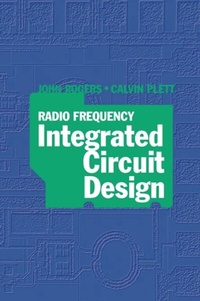
Radio Frequency Integrated Circuit Design
1st Edition
Published on 1. January 2003
430 pages
978-1-58053-485-7 (ISBN)
Description

No matter which type of communications device requiring RFICs you are designing, you can turn to this comprehensive reference for a practical explanation of the full range of RFICs. This book focuses mainly on bipolar technology to demonstrate circuits, but CMOS is included as well. By emphasizing working designs, this book practically transports you into the authors' own RFIC lab so you can fully understand the function of each design detailed in this book. Among the RFIC designs examined are RF integrated LC-based filters, VCO automatic amplitude control loops, and fully integrated transformer-based circuits, as well as image reject mixers and power amplifiers.
More details
Other editions
Additional editions
John Rogers | Calvin Plett
Radio Frequency Integrated Circuit Design
Book
04/2003
Artech House Publishers
€146.50
Shipment within 10-20 days
Content
- Intro
- Contents
- Foreword
- Acknowledgements
- 1. Introduction to Communications Circuits
- 1.1 Introduction
- 1.2 Lower Frequency Analog Design and Microwave Desigh Versus Radio Frequency Integrated Circuit Design
- 1.3 Radio Frequency Integrated Circuits Used in a Communications Transceiver
- 1.4 Overview
- References
- 2. Issues in RFIC Design, Noise, Linearity, and Filtering
- 2.1 Introduction
- 2.2 Noise
- 2.3 Linearity and Distortion in RF Circuits
- 2.4 Dynamic Range
- 2.5 Filtering Issues
- References
- Selected Bibliography
- 3. A Brief Review of Technology
- 3.1 Introduction
- 3.2 Bipolar Transistor Description
- 3.3 Beta Current Dependance
- 3.4 Small-Signal Model
- 3.5 Small-Signal Parameters
- 3.6 High Frequency Effects
- 3.7 Noise in Bipolar Transistors
- 3.8 Base Shot Noise Discussion
- 3.9 Noise Sources in the Transistor Model
- 3.10 Bipolar Transistor Design Considerations
- 3.11 CMOS Transistors
- References
- 4. Impedance Matching
- 4.1 Introduction
- 4.2 Review of the Smith Chart
- 4.3 Impedance Matching
- 4.4 Conversions Between Series and Parallel Resistor-Inductor and Resistor-Capacitor Circuits
- 4.5 Tapped Capacitors and Inductors
- 4.6 The Concept of Mutual Inductance
- 4.7 Matching Using Transformers
- 4.8 Tuning a Transformer
- 4.9 The Bandwidth of an Impedance Transformation Network
- 4.10 Quality Factor of an LC Resonator
- 4.11 Transmission Lines
- 4.12 S, Y, and Z Parameters
- References
- 5. The Use and Design of Passive Circuit Elements in IC Technologies
- 5.1 Introduction
- 5.2 The Technology Back End and Metallization in IC Technologies
- 5.3 Sheet Resistance and the Skin Effect
- 5.4 Parasitic Capacitance
- 5.5 Parasitic Inductance
- 5.6 Current Handling in Metal Lines
- 5.7 Poly Resistors and Diffusion Resistors
- 5.8 Metal-Insulator-Metal Capacitors and Poly Capacitors
- 5.9 Applications of On-Chip Spiral Inductors and Transformers
- 5.10 Design of Inductors and Transformers
- 5.11 Some Basic Lumped Models for Inductors
- 5.12 Calculating the Inductance of Spirals
- 5.13 Self-Resonance of Inductors
- 5.14 The Quality Factor of an Inductor
- 5.15 Characterization of an Inductor
- 5.16 Some Notes About the Proper Use of Inductors
- 5.17 Layout of Spiral Inductors
- 5.18 Isolating the Inductor
- 5.19 The Use of Slotted Ground Shields and Inductors
- 5.20 Basic Transformer Layouts in IC Technologies
- 5.21 Multilevel Inductors
- 5.22 Characterizing Transformers for Use in ICs
- 5.23 On-Chip Transmissons Lines
- 5.24 High-Frequency Measurement of On-Chip Passives and Some Common De-Embedding Techniques
- 5.25 Packaging
- References
- 6. LNA Design
- 6.1 Introduction and Basic Amplifiers
- 6.2 Amplifiers with Feedback
- 6.3 Noise in Amplifiers
- 6.4 Linearity in Amplifiers
- 6.5 Differential Pair (Emitter-Coupled Pair and Other Differential Amplifiers
- 6.6 Low-Voltage Topologies for LNAs and the Use of On-Chip Transformers
- 6.7 DC Bias Networks
- 6.8 Boradband LNA Design Example
- References
- Selected Bibliography
- 7. Mixers
- 7.1 Introduction
- 7.2 Mixing with Nonlinearity
- 7.3 Basic Mixer Operation
- 7.4 Controlled Transconductance Mixer
- 7.5 Double-Balanced Mixer
- 7.6 Mixer with Switching of Upper Quad
- 7.7 Mixer Noise
- 7.8 Linearity
- 7.9 Improving Isolation
- 7.10 IMage Reject and Single-Sideband Mixer
- 7.11 Alternative Mixer Designs
- 7.12 General Design Comments
- 7.13 CMOS Mixers
- References
- Selected Bibliography
- 8. Voltage-Controled Oscillators
- 8.1 Introduction
- 8.2 Specification of Oscillator Properties
- 8.3 The LC Resonator
- 8.4 Adding Negative Resistance Through Feedback to the Resonator
- 8.5 Popular Implementation of Feedback to the Resonator
- 8.6 Configuration of the Amplifier
- 8.7 Analysis of an Oscillator as a Feedback System
- 8.8 Negative Resistance Generated by the Amplifier
- 8.9 Comments on Oscillator Analysis
- 8.10 Basic Differential Oscillator Topologies
- 8.11 A Modified Common-Collector Colpitts Oscillator with Buffering
- 8.12 Several Refinements to the -Gm Topology
- 8.13 The Effect of Parasitics on the Frequency of Oscillation
- 8.14 Large-Signal Nonlinearity in the Transistor
- 8.15 Bias Shifting During Startup
- 8.16 Oscillator Amplitude
- 8.17 Phase Noise
- 8.18 Making the Oscillator Tunable
- 8.19 VCO Automatic-Amplitude Control Circuits
- 8.20 Other Oscillators
- References
- Selected Bibliography
- 9. High-Frequency Filter Circuits
- 9.1 Introduction
- 9.2 Second-Order Filters
- 9.3 Integrated RF Filters
- 9.4 Achieving Filter with Higher Q
- 9.5 Some Simple Image Rejection Formulas
- 9.6 Linearity of the Negative Resistance Circuits
- 9.7 Noise Added Due to the Filter Circuitry
- 9.8 Automatic Q Tuning
- 9.9 Frequency Tuning
- 9.10 Higher-Order Filters
- References
- Selected Bibliography
- 10. Power Amplifiers
- 10.1 Introduction
- 10.2 Power Capability
- 10.3 Efficiancy Calculations
- 10.4 Matching Considerations
- 10.5 Class A, B, and C Amplifiers
- 10.6 Class D Amplifiers
- 10.7 Class E Amplifiers
- 10.8 Class F Amplifiers
- 10.9 Class G and H Amplifiers
- 10.10 Class S Amplifiers
- 10.11 Summary of Amplifier Classes for RF Inegrated Circuits
- 10.12 AC Load Line
- 10.13 Matching to Achieve Desired Power
- 10.14 Transistor Saturation
- 10.15 Current Limits
- 10.16 Current Limits in Integrated Inductors
- 10.17 Power Combining
- 10.18 Thermal Runaway-Ballasting
- 10.19 Breakdown Voltage
- 10.20 Packaging
- 10.21 Effects and Implication of Nonlinearity
- 10.22 CMOS Power Amplifier Example
- References
- About the Authors
- Index
