

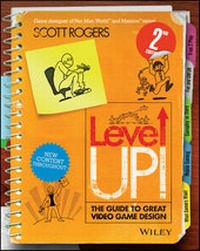
Level Up! The Guide to Great Video Game Design
Description

If you want to design and build cutting-edge video games butaren't sure where to start, then the SECOND EDITION of theacclaimed Level Up! is for you! Written by leading videogame expert Scott Rogers, who has designed the hits Pac ManWorld, Maximo and SpongeBob Squarepants, thisupdated edition provides clear and well-thought out examples thatforgo theoretical gobbledygook with charmingly illustrated conceptsand solutions based on years of professional experience.
Level Up! 2nd Edition has been NEWLYEXPANDED to teach you how to develop marketable ideas, learn whatperils and pitfalls await during a game's pre-production,production and post-production stages, and provide even morecreative ideas to serve as fuel for your own projectsincluding:
* Developing your game design from the spark of inspiration allthe way to production
* Learning how to design the most exciting levels, the mostprecise controls, and the fiercest foes that will keep your playerschallenged
* Creating games for mobile and console systems - includingdetailed rules for touch and motion controls
* Monetizing your game from the design up
* Writing effective and professional design documents with thehelp of brand new examples
Level Up! 2nd Edition is includes all-new content, anintroduction by David "God of War" Jaffe andeven a brand-new chili recipe -making it an even moreindispensable guide for video game designers both "in thefield" and the classroom.
Grab your copy of Level Up! 2nd Edition andlet's make a game!
More details
Other editions
Additional editions
Person
Scott Rogers (Thousand Oaks, CA) is a Principal Imagineer at Walt Disney. After deciding that game designers have more fun, Scott embarked on a career creating game designs for a number of successful titles including Sony's GOD OF WAR, Capcom's MAXIMO: GHOSTS TO GLORY and its sequel MAXIMO VS. ARMY OF ZIN, Namco's PAC-MAN WORLD and THQ's DRAWN TO LIFE series. He lives in Thousand Oaks with his family and a large collection of video games.
Content
Introduction Press Start! 1
If You Are Anything Like Me 1
No, You Can't Have My Job 3
Who Is This Book For? 4
Why a Second Edition? 6
Level 1 Welcome, N00bs! 7
A Brief History of Video Games 10
The Brave New World of Gaming: Mobiles, Online Distribution, and Touchscreens 14
Game Genres 16
Who Makes This Stuff? 17
Programmer 18
Artist 19
Designer 20
Producer 20
Tester 21
Composer 22
Sound Designer 23
Writer 23
Have You Thought about Publishing? 25
Product Manager 25
Creative Manager 25
Art Director 26
Technical Director 26
Marketing Team 26
And the Rest 26
Level 2 Ideas 29
Ideas: Where to Get Them and Where to Stick Them 30
Getting Ahead of the Game 32
What Do Gamers Want? 35
Brainstorming 36
Breaking Writer's Block 38
Why I Hate "Fun" 40
Level 3 Writing the Story 43
Once Upon a Time 43
The Triangle of Weirdness 50
A Likely Story 52
Time to Wrap It Up 55
A Game by Any Other Name 56
Creating Characters Your Players Care About 58
A Few Pointers on Writing for Kids of All Ages 62
Writing for Licenses 62
Level 4 You Can Design a Game, but Can You Do the Paperwork? 65
Writing the GDD, Step 1: The One-Sheet 68
ESRB Ratings 69
Unique Selling Points 70
Competitive Products 70
Writing the GDD, Step 2: The Ten-Pager 71
The Rule of Threes 72
The Ten-Pager Outline 73
Page 1: Title Page 73
Page 2: Game Outline 73
Page 3: Character 74
Page 4: Gameplay 75
Page 5: Game World 76
Page 6: Game Experience 76
Page 7: Gameplay Mechanics 77
Page 8: Enemies 79
Page 9: Multiplayer and Bonus Materials 80
Page 10: Monetization 80
Writing the GDD, Step 3: Gameplay Progression 81
Writing the GDD, Step 4: The Beat Chart 82
Writing the GDD, Step 5: The Game Design Document (and the Awful Truth about Writing It) 85
Writing the GDD, Step 6: Above All, Don't Be a Jerk 89
Level 5 The Three Cs, Part 1: Character 93
Who Do You Want To Be Today? 94
Personality: Do We Really Need Another Kratos? 96
Let's Get Personal 98
Using All the Parts 102
Games Without Characters 103
We Are Not Alone 104
When More Is More 107
Who Are the People in Your Neighborhood? 109
Finally, We Talk About Gameplay 111
Metrics for Non-Characters 114
Be Kind to Our Four-Legged Friends 114
Why Walk When You Can Run? 114
The Art of Doing Nothing 119
Might as Well Jump 120
Hoists and Teeters 124
What Goes Up Must Fall Down 125
Me and My Shadow 126
The Water's Fine . . . or Is It? 127
Level 6 The Three Cs, Part 2: Camera 131
Get It Right: Camera Views 132
First Person Camera 136
Third Person Camera 138
Giving Up Control 142
So You've Decided to Let the Player Control the Camera 142
So You've Decided Not to Let the Player Have Control over the Camera 144
So You've Decided to Let Players Sometimes Have Control over the Camera 145
Two and a Half D 145
Isometric Camera 146
Top-Down Camera 148
AR Cameras 149
Special Case Cameras 149
Tunnel Vision 150
Camera Shot Guide 150
Camera Angle Guide 153
Camera Movement Guide 154
Other Camera Notes 157
Always Point the Camera to the Objective 158
Never Let the Character Get out of the Camera's Sight 159
Multiple-Player Cameras 159
Level 7 The Three Cs, Part 3: Controls 163
Control Is in Your Hand 164
You've Got the Touch 167
Dance, Monkey, Dance 169
Character or Camera Relative? 175
Shake, Rattle, and Roll 177
Level 8 Sign Language: HUD and Icon Design 181
Heads Up! 181
Health Bar 182
Targeting Reticule 183
Ammo Gauge 184
Inventory 185
Score/Experience 185
Positive Messaging 186
Radar/Map 187
Context-Sensitive Prompts 188
The Clean Screen 190
Icon Has Cheezburger? 191
Creating Icons for Mobile Games 194
Don't Get QTE 196
HUDs and Where to Stick 'Em 198
There Are Other Screens Than the HUD 199
A Final Word on Fonts 207
Level 9 Everything I Learned About Level Design, I Learned from Level 9 209
The Top 10 Cliché Video Game Themes 212
The Name Game 218
Everything I Learned About Level Design, I Learned from Disneyland 220
Mapping the World 221
Foreshadowing 222
Goal Setting 223
Following Procedure 225
You've Got the Beat 227
Re-using Re-use 229
The Gary Gygax Memorial Mapping Section 230
Sandbox Play 233
Illusional Narrative 236
The Dave Arneson Memorial Mapping Section 237
Wrapping Up Mapping 248
Gray Matters 251
Leave the Training Level for Last 253
Levels without Characters 254
Level 10 The Elements of Combat 257
400 Quatloos on the Newcomer! 259
Put 'Em Up! 262
And a One and a Two 266
The Big Finish 268
Live by the Sword 270
Now You Have to Kiss Me 273
Let's Get Defensive 273
Dodging the Bullet 276
On Guarding 277
State of the Art Bang Bang 281
The Best Gun for You 286
Run and Gun 290
Not Just Shooting 293
Dang it, Jones! Where Doesn't It Hurt? 297
Death: What Is It Good For? 299
Conflict Without Combat 301
Level 11 They All Want You Dead 305
Sizing Up the Enemy 307
Bad Behavior 308
How Rapid is Rapid? 313
Movement Style 316
Bring on the Bad Guys 318
I Love Designing Enemies 327
The Alphabetical Bestiary of Choices 328
I Hate You to Pieces 337
Non-Enemy Enemies 341
How to Create the World's Greatest Boss Battle 342
Who's the Boss? 342
Size Matters 344
Location, Location, Location 349
Why Not to Create the World's Greatest Boss Battle 351
Level 12 The Nuts and Bolts of Mechanics 353
The Mechanics of Mechanics 353
Holy Death Trap! 357
What I Learned from Making Kids Cry 360
Time to Die 361
The Music of Mechanics 364
Chip Off the Old Block 368
A Nice Little Calm Spot 371
Riddle Me This 372
Puzzle Me That 375
Minigames and Microgames 377
Level 13 Now You're Playing with Power 381
Powering Up 381
"Love Thy Player" 388
Seriously. "Love Thy Player." 390
More Wealth Than You Can Imagine! 391
High Score 394
Achievements 395
Money! Money! Money! 395
Souvenirs 399
Bonus Section about Bonus Features 400
How to Win at Losing 402
Level 14 Multiplayer-The More the Merrier 405
How Many Is the Right Number? 410
MMORPGS, or Hell Is Other People 410
Designing Multiplayer Levels 415
Planning Your Level 415
Mapping Your Level 416
Building Your Level 417
The Dirty Half Dozen 418
Level 15 Everybody Wins: Monetization 419
Cashing In 422
Money Is the Root of Something Something 423
Level 16 Some Notes on Music 427
I Know It When I Hear It 429
Music with Style 430
And the Beat Goes On 431
Sounds Like a Game to Me 434
Level 17 Cutscenes, or No One's Gonna Watch 'Em Anyway 441
A Cut Above 442
How to Write a Screenplay in Eight Easy Steps 444
Finding Your Voice 448
Level 18 And Now the Hard Part 451
No One Cares About Your Stupid Little World 452
Who's Paying? 455
Video Games Is a Haaaard Business 456
When Reality Gets in the Way 457
Emergent, Vertical, or Horizontal? 459
What to Do for an Encore? 462
Continue? 467
Time to Level Up! 467
Bonus Level 1
The One-Sheet Sample 469
Bonus Level 2
The Ten-Page Design Document Sample 473
Bonus Level 3
Game Design Document Template 485
Bonus Level 4
The Medium-Sized List of Story Genres 493
Bonus Level 5
Game Genres 495
Bonus Level 6
The Big List of Environments 503
Bonus Level 7
Mechanics and Hazards 507
Bonus Level 8
Enemy Design Template 509
Bonus Level 9
Boss Design Template 511
Bonus Level 10
High-Concept Pitch Presentation 513
Bonus Level 11
Achievement Unlocked: Exactly Like Making Chili 521
Index 523
Press Start!
If You Are Anything Like Me …
… YOU READ THE first page of a book before you buy it. I find that if I like the first page, I’ll probably like the whole thing. I have noticed that many books have an exciting excerpt on the first page in order to grab the reader’s interest, such as:
The skeleton dragon grabbed the helicopter with bony talons and shook it so hard that Jack’s teeth rattled. Evelyn fought at the controls, attempting any maneuver that would free the copter from beast’s unyielding clutches. “Hang on!” she screamed over the engine’s tortured whine. “We’re going down!” The world whirled around and around as the copter and dragon performed a death waltz. Jack didn’t remember the copter slamming hard into the skyscraper or the crash or the dragon’s bones raining down or being thrown from the wreckage—until Evelyn shook him into consciousness. “Jack! Jack!” she said. “We need to move. Now!” “What’s the hurry, Sis? That dragon’s toast.” Then his eyes finally focused. On the cemetery gate. On the crooked gravestones. On the zombies pulling themselves from the dirt. Jack thought, “Nuts. I should have never opened that book.”
Not that I would ever resort to such cheap tactics in this book. I have also noticed that some books try to gain respectability by publishing a positive quote from an industry professional or famous person on their first page:
I learned more from reading the first page of the second edition of Level Up! The Book of Great Video Game Design than I learned from working for 25 years in the video game industry!
–A very famous game designer1
You obviously don’t need someone else to tell you how to make up your mind. Just by picking up this book, I can tell you are a discriminating reader. I can also tell you are seeking the straight truth on the creation of video games. This book will teach you the who, what, where and, most importantly, how to design video games. If you have an interest in arcade games, boss fights, chili, deadly traps, ergonomics, fun, giant hydras, haunted mansions, islands and alleys, jumps, killer bunnies, leitmotifs, Mexican pizza, non-player characters, one-sheet designs, pitch sessions, quests, robotic chickens, smart bombs, the triangle of weirdness, un-fun, violence, whack-a-mole, XXX, Y-axis and zombies, then this is the book for you.
Before we start, keep in mind that there are many ways to approach game design. All of them are valid, as long as they can communicate the designer’s ideas. The tricks and techniques found in this second edition of Level Up! are MY WAYS of creating game design.
Another quick reminder: when I say “I designed a game,” this is an oversimplification. Video games are created by many, many, many talented people (you’ll be introduced to them shortly) and to give the impression that I did all the work myself is not only incorrect but egotistical.2 There is no “I” in team.3
The majority of the games I’ve helped design were single player action games, so many of the examples found in this edition of Level Up! are skewed towards that perspective. It’s just the way I think. But I have also found that most of the gameplay concepts are transferable to many different genres of games. It won’t be too hard for you to translate my advice to your own game, no matter what the genre.
Another thing before we get started. If you are looking for a single chapter about gameplay, don’t bother. Because EVERY chapter in this book is about gameplay. You should be thinking about gameplay all the time and how things affect the player, even when designing passive elements like cutscenes, monetization models, and pause screens.
Since you have made it this far, I may as well start by actually telling you the bad news first. Making video games is very hard work.4 I have worked in video games for over 20 years and on games that have sold millions of copies.
But in that time, I have learned that making video games is also the best job in the world. It can be thrilling, frustrating, rewarding, nerve-wracking, hectic, boring, vomit-inducing, and just plain fun.
No, You Can’t Have My Job
Over the course of my career, I came up with some Clever Ideas and learned some Universal Truths. For your convenience, I have added these at the end of each “level.”
I also learned a couple of very important things. You can tell they are very important because they are written in all uppercase letters. The first very important thing I learned was:
GAME DESIGNERS HAVE MORE FUN
I know this, because my first job in the video game industry was as an artist.5 Back in those 16-bit days, video game artists drew images with pixels. There are several great 16-bit artists, like Paul Robertson and the teams that made the Metal Slug and classic Capcom fighting games; but for me, drawing pictures out of pixels is like drawing with bathroom tiles. Here is what a drawing I made out of pixels looks like:
Anyway, as I was “pushing pixels” I heard the sound of raucous laughter coming from the group of cubicles next to mine. I peered over the wall to see a bunch of video game designers yukking it up and have a good ol’ time. For the record, I was not having a good ol’ time pushing pixels. I realized, “Those game designers are having more fun than I am! Making video games should be fun! I want to have fun! I want to become a game designer too!” And so I did. I eventually worked my way up the ladder to become a game designer. After I became a real game designer, I learned the second very important thing:
NO ONE ON YOUR TEAM WANTS TO READ YOUR DESIGN DOCUMENT
This is a horrible thing to discover, but it is something every game designer needs to hear. Here I was, a brand new game designer with brand new game designs ready to go, and no one wanted to read any of them! What was I to do? In order to solve this problem and get my colleagues to read my design documents, I started drawing them as cartoons. And guess what? It worked. They conveyed the ideas I wanted to get across to my teammates. And I’ve been designing games this way ever since, many of which have gone on to become top-selling titles. That is why you will find many cartoons, so you will continue reading and understand the ideas presented. If you do, then you can apply them to your own design and become a great designer, too.
Who Is This Book For?
Why you, of course. Provided you are one of the following people.
A working video games professional. There are lots of books about video game design, but most of them are full of THEORY, which I have never found very helpful while making a game. Don’t get me wrong, theory is great when you are at a game developers conference or one of those wine and cheese affairs we game designers always find ourselves at. But when I am working on a game, with my sleeves rolled up and blood splattered all over the walls,6 I need practical nuts n’ bolts advice on how to solve any problems I may encounter. I mention this because I assume that some of you reading this second edition of Level Up! will be experienced video game professionals. I hope you find the techniques and tips in this book useful in your day-to-day work. Not that this book doesn’t have uses for beginners.
I’m talking about you, future video game designers. Remember, one page ago when I told you I was a pixel pusher? There was a point to that story, which is I was just like you. Maybe you’re also an artist who is tired of hearing the game designers laughing it up over in the other office. Or a programmer who knows he can design a better enemy encounter than the knucklehead currently doing it on your game. Or maybe you are a tester who wants to move up in the world, but you don’t know how to do it. When I wanted to become a video game designer, there weren’t any books on the subject. We had to learn everything from other game designers. I was lucky to have a mentor and an opportunity to work as a game designer. If you don’t have either of these things, don’t fret. Read this book; I will be your mentor. All you need to do is follow my advice, be prepared, and take advantage of the opportunity when it finally arrives.
This book is also great for students of video game design. Back when I started making games, I didn’t take any classes on video game design—because they didn’t exist! I just made stuff up as I went along! And I made a lot of mistakes. This is why I wrote this book: so you can learn from all my mistakes before they become your mistakes too.
Finally, this book is for anyone who loves video games. I love video games. I love to play them. I love to make them and I love to read about making them. If you want to make video games, then you must love them too. Ironically, I know several people who work in video games that freely admit they do not like to play video games. That does not make any sense to me. Why would you work in video games if you do not love video games? They are fools. They should just step aside and let someone who loves video games make video games. Someone like...
