

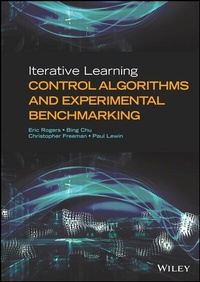
Iterative Learning Control Algorithms and Experimental Benchmarking
Description

Iterative Learning Control Algorithms and Experimental Benchmarking
Presents key cutting edge research into the use of iterative learning control
The book discusses the main methods of iterative learning control (ILC) and its interactions, as well as comparator performance that is so crucial to the end user. The book provides integrated coverage of the major approaches to-date in terms of basic systems, theoretic properties, design algorithms, and experimentally measured performance, as well as the links with repetitive control and other related areas.
Key features:
- Provides comprehensive coverage of the main approaches to ILC and their relative advantages and disadvantages.
- Presents the leading research in the field along with experimental benchmarking results.
- Demonstrates how this approach can extend out from engineering to other areas and, in particular, new research into its use in healthcare systems/rehabilitation robotics.
The book is essential reading for researchers and graduate students in iterative learning control, repetitive control and, more generally, control systems theory and its applications.
More details
Other editions
Additional editions

Persons
Professor Eric Rogers, Dr. Bing Chu, Professor Christopher Freeman, and Professor Paul Lewin, University of Southampton, UK
Content
Preface vii
1 Iterative Learning Control: Origins and General Overview 1
1.1 The Origins of ILC 2
1.2 A Synopsis of the Literature 5
1.3 Linear Models and Control Structures 6
1.3.1 Differential Linear Dynamics 7
1.4 ILC for Time-Varying Linear Systems 9
1.5 Discrete Linear Dynamics 11
1.6 ILC in a 2D Linear Systems/Repetitive Processes Setting 16
1.6.1 2D Discrete Linear Systems and ILC 16
1.6.2 ILC in a Repetitive Process Setting 17
1.7 ILC for Nonlinear Dynamics 18
1.8 Robust, Stochastic, and Adaptive ILC 19
1.9 Other ILC Problem Formulations 21
1.10 Concluding Remarks 22
2 Iterative Learning Control: Experimental Benchmarking 23
2.1 Robotic Systems 23
2.1.1 Gantry Robot 23
2.1.2 Anthromorphic Robot Arm 25
2.2 Electro-Mechanical Systems 26
2.2.1 Nonminimum Phase System 26
2.2.2 Multivariable Testbed 29
2.2.3 Rack Feeder System 30
2.3 Free Electron Laser Facility 32
2.4 ILC in Healthcare 37
2.5 Concluding Remarks 38
3 An Overview of Analysis and Design for Performance 39
3.1 ILC Stability and Convergence for Discrete Linear Dynamics 39
3.1.1 Transient Learning 41
3.1.2 Robustness 42
3.2 Repetitive Process/2D Linear Systems Analysis 43
3.2.1 Discrete Dynamics 43
3.2.2 Repetitive Process Stability Theory 46
3.2.3 Error Convergence Versus Along the Trial Performance 51
3.3 Concluding Remarks 55
4 Tuning and Frequency Domain Design of Simple Structure ILC Laws 57
4.1 Tuning Guidelines 57
4.2 Phase-Lead and Adjoint ILC Laws for Robotic-Assisted Stroke Rehabilitation 58
4.2.1 Phase-Lead ILC 61
4.2.2 Adjoint ILC 63
4.2.3 Experimental Results 63
4.3 ILC for Nonminimum Phase Systems Using a Reference Shift Algorithm 68
4.3.1 Filtering 74
4.3.2 Numerical Simulations 75
4.3.3 Experimental Results 75
4.4 Concluding Remarks 81
5 Optimal ILC 83
5.1 NOILC 83
5.1.1 Theory 83
5.1.2 NOILC Computation 86
5.2 Experimental NOILC Performance 89
5.2.1 Test Parameters 90
5.3 NOILC Applied to Free Electron Lasers 93
5.4 Parameter Optimal ILC 96
5.4.1 An Extension to Adaptive ILC 98
5.5 Predictive NOILC 99
5.5.1 Controlled System Analysis 104
5.5.2 Experimental Validation 106
5.6 Concluding Remarks 116
6 Robust ILC 117
6.1 Robust Inverse Model-Based ILC 117
6.2 Robust Gradient-Based ILC 123
6.2.1 Model Uncertainty -Case (i) 127
6.2.2 Model Uncertainty -Cases (ii) and (iii) 128
6.3 H8 Robust ILC 132
6.3.1 Background and Early Results 132
6.3.2 H8 Based Robust ILC Synthesis 137
6.3.3 A Design Example 142
6.3.4 Robust ILC Analysis Revisited 151
6.4 Concluding Remarks 153
7 Repetitive Process-Based ILC Design 155
7.1 Design with Experimental Validation 155
7.1.1 Discrete Nominal Model Design 155
7.1.2 Robust Design -Norm-Bounded Uncertainty 160
7.1.3 Robust Design - Polytopic Uncertainty and Simplified Implementation 165
7.1.4 Design for Differential Dynamics 170
7.2 Repetitive Process-Based ILC Design Using Relaxed Stability Theory 170
7.3 Finite Frequency Range Design and Experimental Validation 178
7.3.1 Stability Analysis 178
7.4 HOILC Design 194
7.5 Inferential ILC Design 196
7.6 Concluding Remarks 202
8 Constrained ILC Design 203
8.1 ILC with Saturating Inputs Design 203
8.1.1 Observer-Based State Control Law Design 203
8.1.2 ILC Design with Full State Feedback 209
8.1.3 Comparison with an Alternative Design 210
8.1.4 Experimental Results 215
8.2 Constrained ILC Design for LTV Systems 219
8.2.1 Problem Specification 219
8.2.2 Implementation of Constrained Algorithm 1 - a Receding Horizon Approach 223
8.2.3 Constrained ILC Algorithm 3 224
8.3 Experimental Validation on a High-Speed Rack Feeder System 226
8.3.1 Simulation Case Studies 226
8.3.2 Other Performance Issues 230
8.3.3 Experimental Results 236
8.3.4 Algorithm 1: QP-Based Constrained ILC 236
8.3.5 Algorithm 2: Receding Horizon Approach-Based Constrained ILC 237
8.4 Concluding Remarks 238
9 ILC for Distributed Parameter Systems 241
9.1 Gust Load Management for Wind Turbines 241
9.1.1 Oscillatory Flow 246
9.1.2 Flow with Vortical Disturbances 251
9.1.3 Blade Conditioning Measures 253
9.1.4 Actuator Dynamics and Trial-Varying ILC 254
9.1.5 Proper Orthogonal Decomposition-Based Reduced Order Model Design 257
9.2 Design Based on Finite-Dimensional Approximate Models with Experimental Validation 266
9.3 Finite Element and Sequential Experimental Design-based ILC 280
9.3.1 Finite Element Discretization 281
9.3.2 Application of ILC 283
9.3.3 Optimal Measurement Data Selection 284
9.4 Concluding Remarks 288
10 Nonlinear ILC 289
10.1 Feedback Linearized ILC for Center-Articulated Industrial Vehicles 289
10.2 Input-Output Linearization-based ILC Applied to Stroke Rehabilitation 293
10.2.1 System Configuration and Modeling 293
10.2.2 Input-Output Linearization 296
10.2.3 Experimental Results 299
10.3 Gap Metric ILC with Application to Stroke Rehabilitation 302
10.4 Nonlinear ILC - an Adaptive Lyapunov Approach 310
10.4.1 Motivation and Background Results 311
10.5 Extremum-Seeking ILC 320
10.6 Concluding Remarks 322
11 Newton Method Based ILC 323
11.1 Background 323
11.2 Algorithm Development 324
11.2.1 Computation of Newton-Based ILC 326
11.2.2 Convergence Analysis 327
11.3 Monotonic Trial-to-Trial Error Convergence 328
11.3.1 Monotonic Convergence with Parameter Optimization 329
11.3.2 Parameter Optimization for Monotonic and Fast Trial-to-Trial Error Convergence 330
11.4 Newton ILC for 3D Stroke Rehabilitation 331
11.4.1 Experimental Results 336
11.5 Constrained Newton ILC Design 337
11.6 Concluding Remarks 347
12 Stochastic ILC 349
12.1 Background and Early Results 349
12.2 Frequency Domain-Based Stochastic ILC Design 356
12.3 Experimental Comparison of ILC Laws 364
12.4 Repetitive Process-Based Analysis and Design 378
12.5 Concluding Remarks 387
13 Some Emerging Topics in Iterative Learning Control 389
13.1 ILC for Spatial Path Tracking 389
13.2 ILC in Agriculture and Food Production 394
13.2.1 The Broiler Production Process 395
13.2.2 ILC for FCR Minimization 400
13.2.3 Design Validation 404
13.3 ILC for Quantum Control 406
13.4 ILC in the Utility Industries 410
13.4.1 ILC Design 413
13.5 Concluding Remarks 415
Appendix A 417
A.1 The Entries in the Transfer-Function Matrix (2.2) 417
A.2 Entries in the Transfer-Function Matrix (2.4) 418
A.3 Matrices E1, E2, H1, and H2 for the Designs of (7.36) and (7.37) 419
References 421
Index 437
1
Iterative Learning Control: Origins and General Overview
A commonly encountered requirement in some industries is for a machine to repeat the same finite duration operation over and over again. The exact sequence is that the procedure is completed and then the system or process involved resets to the starting location and the next one begins. A typical scenario is a gantry robot, such as the one shown in Figure 1.1, undertaking a "pick and place" operation encountered in many industries where the following steps must be conducted in synchronization with a conveyor system: (i) collect an object from a fixed location, (ii) transfer it over a finite duration, (iii) place it on the moving conveyor, (iv) return to the original location for the next object and then, (v) repeat the previous four steps for as many objects as required or can be transferred before it is necessary to stop for maintenance or other reasons. Stopping these robots for such reasons in high-throughput applications means down time and lost production.
Figure 1.2 shows a 3D reference trajectory for the gantry robot and Figure 1.3 its -axis component. On each execution a variable, say is defined over the finite duration taken to move from the pick to place locations, e.g. , but it is also required to distinguish variables according to which execution is under consideration. One option, used except where stated otherwise in this book, is to write where is a nonnegative integer termed the trial number with denoting the trial duration or length.
Let be a prespecified 3D path or trajectory that the robot is required to follow between the "pick" and "place" locations (and back to the "pick" location), such as Figure 1.2 or, to focus on one axis, Figure 1.3. Then on trial , the error is and if the question is: how should the control input signal be adjusted to reduce or remove this error?
In applications such as the one considered, the system is performing the same operation repeatedly under the same operating conditions. One approach to control design is to copy human behavior and aim to learn from experience, i.e. the errors generated on previous trials are rich in information. This information is not exploited by a standard controller that would produce the same error on each trial. Iterative learning control (ILC) aims to improve performance by using information from previous trials to update the control law to be applied on the next one. As the above example illustrates, a significant application area for ILC is robotics.
As with other areas within control systems, there has been a debate, see the next section, on the origins of ILC. Since the 1980s, when concentrated research began, applications for ILC have spread beyond robotics in the industrial domain and outside engineering into healthcare. An example from the latter area, in the form of robotic-assisted upper-limb stroke rehabilitation, is introduced in Section 2.4 and considered in depth in Sections 4.2, 10.2, 10.3, and 11.4 of this book.
Figure 1.1 A gantry robot for a pick-and-place operation with the axes marked.
Figure 1.2 D reference trajectory for the gantry robot.
1.1 The Origins of ILC
According to [2, 33] and others, the basic idea of ILC was first proposed in a 1971 patent [89] and the journal article [256] published in Japanese. The first concerted volume of work that initiated widespread interest was, in particular, the journal paper [12], which considers a simple first-order linear servomechanism system for speed control of a voltage-controlled DC-servomotor. In this section, this system is used to highlight the essence of ILC, and it is appropriate to start by quoting parts of the opening two paragraphs in this paper.
Figure 1.3 -axis component of the gantry robot reference trajectory.
"It is human to make mistakes, but it also human to learn from such experience. Athletes have improved their form of body motion by learning through repeated training and skilled hands have mastered the operation of machines or plants by acquiring skill in practice and gaining knowledge. Is it possible to think of a way to implement such a learning ability in the automatic operation of dynamic systems?"
Motivated by this consideration, Arimoto et al. [12] proposed "a practical approach to the problem of bettering the present operation of mechanical robots by using the data of previous operations." This work constructed an "iterative betterment process for the dynamics of robots so that the trajectory of their motion approaches asymptotically a given desired trajectory as the number of operation trials increases." The example in [12] is next used to illustrate the construction of ILC laws and the behavior that can arise. A critical feature is "the direct use of the underlying dynamics of the objective systems."
The form of the control law developed in [12] applies to systems that are required to track a desired reference trajectory of a fixed length and specified a priori. After each trial, resetting of the system states occurs, during which time the measured output is used in the construction of the control input for application on the next trial. In [12], the system dynamics were assumed trial-invariant and invertible. These six distinguishing features of ILC highlighted in bold provided the basis for a major area of research in the control systems community internationally, both in terms of theory and an ever-broadening list of applications, many with supporting experimental verification or actual implementation.
As a motivating example, Arimoto et al. [12] considered speed control of a voltage-controlled DC servomotor where if the armature inductance is sufficiently small and mechanical friction is ignored, the resulting controlled dynamics are described by
(1.1)where denotes the angular velocity of the motor, is the input voltage, and and are constants.
Suppose that a reference signal, or trajectory, , for the angular velocity is given over the fixed finite duration and also that the system dynamics are unknown in the sense that the exact values of and in (1.1) may not be available. Also, it is assumed that is continuously differentiable, which is a commonly used assumption in differential ILC design.
The design problem is to construct an input voltage that coincides with over If an arbitrary input is applied, the error between the desired output and the first response is
(1.2)where
(1.3)Also, construct the voltage
(1.4)and apply this as the input on the next trial. Storing the resulting error constructing , and continuing this sequence of operations give on trial
(1.5)Suppose that for all Then since is continuously differentiable and using (1.5) gives
(1.6)Hence,
(1.7)where
Supporting simulation studies are in [12]. Since this first work, various definitions of ILC have been given in the literature, including the following quoted in [2]:
- The learning control concept stands for the repeatability of operating a given objective system and the possibility of improving the control input on the basis of previous actual operation data [12].
- It is a recursive online control method that relies on less calculation and less a priori knowledge about the system dynamics. The idea is to apply a simple algorithm repetitively to an unknown system, until perfect tracking is achieved [26].
- ILC is an approach to improve the transient response of the system that operates repetitively over a fixed time interval [166].
- ILC considers systems that repetitively perform the same task with a view to sequentially improving accuracy [4].
- ILC is to utilize the system repetitions as an experience to improve the system control performance even under incomplete knowledge of the system to be controlled [50].
- The controller learns to produce zero-tracking error during repetitions of a command or learns to eliminate the effects of a repeating disturbance on a control system [210].
- The main idea behind ILC is to iteratively find an input sequence such that the output of the system is as close as possible to a desired output. Although ILC is directly associated with control, it is important to note that the end result is that the system has been inverted.
- We learned that ILC is about enhancing a system's performance by means of repetition, but we did not learn how it is done. This brings us to the core activity in ILC research, which is the construction and subsequent analysis of algorithms [266].
Each of these definitions has their focus, but the underlying question is the same: how to improve performance using information from previous trials to update the control law applied on the current one? In some applications, ILC will form only one possible way of designing the controller...
