

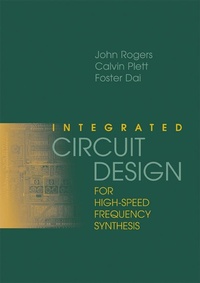
Integrated Circuit Design for High-Speed Frequency Synthesis
1st Edition
Published on 1. January 2005
496 pages
978-1-58053-983-8 (ISBN)
Description

Get hands-on expertise in the design of frequency synthesizers in high-speed integrated circuits with this complete, one-stop resource packed with straight-from-the-lab techniques, procedures, and applications. It delivers a definitive introduction to sys
More details
Other editions
Additional editions
Foster Dai | Calvin Plett | John Rogers
Integrated Circuit Design for High-Speed Frequency Synthesis
Book
02/2006
Artech House Publishers
€141.13
Shipment within 10-20 days
Content
- Intro
- Contents
- Preface
- 1 Introduction 1
- 1.1 Introduction to Frequency Synthesis 1
- 1.2 Frequency Synthesis for Telecommunications Systems 1
- 1.3 Frequency Synthesis for Digital Circuit Applications 5
- 1.4 Frequency Synthesis for Clock and Data Recovery 8
- 1.5 Frequency Synthesis for Modulation and Waveform Generation 11
- 1.6 Overview 13
- References 14
- 2 Synthesizer Architectures 17
- 2.1 Introduction 17
- 2.2 Integer-N PLL Synthesizers 17
- 2.3 Fractional-N PLL Frequency Synthesizers 18
- 2.3.1 Fractional-N Synthesizer with Dual-Modulus Prescaler 19
- 2.3.2 An Accumulator with Programmable Size 21
- 2.3.3 Fractional-N Synthesizer with Multimodulus Divider 23
- 2.3.4 Fractional-N Spurious Components 24
- 2.4 Delay-Locked Loops 27
- 2.5 Clock and Data Recovery (CDR) PLLs 29
- 2.6 Direct Digital Synthesizers 31
- 2.6.1 Direct Digital Synthesizer with Read-Only Memory Lookup Table 32
- 2.6.2 ROM-Less Direct Digital Synthesizer 33
- 2.7 Direct Analog Frequency Synthesizers 33
- 2.8 Hybrid Frequency Synthesizers 34
- References 36
- 3 System-Level Overview of PLL-Based Frequency Synthesis 43
- 3.1 Introduction 43
- 3.2 PLLs (Example of a Feedback System) 43
- 3.3 PLL Components 44
- 3.3.1 VCOs and Dividers 44
- 3.3.2 Phase Detectors 46
- 3.3.3 The Loop Filter 51
- 3.4 Continuous-Time Analysis for PLL Synthesizers 52
- 3.4.1 Simplified Loop Equations 53
- 3.4.2 PLL System Frequency Response and Bandwidth 55
- 3.4.3 Complete Loop Transfer Function, Including C2 56
- 3.5 Discrete-Time Analysis for PLL Synthesizers 58
- 3.6 Transient Behavior of PLLs 61
- 3.6.1 Linear Transient Behavior 62
- 3.6.2 Nonlinear Transient Behavior 66
- 3.7 Phase Noise and Timing Jitter in PLL Synthesis 71
- 3.7.1 Various Noise Sources in PLL Synthesizers 75
- 3.7.2 In-Band and Out-of-Band Phase Noise in PLL Synthesis 78
- References 83
- 4 Introduction to Digital IC Design 85
- 4.1 Digital Design Methodology and Flow 85
- 4.2 Verilog HDL 88
- 4.2.1 Verilog Program Structure 89
- 4.2.2 Verilog Data Formats 94
- 4.2.3 Verilog Operators 95
- 4.2.4 Verilog Control Constructs 95
- 4.2.5 Blocking and Nonblocking Assignments 97
- 4.2.6 Tasks and Functions 99
- 4.3 Behavioral and Structural Modeling 101
- 4.4 Combinational Digital Circuit Design 102
- 4.5 Sequential Digital Circuit Design 103
- 4.6 Digital Design Example I: A Multimodulus Divider 106
- 4.7 Digital Design Example II: A Programmable MASH SD Modulator 109
- 4.7.1 MASH SD Modulator Top-Level Structure 110
- 4.7.2 Fractional Accumulator with Programmable Size and Seed-Loading Capability 114
- 4.7.3 Reset Synchronization 116
- 4.7.4 Simulated Results 117
- References 118
- 5 CMOS Logic and Current Mode Logic 119
- 5.1 Introduction 119
- 5.2 CMOS Logic Circuits 120
- 5.3 Large-Signal Behavior of Bipolar and CMOS Differential Pairs 121
- 5.4 Effect of Capacitance on Slew Rate 125
- 5.5 Trade-Off Between Power Consumption and Speed 129
- 5.6 CML Combinational Circuits 132
- 5.7 CML Sequential Circuits 134
- 5.8 Master-Slave D-Flip-Flop 139
- 5.9 CML Circuit-Delay Analysis 142
- 5.10 Low-Power CML Circuits 144
- 5.11 CML Biasing Circuits 146
- 5.12 Driver Circuits 150
- References 152
- 6 Dividers and Phase-Frequency Detectors 153
- 6.1 Introduction 153
- 6.2 Dividers 153
- 6.2.1 A Static Divide-by-Two Circuit 155
- 6.2.2 Programmable Divide-by-Two or Divide-by-Three Circuit 158
- 6.2.3 A 50% Duty Cycle, High-Speed, Divide-by-Three Circuit 163
- 6.2.4 A Multimodulus Divider 165
- 6.2.5 A Generic MMD Architecture 170
- 6.2.6 Pulse-Swallow Dividers 175
- 6.3 Multipliers 180
- 6.4 Phase Detectors 181
- 6.4.1 Basic Types of Phase Detectors 181
- 6.4.2 Circuit Implementations of PFDs 183
- 6.4.3 Dead Zone in PFDs 186
- 6.4.4 Lock-Detection Circuits
- 6.4.5 A Modified PFD with Aligned UP and DN Pulses
- 6.4.6 PFDs for CDR Applications
- References
- 7 Charge Pumps and Loop Filters 199
- 7.1 Introduction 199
- 7.2 Charge Pumps 199
- 7.2.1 A Basic Charge Pump 199
- 7.2.2 Saturation Voltage 200
- 7.2.3 Current Source Output Impedance 201
- 7.2.4 Reference Feedthrough 203
- 7.2.5 Transistor Gain Considerations 206
- 7.2.6 Charge Pump Noise 207
- 7.2.7 Charge Sharing 209
- 7.2.8 Improving Matching Between Ip and In 209
- 7.2.9 Charge Pumps Compatible with CML/ECL 211
- 7.2.10 A Differential Charge Pump 215
- 7.2.11 Common-Mode Feedback for a Differential Charge Pump 217
- 7.2.12 Another Differential Charge Pump 217
- 7.2.13 Programmable Bias Schemes 218
- 7.3 Loop Filters 218
- 7.3.1 Passive Loop Filters 219
- 7.3.2 Active Loop Filters 222
- 7.3.3 LC Loop Filters 224
- References 230
- 8 Voltage-Controlled Oscillators 233
- 8.1 Introduction 233
- 8.2 Specification of Oscillator Properties 233
- 8.3 LC-Based VCOs 233
- 8.3.1 Inductors 234
- 8.3.2 Varactors for Oscillator Frequency Control 238
- 8.4 Oscillator Analysis 241
- 8.4.1 Colpitts Oscillator Analysis 242
- 8.4.2 Negative Resistance of -Gm Oscillator 244
- 8.5 Amplitude of a Negative Gm Oscillator 244
- 8.6 Several Refinements to the -Gm Topology 245
- 8.7 Injection-Locked Oscillators 246
- 8.7.1 Phase Shift of Injection-Locked Oscillator 254
- 8.8 Quadrature LC Oscillators Using Injection Locking 257
- 8.8.1 Parallel Coupled Quadrature LC Oscillators 258
- 8.8.2 Series Coupled Quadrature Oscillators 263
- 8.8.3 Other Quadrature-Generation Techniques 263
- 8.9 Other Techniques to Generate Quadrature Signals 264
- 8.10 Phase Noise in LC Oscillators 264
- 8.10.1 Linear or Additive Phase Noise and Leeson's Formula 265
- 8.10.2 Switching Phase Noise in Cross-Coupled Pairs 269
- 8.11 Low-Frequency Phase Noise Upconversion Reduction Techniques 270
- 8.11.1 Bank Switching 270
- 8.11.2 gm Matching and Waveform Symmetry 272
- 8.11.3 Differential Varactors and Differential Tuning 273
- 8.12 Ring Oscillators 276
- 8.13 Common Inverter Circuits 281
- 8.14 Method for Designing a Two-Stage Ring Oscillator 284
- 8.15 Phase Noise and Jitter in Ring Oscillators 287
- 8.16 Crystal Oscillators 294
- 8.17 Summary: Comparison of Oscillator Performance 298
- References 299
- 9 SD Modulation for Fractional-N Synthesis 301
- 9.1 Introduction 301
- 9.2 Basic Concepts 301
- 9.2.1 Quantization Noise and Oversampling Effects 301
- 9.2.2 Noise-Shaping Effect 306
- 9.2.3 An Overview of SD Modulators 308
- 9.2.4 First-Order SD Modulators 309
- 9.2.5 Second-Order SD Modulators 311
- 9.2.6 High-Order SD Modulators 312
- 9.3 SD Modulation in Fractional-N Frequency Synthesis 315
- 9.3.1 A First-Order SD Modulator for Fractional-N Frequency Synthesis 317
- 9.3.2 MASH SD Modulator 319
- 9.3.3 Single-Stage SD Modulators with Multiple Feedback Paths 326
- 9.3.4 Single-Stage SD Modulators with a Single Feedback Path 327
- 9.3.5 A Generic High-Order SD Modulator Topology 330
- 9.3.5.1 Generic SD Modulator Topology with Integrators 1/(1 - z -1 ) and Without Delay in the Loop Feedback Path 331
- 9.3.5.2 Generic SD Modulator Topology with Integrators z -1/(1 - z -1 ) and Without Delay in the Loop Feedback Path 334
- 9.3.5.3 Generic SD Modulator Topology with Integrators z -1/(1 - z -1 ) and with a Delay in the Loop Feedback Path
- 9.3.5.4 Generic SD Modulator Topology with Integrators 1/(1 - z -1 ) and with a Delay in the Loop Feedback Path 337
- 9.3.6 Modified SD Modulator with Improved High-Frequency Response 338
- 9.3.6.1 Single-Stage Multiple Feedforward SD Modulator (SSMF-I) 338
- 9.6.3.2 Single-Stage Multiple Feedforward SD Modulator (SSMF-II) 339
- 9.3.7 Phase Noise Due to SD Converters 342
- 9.3.8 Randomization by Noise-Shaped Dithering 347
- 9.3.9 Spur Reduction Using Precalculated Seeds 349
- 9.3.10 Dynamic Range 349
- 9.3.11 Maximal Loop Bandwidth 352
- 9.3.12 Optimal Parameters 354
- 9.3.13 Performance Comparison 355
- References 356
- 10 Direct Digital Synthesis 359
- 10.1 Introduction 359
- 10.2 DDS Theory of Operation 360
- 10.3 DDS Spectral Purity 363
- 10.3.1 Phase Noise Due to Clock Jitter 364
- 10.3.2 Spurs Due to Discrete Phase Accumulation 365
- 10.3.3 Spurs and Quantization Noise Due to Phase Truncation 367
- 10.3.4 Quantization Noise Due to Finite Number of Amplitude Bits 373
- 10.3.5 DAC Nonlinearities and Aliased Images 374
- 10.3.6 Oversampling Effect 376
- 10.4 SD Noise Shaping in DDS 376
- 10.4.1 DDS Using Phase Domain SD Noise Shaping 377
- 10.4.2 DDS Using Frequency Domain SD Noise Shaping 379
- 10.4.3 ROM Size Reduction Using SD Noise Shaping 379
- 10.5 High-Speed ROM-Less DDS 381
- 10.5.1 Pipelined Accumulator 383
- 10.5.2 Accumulator with CLA Adders 384
- 10.5.3 Sine-Weighted Nonlinear DACs 388
- 10.5.4 Nonlinear DAC Segmentations 389
- 10.5.5 Nonlinear Coarse DAC 391
- 10.5.6 Comparison of ROM-Less DDS Performance 394
- References 395
- 11 Direct Modulation in Frequency Synthesizers 397
- 11.1 Introduction
- 11.2 Direct Modulation in PLL Frequency Synthesizers 398
- 11.3 Direct Digital Modulation and Waveform Generation in a DDS 401
- 11.3.1 Phase Modulation 403
- 11.3.2 Phase Shift Keying 403
- 11.3.3 Frequency Modulation 407
- 11.3.4 Minimum Shift Keying 411
- 11.3.5 Step Frequency 412
- 11.3.6 Chirp Waveforms 412
- 11.3.7 Amplitude Modulation 413
- 11.3.8 Quadrature Amplitude Modulation 413
- 11.3.9 Waveform Generation 414
- References 415
- Appendix A: A Review of Basic Control Theory417
- A.1 Introduction 417
- A.2 The Continuous-Time Laplace Transform 418
- A.3 The Laplace Transform and Sampling 418
- A.4 System Modeling with Frequency Response 423
- A.4.1 Frequency Response of Continuous Systems 423
- A.4.2 Frequency Response of Sampled Systems 428
- A.5 Response in the Time Domain 431
- A.6 Feedback Systems 436
- A.7 Steady-State Error and the System Type 440
- A.8 Stability 441
- A.9 Root Locus 442
- References 445
- Appendix B: A Review of Transistor Models
- B.1 Introduction 447
- B.2 The Basics of CMOS Transistors 447
- B.2.1 Basic DC Biasing Characteristics 447
- B.2.2 Basic CMOS Square Law Equations 449
- B.2.3 The Body Effect 450
- B.2.4 High-Frequency Effects 450
- B.2.5 Thermal Noise 451
- B.2.6 Shot Noise 452
- B.2.7 1/f Noise 452
- B.2.8 Gate Noise 452
- B.2.9 CMOS Small-Signal Model, Including Noise 453
- B.3 Bipolar Transistors 453
- References 457
- About the Authors 459
- Index 461
