

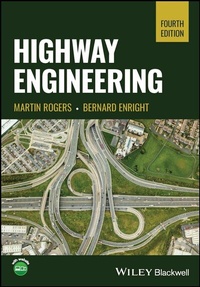
Highway Engineering
Description

Understand a foundational area of civil engineering with this up-to-date textbook
Highway construction is a complex discipline within civil engineering, with the potential to transform national economies and transportation infrastructures. With car infrastructure coming under both increasing demand and increasing scrutiny for its environmental impact, the challenges and complexities of highway engineering have never been a more vital subject. The future of sustainable transportation depends on an engineering profession with a solid grasp of the fundamentals of highway design and construction.
Highway Engineering provides a comprehensive overview of these fundamentals, preparing civil engineers and engineering students to analyze, design, and build highways. Situating its subject in the context of a broader political economy, social and ecological reality, and more, it proceeds in a logical sequence from planning to design to construction to maintenance. The result is a fully up-to-date introduction to this subject at the heart of transport engineering.
Readers of the fourth edition of Highway Engineering will also find:
* Strong integration of material from the UK Design Manual for Roads and Bridges, incorporating recent significant changes in the design of highway pavements
* Detailed examples and case studies to cultivate deepened understanding
* Increased attention to the growing importance of non-car-based modes of highway transportation--walking, cycling and public transport.
Highway Engineering is essential for engineering students studying civil engineering or transport engineering, as well as for professional civil engineers looking for a reference work.
More details
Other editions
Additional editions
Persons
Martin Rogers, PhD, is a Transport Planning Practitioner and Senior Lecturer in the School of Transport and Civil Engineering, Technological University Dublin, Ireland. He is a Transport Planning Professional (TPS), a Chartered Civil Engineer (ICE) and Chartered Town Planner (RTPI), with extensive experience in both the private and public sectors, including membership in the Dublin Transport Initiative Study Team that devised the Dublin city region's first integrated transportation plan.
Bernard Enright, PhD, is a Lecturer in the School of Transport and Civil Engineering, Technological University Dublin, Ireland. He has considerable experience in the engineering and information technology industries and has published extensively on highway engineering and related subjects.
Content
About the Companion Website xv
1 The Transportation Planning Process 1
1.1 Why Are Highways So Important? 1
1.2 The Administration of Highway Schemes 1
1.3 Sources of Funding 2
1.4 Highway Planning 3
1.4.1 Introduction 3
1.4.2 Travel Data 4
1.4.3 Highway Planning Strategies 6
1.4.3.1 Land-Use Transportation Approach 6
1.4.3.2 The Demand Management Approach 6
1.4.3.3 The Car-Centred Approach 7
1.4.3.4 The Public Transport-Centred Approach 7
1.4.4 Transportation Studies 7
1.4.4.1 Transportation Survey 7
1.4.4.2 Production and Use of Mathematical Models 8
1.5 The Decision-Making Process in Highway and Transport Planning 8
1.5.1 Introduction 8
1.5.2 Economic Assessment 10
1.5.3 Environmental Assessment 11
1.5.4 Public Consultation 12
1.6 Summary 13
References 13
2 Forecasting Future Traffic Flows 15
2.1 Basic Principles of Traffic Demand Analysis 15
2.2 Demand Modelling 16
2.3 Land-Use Models 18
2.4 Trip Generation 18
2.4.1 TRICS ® Database 23
2.5 Trip Distribution 24
2.5.1 Introduction 24
2.5.2 The Gravity Model 25
2.5.3 Growth Factor Models 30
2.5.4 The Furness Method 31
2.6 Modal Split 36
2.7 Traffic Assignment 41
2.8 A Full Example of the Four-Stage Transportation Modelling Process 46
2.8.1 Trip Production 46
2.8.2 Trip Distribution 47
2.8.3 Modal Split 50
2.8.4 Trip Assignment 52
2.9 'Decide and Provide' Versus 'Predict and Provide' 53
2.10 Concluding Comments 54
Additional Problems 54
References 57
3 Scheme Appraisal for Highway Projects 59
3.1 Introduction 59
3.2 Economic Appraisal of Highway Schemes 60
3.3 Cba 61
3.3.1 Introduction 61
3.3.2 Identifying the Main Project Options 61
3.3.3 Identifying all Relevant Costs and Benefits 62
3.3.3.1 Reductions in VOCs 63
3.3.3.2 Savings in Time 63
3.3.3.3 Reduction in the Frequency of Accidents 64
3.3.4 Economic Life, Residual Value, and the Discount Rate 64
3.3.5 Use of Economic Indicators to Assess Basic Economic Viability 65
3.3.6 Highway CBA Worked Example 67
3.3.6.1 Introduction 67
3.3.6.2 Computation of Discounted Benefits and Costs 68
3.3.6.3 Npv 70
3.3.6.4 Benefit-Cost Ratio 70
3.3.6.5 Irr 70
3.3.6.6 Summary 70
3.3.7 Coba 70
3.3.8 Advantages and Disadvantages of CBA 71
3.4 Payback Analysis 73
3.5 Environmental Appraisal of Highway Schemes 75
3.6 The New Approach to Appraisal 80
3.6.1 Environment 81
3.6.1.1 Noise 81
3.6.1.2 Local Air Quality 81
3.6.1.3 Landscape 82
3.6.1.4 Biodiversity 82
3.6.1.5 Heritage 82
3.6.1.6 Water 82
3.6.1.7 Safety 83
3.6.1.8 Economy 83
3.6.1.9 Journey Times and VOCs 83
3.6.1.10 Costs 83
3.6.1.11 Reliability 83
3.6.1.12 Regeneration 83
3.6.1.13 Accessibility 84
3.6.1.14 Pedestrians, Cyclists, and Equestrians 84
3.6.1.15 Access to Public Transport 85
3.6.1.16 Community Severance 85
3.6.1.17 Integration 85
3.7 NATA Refresh 86
3.7.1 Changes to the AST 86
3.7.2 Enhanced Presentation of Monetary Impacts 87
3.7.3 More Detailed Relationship Between Benefit-Cost Ratio and Value for Money 87
3.8 Transport Analysis Guidance: The Transport Appraisal Process 87
3.9 Project Management Guidelines 89
3.10 Common Appraisal Framework for Transport Projects and Programmes 90
3.11 Summary 91
References 91
4 Basic Elements of Highway Traffic Analysis 93
4.1 Introduction 93
4.2 Surveying Road Traffic 93
4.2.1 Introduction 93
4.2.2 Vehicle Surveys 94
4.2.2.1 Introduction 94
4.2.2.2 Manual Counts 94
4.2.2.3 Automatic Counts 94
4.2.3 Speed Surveys 95
4.2.4 Delay/Queuing Surveys 96
4.2.5 Area-Wide Surveys 96
4.2.5.1 Introduction 96
4.2.5.2 Roadside Interview Surveys 97
4.2.5.3 Self-Completion Forms 97
4.2.5.4 Registration Plate Surveys 97
4.3 Journey Speed and Travel Time Surveys 98
4.3.1 Introduction 98
4.3.2 The Moving Observer Method 98
4.4 Speed, Flow, and Density of a Stream of Traffic 103
4.4.1 Speed-Density Relationship 103
4.4.2 Flow-Density Relationship 104
4.4.3 Speed-Flow Relationship 105
4.5 Headway Distributions in Highway Traffic Flow 109
4.5.1 Introduction 109
4.5.2 Negative Exponential Headway Distribution 110
4.5.3 Limitations of the Poisson System for Modelling Headway 114
4.6 Queuing Analysis 114
4.6.1 Introduction 114
4.6.2 The D/D/1 Queuing Model 114
4.6.3 The M/D/1 Queuing Model 118
4.6.4 The M/M/1 Queuing Model 119
4.6.5 The M/M/N Queuing Model 120
Additional Problems 123
References 128
5 Determining the Capacity of a Highway 129
5.1 Introduction 129
5.2 The 'Level of Service' Approach Using the Transportation Research Board 129
5.2.1 Introduction 129
5.2.2 Some Definitions 131
5.2.3 Maximum Service Flow Rates for Multilane Highways 131
5.2.4 Maximum Service Flow Rates for Two-Lane Highways 137
5.2.5 Sizing a Road Using the Highway Capacity Manual Approach 140
5.3 The 2010 Highway Capacity Manual - Analysis of Capacity and Level of Service for Multi-Lane and Two-Lane Highways 143
5.3.1 Introduction 143
5.3.2 Capacity and Level of Service of Multilane Highways (2010 Highway Capacity Manual) 143
5.3.2.1 Flow Characteristics Under Base Conditions 143
5.3.2.2 Capacity of Multilane Highway Segments 144
5.3.2.3 Level of Service (LOS) for Multilane Highway Segments 144
5.3.2.4 Required Data for the LOS Computation 144
5.3.2.5 Computing LOS for a Multilane Highway 145
5.3.3 Capacity and Level of Service of Two-Lane Highways 150
5.3.3.1 Flow Characteristics Under Base Conditions 150
5.3.3.2 Capacity and Level of Service 150
5.3.3.3 Required Input Data and Default Values 151
5.3.3.4 Demand Volumes and Flow Rates 152
5.3.3.5 Computing LOS and Capacity for a Two-Lane Highway 152
5.3.3.6 Determining Level of Service for Class 1 Two-Lane Highways 154
5.3.3.7 Determining the Level of Service for Class 2 Two-Lane Highways 161
5.3.3.8 Determining the Level of service for Class 3 Two-Lane Highways 166
5.4 The 2016 Highway Capacity Manual - Analysis of Capacity and Level of Service for Multi-Lane Highways 167
5.4.1 Introduction 167
5.4.2 Capacity and Level of Service of Multilane Highways (2016 Highway Capacity Manual) 167
5.4.2.1 Speed Versus Flow 167
5.4.2.2 Baseline Conditions and Capacity 167
5.4.2.3 Determining Free-Flow Speed 168
5.4.2.4 Determination of Incident Flow Rate 168
5.4.2.5 Calculation of Density and Determination of Level of Service 168
5.5 The UK Approach for Rural Roads 170
5.5.1 Introduction 170
5.5.2 Estimation of AADT for a Rural Road in Its Year of Opening 171
5.6 The UK Approach to Urban Roads 173
5.6.1 Introduction 173
5.6.2 Forecast Flows on Urban Roads 174
5.7 Expansion of 12- and 16-Hour Traffic Counts into AADT Flows 177
5.8 Concluding Comments 178
Additional Problems 179
References 181
6 The Design of Highway Intersections 183
6.1 Introduction 183
6.2 Deriving DRFs from Baseline Traffic Figures 184
6.2.1 Existing Junctions 184
6.2.2 New Junctions 184
6.2.3 Short-Term Variations in Flow 184
6.2.4 Conversion of AADT to Highest Hourly Flows 185
6.3 Major/Minor Priority Intersections 185
6.3.1 Introduction 185
6.3.2 Equations for Determining Capacities and Delays 189
6.3.3 Geometric Layout Details 196
6.3.3.1 Horizontal Alignment 196
6.3.3.2 Vertical Alignment 196
6.3.3.3 Visibility 196
6.3.3.4 Dedicated Lane on the Major Road for Right-Turning Vehicles 196
6.4 Roundabout Intersections 197
6.4.1 Introduction 197
6.4.2 Types of a Roundabout 199
6.4.2.1 Mini-Roundabout 199
6.4.2.2 Normal Roundabout 200
6.4.2.3 Double Roundabout 200
6.4.2.4 Other Forms 201
6.4.3 Traffic Capacity at Roundabouts 203
6.4.3.1 Drf 205
6.4.4 Geometric Details 209
6.4.4.1 Entry Width 209
6.4.4.2 Entry Angle 209
6.4.4.3 Entry Radius 209
6.4.4.4 Entry Deflection/Entry Path Radius 210
6.4.4.5 Icd 210
6.4.4.6 Circulatory Carriageway 210
6.4.4.7 Main Central Island 210
6.5 Basics of Traffic Signal Control: Optimisation and Delays 210
6.5.1 Introduction 210
6.5.2 Phasing at a Signalised Intersection 212
6.5.3 Saturation Flow 212
6.5.4 Effective Green Time 217
6.5.5 Optimum Cycle Time 217
6.5.6 Average Vehicle Delays at the Approach to a Signalised Intersection 220
6.5.7 Average Queue Lengths at the Approach to a Signalised Intersection 222
6.5.8 Signal Linkage 223
6.6 Concluding Remarks 228
Additional Problems 228
References 230
7 Geometric Alignment and Design 233
7.1 Basic Physical Elements of a Highway 233
7.1.1 Main Carriageway 233
7.1.2 Central Reservation 233
7.1.3 Hard Shoulders/Hard Strips/Verges 234
7.2 Design Speed and Stopping and Overtaking Sight Distances 237
7.2.1 Introduction 237
7.2.2 Urban Roads 238
7.2.3 Rural Roads 239
7.2.3.1 Statutory Constraint 239
7.2.3.2 Layout Constraint 239
7.2.3.3 Alignment Constraint 240
7.2.3.4 New/Upgraded Rural Roads 242
7.3 Geometric Parameters Dependent on Design Speed 244
7.4 Sight Distances 244
7.4.1 Introduction 244
7.4.2 Stopping Sight Distance 245
7.4.3 Overtaking Sight Distance 246
7.5 Horizontal Alignment 248
7.5.1 General 248
7.5.2 Deriving the Minimum Radius Equation 248
7.5.3 Horizontal Curves and Sight Distances 251
7.5.3.1 Alternative Method for Computing Ms 253
7.5.4 Transitions 254
7.5.4.1 Shift 255
7.6 Vertical Alignment 258
7.6.1 General 258
7.6.2 K Values 259
7.6.3 Visibility and Comfort Criteria 260
7.6.4 Parabolic Formula 260
7.6.5 Crossfalls 263
7.6.6 Vertical Crest Curve Design and Sight Distance Requirements 264
7.6.6.1 Derivation of Crest Curve Formulae 265
7.6.7 Vertical Sag Curve Design and Sight Distance Requirements 269
7.6.7.1 Driver Comfort 269
7.6.7.2 Clearance from Structures 269
7.6.7.3 Sag Curves in Night-Time Conditions 270
Additional Problems 271
References 274
8 Highway Pavement Materials 275
8.1 Introduction 275
8.2 Pavement Components: Terminology 275
8.3 Soils at Subformation Level 279
8.4 Materials in Foundations 279
8.5 Materials in Flexible Pavements 280
8.5.1 Bitumen 280
8.5.2 Asphalt Concrete (Coated Macadams) 281
8.5.3 Hot Rolled Asphalt 282
8.5.4 Aggregates 282
8.5.5 Designation of Asphalt Materials Used in Flexible Pavements 282
8.6 Concrete in Rigid Pavements 284
8.7 Surfacing Materials 285
8.7.1 Surface Dressing and Modified Binders 285
8.7.1.1 Cutback Bitumen 285
8.7.1.2 Bituminous Emulsions 285
8.7.1.3 Chippings 286
8.8 Stiffness Modulus 286
8.9 Measurement and Testing of Material and Pavement Properties 289
8.9.1 CBR Test 289
8.9.2 Determination of CBR Using Plasticity Index 292
8.9.2.1 Liquid Limit 292
8.9.2.2 Plastic Limit 292
8.9.2.3 Plasticity Index 292
8.9.2.4 Using I P and Soil Type to Derive CBR 292
8.9.3 Using CBR to Estimate Stiffness Modulus 293
8.9.4 Falling Weight Deflectometer (FWD) 293
8.9.5 Light Weight Deflectometer (LWD) 297
8.9.6 Dynamic Cone Penetrometer (DCP) 298
8.9.7 Penetration Test for Bitumen 298
8.9.8 Softening Point of Bitumen 299
8.9.9 Polished Stone Value (PSV) 300
8.9.10 Aggregate Abrasion Value (AAV) 300
8.9.11 Patch Test 300
Additional Problems 301
References 302
Design Manual for Roads and Bridges 302
Standards 302
Other Government Publications 303
Other References 303
9 Design and Construction of Highway Pavements 305
9.1 Introduction and Design Approach 305
9.2 Sustainability and Good Road Design 306
9.3 Whole-Life Cost Analysis 307
9.4 Traffic Loading 307
9.4.1.1 Commercial Vehicle Flow (F) 309
9.4.1.2 Growth Factor (G) 309
9.4.1.3 Wear Factor (W) 310
9.4.1.4 Design Period (Y) 310
9.4.1.5 Percentage of Vehicles in the Heaviest Loaded Lane (P) 311
9.5 Foundation Design 314
9.5.1 Introduction 314
9.5.2 Restricted Foundation Design Method 316
9.5.3 Performance Design Method 319
9.5.3.1 Design Charts for Foundation Layer Thickness: Performance Design 321
9.5.3.2 Testing Foundation Surface Modulus on Demonstration Area and During Construction 322
9.5.4 Drainage and Frost 323
9.6 Pavement Design 324
9.6.1 Design of Flexible Pavements 325
9.6.2 Design of Rigid Pavements 328
9.6.2.1 Continuously Reinforced Concrete 328
9.6.2.2 Roller Compacted Concrete 331
9.6.2.3 Jointed Concrete Pavements 332
9.7 Construction of Flexible Pavements 334
9.7.1 Construction of Bituminous Road Surfacings 334
9.7.1.1 Transporting and Placing 335
9.7.1.2 Compaction of the Bituminous mix 336
9.7.1.3 Application of Coated Chippings to Smooth Surfacings 336
9.8 Construction of Rigid Pavements 336
9.8.1 Concrete Slab and Joint Details 336
9.8.1.1 Joints in Concrete Pavements 337
9.8.2 Reinforcement 339
Additional Problems 339
References 340
Design Manual for Roads and Bridges 340
Standards 341
Other Government Publications 341
Other References 342
10 Pavement Maintenance 343
10.1 Introduction 343
10.2 Pavement Deterioration 343
10.3 Compiling Information on the Pavement's Condition 345
10.3.1 Introduction 345
10.3.2 Traffic-Speed Surveys of Surface and Structural Condition 346
10.3.3 Traffic-Speed Surveys of Skidding Resistance 348
10.3.3.1 Skidding Resistance 348
10.3.3.2 Measurement of Skidding Resistance 349
10.3.4 Visual Condition Surveys 350
10.3.5 Cores 351
10.3.6 Dynamic Cone Penetrometer 351
10.3.7 Deflectograph 351
10.3.8 Ground-Penetrating Radar (GPR) 353
10.3.9 Falling Weight Deflectometer (FWD) 354
10.3.10 Other Investigation Techniques 354
10.4 Forms of Maintenance 354
10.4.1 Flexible Pavements 355
10.4.2 Rigid Pavements 357
References 359
11 The Highway Engineer and the Development Process 361
11.1 Introduction 361
11.2 Transport Assessments 362
11.2.1 Introduction 362
11.2.2 Identifying the Need for an Assessment 362
11.2.3 Preparing a TA 363
11.2.3.1 Description of On-Site Existing Baseline Conditions 364
11.2.3.2 Definition of the Proposed Development 365
11.2.3.3 Setting the Assessment Years for Which Capacity Analyses Are Carried Out 365
11.2.3.4 Setting the Analysis Periods for Which Capacity Analyses Are Carried Out 365
11.2.3.5 Estimation of Trips Generated by the Proposal 366
11.2.4 Final Comment 367
11.3 Travel Plans 367
11.3.1 Introduction 367
11.3.2 Thresholds 367
11.3.3 When Is a Travel Plan Required? 368
11.3.4 What Information Should Be Included Within a Travel Plan? 369
11.3.4.1 Appointment of a Travel Plan Coordinator 369
11.3.4.2 Initial Monitoring Process 369
11.3.4.3 Setting Targets for Modal Split 370
11.3.4.4 Monitoring How Things Have Changed 370
11.3.5 Mobility Management Plans in Ireland 371
11.4 Road Safety Audits 372
11.4.1 Principles Underlying the Road Safety Audit Process 372
11.4.2 Definition of Road Safety Audit 373
11.4.3 Stages Within Road Safety Audits 374
11.4.4 Road Safety Audit Response Report 375
11.4.5 Checklists for Use Within the RSA Process 376
11.4.6 Risk Analysis 378
11.4.7 Conclusions 381
References 381
12 Defining Sustainability in Transportation Engineering 383
12.1 Introduction 383
12.2 Social Sustainability 383
12.3 Environmental Sustainability 383
12.4 Economic Sustainability 384
12.5 The Four Pillars of Sustainable Transport Planning 384
12.5.1 Put Appropriate Governance in Place 385
12.5.2 Provide Efficient Long-Term Finance 385
12.5.3 Make Strategic Investments in Major Infrastructure 385
12.5.4 Support Investments Through Local Design 386
12.5.5 Concluding Comments 386
12.6 How Will Urban Areas Adapt to the Need for Increased Sustainability? 386
12.7 The Role of the Street in Sustainable Transport Planning 387
12.7.1 Street Classification System 387
12.7.2 Designing an Individual Street 387
12.7.2.1 Introduction 387
12.7.2.2 A Rational Approach to Speed in Urban Areas 389
12.7.3 The Pedestrian Environment 390
12.7.3.1 General Design Principles of Footpaths 390
12.7.4 Design for Cycling 392
12.7.4.1 Cycling Design Criteria 392
12.7.4.2 Design Guidelines 393
12.7.5 Carriageway Widths on Urban Roads and Streets 396
12.7.6 Surfaces 396
12.7.7 Junction Design in an Urban Setting 398
12.7.8 Forward Visibility/Visibility Splays 399
12.8 Public Transport 400
12.8.1 Bus and Rail Services in Cities 400
12.8.2 Design of Street Network to Accommodate Bus Services 401
12.9 Using Performance Indicators to Ensure a More Balanced Transport Policy 402
12.9.1 The Traditional Approach 402
12.9.2 Using LOS to Measure the Quality of Pedestrian Facilities 402
12.9.2.1 Introduction 402
12.9.2.2 Formulae for Estimation of Link-Based Pedestrian LOS 404
12.9.2.3 Free-Flow Walking Speed 405
12.9.2.4 Average Pedestrian Space 405
12.9.2.5 Pedestrian LOS Score (I p, link) 405
12.9.2.6 Determining Link-Based Pedestrian LOS 406
12.9.3 Using LOS to Measure the Quality of Cycling Facilities 408
12.9.3.1 Formulae for Estimation of Link-Based Bicycle LOS 408
12.9.3.2 Determining Link-Based Bicycle LOS 410
12.9.4 Measuring the Quality of Public Transport Using LOS 412
12.9.4.1 Acceleration-Deceleration Delay 414
12.9.4.2 Delay Due to Serving Passengers 414
12.9.4.3 Re-entry Delay (d re) 414
12.10 A Sustainable Parking Policy 419
12.10.1 Introduction 419
12.10.2 Seminal Work of Donald Shoup in the United States 419
12.10.3 The Pioneering ABC Location Policy in the Netherlands 420
12.10.4 Possible Future Sustainable Parking Strategies 421
References 422
Index 423
1
The Transportation Planning Process
1.1 Why Are Highways So Important?
Highways are vitally important to a country's economic development. The construction of a high-quality road network directly increases a nation's economic output by reducing journey times and costs, making a region more attractive economically. The actual construction process will have the added effect of stimulating the construction market.
1.2 The Administration of Highway Schemes
The administration of highway projects differs from one country to another, depending on social, political, and economic factors. The design, construction, and maintenance of major national primary routes such as motorways or dual carriageways are generally the responsibility of a designated government department or an agency of it, with funding, in the main, coming from the central government. Those of secondary importance, feeding into the national routes, together with local roads, tend to be the responsibility of local authorities. The central government or an agency of it will usually take responsibility for the development of national standards.
National Highways (formerly Highways England) is an executive organisation charged within England with responsibility for the maintenance and improvement of the motorway/trunk road network. National Highways is also the statutory consultant in the planning process. Any development proposal likely to result in an adverse impact on safety or efficiency levels must interact with the organisation (in Ireland, Transport Infrastructure Ireland, formerly the National Roads Authority, has a similar function). It operates on behalf of the relevant government minister who still retains responsibility for overall policy, determines the framework within which the agency is permitted to operate and establishes its goals and objectives and the time frame within which these should take place.
In the United States, the US Federal Highway Administration has the responsibility at the federal level for formulating national transportation policy and for funding major projects that are subsequently constructed, operated, and maintained at the state level. It is one of the nine primary organisational units within the US Department of Transportation (USDOT). The Secretary of Transportation, a member of the President's cabinet, is the USDOT's principal.
Each state government has a department of transportation, which occupies a pivotal position in the development of road projects. Each has responsibility for the planning, design, construction, maintenance, and operation of its federally funded highway system. In most states, its highway agency has the responsibility for developing routes within the state-designated system. These involve roads of both primary and secondary statewide importance. The state department also allocates funds to the local government. At the city/county level, the local government in question sets design standards for local roadways and has the responsibility for maintaining and operating them.
1.3 Sources of Funding
Obtaining adequate sources of funding for highway projects has been an ongoing problem throughout the world. Highway construction has been funded in the main by public monies. However, increasing competition for government funds from the health and education sector has led to an increasing desire to remove the financing of major highway projects from such competition by the introduction of user or toll charges.
Within the United Kingdom, the New Roads and Street Works Act 1991 gave the Secretary of State for Transport the power to create highways using private funds, where access to the facility is limited to those who have paid a toll charge. In most cases, however, the private sector has been unwilling to take on substantial responsibility for expanding the road network within the United Kingdom. Roads still tend to be financed from the public purse, with the central government being fully responsible for the capital funding of major trunk road schemes. For roads of lesser importance, each local authority receives a block grant from the central government that can be utilised to support a maintenance programme at the local level or to aid in the financing of a capital works programme. These funds will supplement monies raised by the authority through local taxation. A local authority is also permitted to borrow money for highway projects but only with the central government's approval.
In 2018, the UK Government announced a £28.8 billion National Roads Fund for 2020-2025. Within the National Roads fund, the Roads Investment Strategy 2 (RIS2), published in March 2020, will receive funding of £27.4 billion. Some of this funding will be used to build new road capacity, but much more will be used to improve the quality and reduce the negative impacts of the existing Strategic Road Network.
Within the United States, fuel taxes have financed a significant proportion of the highway system, with road tolls being charged for the use of some of the more expensive highway facilities. Tolling declined between 1960 and 1990, partly because of the introduction of the Interstate and Defense Highways Act in 1956, which prohibited the charging of tolls on newly constructed sections of the interstate highway system, and because of the wide availability of federal funding at the time for such projects. Within the past 10 years, however, the use of toll charges, user fees, and user taxes as methods of highway funding have returned. In 2016, Hawaii's roads were 71% funded by these sources.
The question of whether public or private funding should be used to construct a highway facility is a complex political issue. Some feel that public ownership of all infrastructures is a central role of government and under no circumstances should it be constructed and operated by private interests. Others take the view that any measure that reduces taxes and encourages private enterprise should be encouraged. Both arguments have some validity, and any responsible government must strive to strike the appropriate balance between these two distinct forms of infrastructure funding.
Within the United Kingdom, not all items in RIS2 are funded directly from the Statement of Funds detailed by the government. For example, while the government will continue to deliver road enhancements in partnership with developers and local partners, in certain situations, particularly those where an enhancement predominantly benefits a new development, suitable contributions will be secured from key beneficiaries.
While the United Kingdom's current roads spending plan reflects that the clear majority of longer journeys, passenger, and freight will be made by road; and that rural, remote areas will always depend more heavily on roads, there is an ultimate policy aim within the United Kingdom to decarbonise motor transport. As stated in the document 'Decarbonising Transport, A Better, Greener Britain', published by the UK Department of Transport (2021), all new cars and vans are planned to be fully zero emission at the tailpipe from 2035. In addition, the aim will also be to reduce the priority given to private car transport, making public transport, cycling, and walking the natural first choice for all who can take it, and reducing urban road traffic in overall terms. Improvements to public transport, walking and cycling, promoting ridesharing and higher car occupancy, and the changes in commuting, shopping, and business travel accelerated by the COVID-19 pandemic are seen as offering the opportunity for a reduction, or at least a stabilisation, in traffic more widely. The government policy aims to reduce congestion through more efficient use of limited road space, for example, through vehicle sharing/increasing occupancy and consolidating freight.
1.4 Highway Planning
1.4.1 Introduction
The process of transportation planning entails developing a transportation plan for an urban region. It is an ongoing process that seeks to address the transport needs of the inhabitants of the area and with the aid of a process of consultation with all relevant groups strives to identify and implement an appropriate plan to meet these needs.
The process takes place at a number of levels. At an administrative/political level, a transportation policy is formulated, and politicians must decide on the general location of the transport corridors/networks to be prioritised for development, on the level of funding to be allocated to the different schemes, and on the mode or modes of transport to be used within them.
Below this level, professional planners and engineers undertake a process to define in some detail the corridors/networks that comprise each of the given systems selected for development at a higher political level. This is the level at which what is commonly termed a transportation study takes place. It defines the links and networks and involves forecasting future population and economic growth, predicting the level of potential movement within the area, and describing both the physical nature and modal mix of the system required to cope with the region's transport needs, be they road, rail, cycling, or pedestrian based. The methodologies for estimating the distribution of traffic over a transport network are detailed in Chapter 2.
At the lowest planning level, each project within a given system is defined in detail in terms of its physical extent and layout. In the case of road schemes, these functions are the...
