

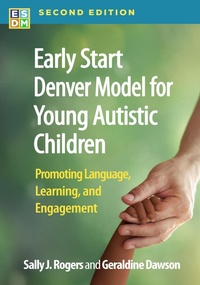
Early Start Denver Model for Young Autistic Children
Promoting Language, Learning, and Engagement
2nd Edition
Published on 18. December 2025
343 pages
978-1-4625-5918-3 (ISBN)
Description

Used worldwide, this trusted resource is now in a thoroughly revised second edition, reflecting key advances in early intervention research and practice. The Early Start Denver Model (ESDM) is the first comprehensive, naturalistic, developmental-behavioral, empirically tested intervention specifically designed for infants displaying early signs of autism and young autistic children. Leading experts Sally J. Rogers and Geraldine Dawson guide practitioners to assess and support all aspects of children's development--including social communication, language, cognition, imitation, and play--using enjoyable, interactive routines in everyday settings. The manual is grounded in state-of-the art findings from the developmental, clinical, and learning sciences. The companion website provides details about the ESDM Fidelity Rating System and a summary of key intervention strategies.
New to This Edition
- Chapters on what to do when a child's progress is concerning, partnering with families, and implementation of ESDM in different countries and cultures.
- Significant new research on brain development and how it differs in autism.
- Updated and comprehensive approach to promoting language development, with increased attention to alternative and augmentative communication strategies.
- New and revised decision trees and expanded efficacy research.
- Focus on promoting autistic children's development from a neurodiversity-affirming perspective.
More details
Other editions
Additional editions
Sally J. Rogers | Geraldine Dawson
Early Start Denver Model for Young Autistic Children, Second Edition
Promoting Language, Learning, and Engagement
Book
01/2026
2nd Edition
Guilford Press
€68.50
Shipment within 15-20 days
Persons
Sally J. Rogers, PhD, is Distinguished Professor Emeritus of Psychiatry at the MIND Institute, UC Davis Health, University of California, Davis. A developmental psychologist, she has been involved at the international level in major clinical and research activities on autism for many decades. She has served as president of the International Society for Autism Research (INSAR) and was a member of the DSM-5 Work Group on autism and other neurodevelopmental conditions. Dr. Rogers has spent her entire career studying cognitive and social-communicative development and intervention in young children with disabilities and has published over 300 scientific papers, books, and chapters. As a licensed psychologist, she has provided clinical care to hundreds of infants and young children and their families in Michigan, Missouri, Colorado, and California. Dr. Rogers is a Fellow of the American Psychological Association, the Association for Psychological Science, and INSAR, and has received numerous awards for her contributions to the field of developmental disabilities. She is ranked in the top 1% of Clarivate Analytics Highly Cited Researchers.
Geraldine Dawson, PhD, is the William Cleland Distinguished Professor of Psychiatry and Behavioral Sciences, Professor of Pediatrics, and Professor of Psychology and Neuroscience at Duke University, and is founding Director of the Duke Center for Autism and Brain Development. She also directs the Duke NIH Autism Center of Excellence. A child psychologist and researcher, Dr. Dawson has published more than 400 articles and chapters and 13 books on early autism detection and intervention and brain development. Her studies have been recognized as among the top 20 annual advances in autism research by the National Institutes of Health 13 times. Dr. Dawson has served as president of the International Society for Autism Research (INSAR) and was the first Chief Science Officer for Autism Speaks, the largest autism science and advocacy organization. She is a member of the American Academy of Arts and Sciences and a Fellow of the American Psychological Association, the Association for Psychological Science, and INSAR, and has received numerous awards for her contributions to research. She is ranked in the top 1% of Clarivate Analytics Highly Cited Researchers.
Geraldine Dawson, PhD, is the William Cleland Distinguished Professor of Psychiatry and Behavioral Sciences, Professor of Pediatrics, and Professor of Psychology and Neuroscience at Duke University, and is founding Director of the Duke Center for Autism and Brain Development. She also directs the Duke NIH Autism Center of Excellence. A child psychologist and researcher, Dr. Dawson has published more than 400 articles and chapters and 13 books on early autism detection and intervention and brain development. Her studies have been recognized as among the top 20 annual advances in autism research by the National Institutes of Health 13 times. Dr. Dawson has served as president of the International Society for Autism Research (INSAR) and was the first Chief Science Officer for Autism Speaks, the largest autism science and advocacy organization. She is a member of the American Academy of Arts and Sciences and a Fellow of the American Psychological Association, the Association for Psychological Science, and INSAR, and has received numerous awards for her contributions to research. She is ranked in the top 1% of Clarivate Analytics Highly Cited Researchers.
Content
Preface
1. What Brain Science Tells Us about How Young Autistic Children Learn
2. An Overview of the Early Start Denver Model
3. Setting Up the Early Start Denver Model
4. Developing Short-Term Learning Objectives
5. Formulating Daily Teaching Targets and Tracking Progress
6. Developing and Conducting an Early Start Denver Model Session
7. Developing Intentional Communication
8. Promoting Children's Language Development
9. Developing Imitation and Play
10. When a Child's Rate of Progress Is Concerning
11. Partnering with Families
12. Using the Early Start Denver Model in Group Settings
13. Using the Early Start Denver Model in Varying Cultures
Appendix. Early Start Denver Model Intervention Fidelity Coding Sheet
References
Index
1. What Brain Science Tells Us about How Young Autistic Children Learn
2. An Overview of the Early Start Denver Model
3. Setting Up the Early Start Denver Model
4. Developing Short-Term Learning Objectives
5. Formulating Daily Teaching Targets and Tracking Progress
6. Developing and Conducting an Early Start Denver Model Session
7. Developing Intentional Communication
8. Promoting Children's Language Development
9. Developing Imitation and Play
10. When a Child's Rate of Progress Is Concerning
11. Partnering with Families
12. Using the Early Start Denver Model in Group Settings
13. Using the Early Start Denver Model in Varying Cultures
Appendix. Early Start Denver Model Intervention Fidelity Coding Sheet
References
Index
